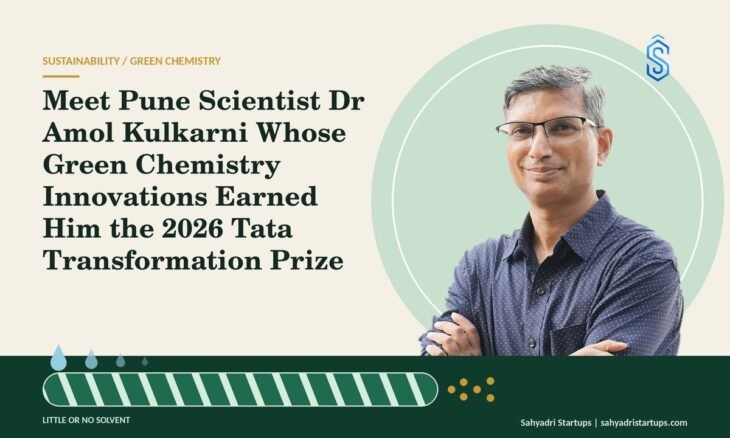
A Pune-based chemical engineer whose research is helping industries move away from solvent-intensive manufacturing has won the 2026 Tata Transformation Prize in the Sustainability category.
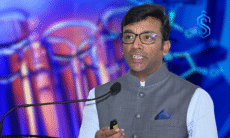
Dr Amol Kulkarni, Chief Scientist at CSIR-National Chemical Laboratory (CSIR-NCL), has been recognised for developing reactor technologies that enable chemical production with little or no solvent.
The research addresses a significant challenge in conventional chemical manufacturing, where solvents contribute to industrial waste, emissions and production costs.
Dr Amol Kulkarni and his team have developed screw reactor technologies that allow chemical reactions to take place with minimal or no solvent use, offering an alternative to traditional manufacturing methods.
The team has already developed solvent-free manufacturing processes for dyes, zeolites and pharmaceuticals, with some of the technologies transferred to industry.
Their wider application could help chemical manufacturers reduce solvent consumption, waste generation and emissions while improving production economics.
Beyond developing the reactors, Dr Amol Kulkarni is working on integrating real-time sensing, artificial intelligence (AI) and digital twin technologies to improve reactor design and industrial scale-up.
The objective is to establish design principles that can make these technologies suitable for wider manufacturing applications.
From laboratory research to industrial applications
Dr Amol Kulkarni’s work extends beyond solvent-free chemistry. A major part of his research has focused on converting conventional batch-based chemical processes into continuous manufacturing systems, improving process efficiency by more than two orders of magnitude.
Continuous flow reactor technology allows chemical reactions to be carried out in a controlled, uninterrupted process rather than in separate production batches.
His work has demonstrated applications across chemical intermediates used in pharmaceutical, agrochemical, perfumery and dyestuff industries.
He has also developed scalable continuous manufacturing processes for products such as silver nanowires, mesoporous silica and azelaic acid.
The industrial reach of this research is reflected in his collaborations with more than 65 chemical companies on batch-to-continuous process transformation projects. He has also trained over 1,400 professionals from 160 industries in continuous flow synthesis.
Dr Amol Kulkarni has designed and patented several flow reactors that have subsequently been licensed to Indian industries.
His research portfolio includes more than 140 publications in international peer-reviewed journals and over 50 patent filings. He has also supervised 17 PhD students, of whom seven are currently pursuing their research.
Research career and previous recognitions
Dr Amol Kulkarni has been part of CSIR-NCL’s Chemical Engineering and Process Development Division since 2005.
He completed his bachelor’s degree in chemical engineering in 1998 and PhD in 2003 from the Institute of Chemical Technology (ICT), Mumbai.
He subsequently undertook postdoctoral research at Germany’s Max Planck Institute in Magdeburg as a Humboldt Fellow in 2004. In 2010, he was selected as an IUSSTF Research Fellow at the Massachusetts Institute of Technology (MIT), USA.
His previous honours include the Shanti Swarup Bhatnagar Award in Engineering Sciences (2020), Fellowship of the Indian National Academy of Engineering (2021) and the Indian Chemical Council’s D. M. Trivedi Lifetime Achievement Award (2023).
He also received the VASVIK Award for Excellence in Industrial Research in 2016 and the Swarnajayanti Fellowship from the Department of Science and Technology in 2015.
About the Tata Transformation Prize
Established in 2023 by Tata Sons and powered by The New York Academy of Sciences, the Tata Transformation Prize supports research aimed at addressing major challenges facing India.
The award recognises high-risk, high-reward scientific research with the potential for technological development and commercial scale-up. It covers three categories: Food Security, Sustainability and Healthcare, with the broader objective of supporting innovations that can improve quality of life in India and beyond.