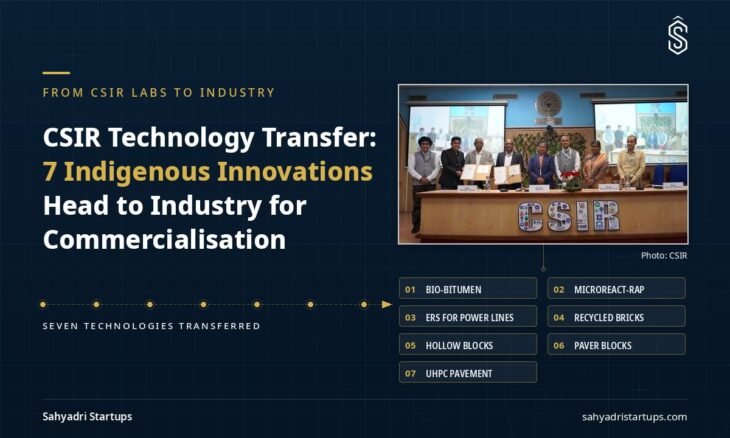
New Delhi: The Council of Scientific and Industrial Research (CSIR) has transferred several indigenous technologies to private companies and industry institutions, covering road construction, power infrastructure and sustainable building materials.
The latest agreements include technologies that convert agricultural waste into bio-bitumen, reuse reclaimed asphalt in road maintenance and manufacture construction products using recycled aggregates.
The technology transfer agreements involve four CSIR laboratories: CSIR-Structural Engineering Research Centre (CSIR-SERC), Chennai; CSIR-Central Road Research Institute (CSIR-CRRI), New Delhi; CSIR-Advanced Materials and Processes Research Institute (CSIR-AMPRI), Bhopal; and CSIR-Indian Institute of Petroleum (CSIR-IIP), Dehradun.
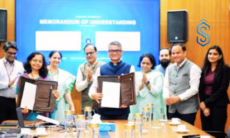
The technology transfer were formalised at an event at CSIR Headquarters in New Delhi, chaired by Dr N. Kalaiselvi, Secretary, Department of Scientific and Industrial Research (DSIR), and Director General, CSIR.
Two additional Memoranda of Understanding (MoUs) were signed to expand research and technical collaboration with industry organisations.
Bio-Bitumen and Recycled Asphalt Technologies Find Industry Partners
Among the technologies transferred by CSIR-CRRI is Bio-Bitumen, developed jointly with CSIR-IIP. The technology processes agricultural residues, including rice straw (parali), into a biomass-derived material that can partially replace conventional petroleum-based bitumen.
CSIR transferred the technology to RAACS Solutions Private Limited, Bihar, operating as BioBhoomi, and SAR Parivahan Private Limited, Kolkata.
Another road construction solution, MicroReAct-RAP, was transferred to three companies: Innovative Roadztech Private Limited, Delhi; AVK BlackGold Infra Private Limited, Surat; and Hindustan Colas Private Limited (HINCOL), Mumbai.
The cold micro-surfacing technology incorporates up to 40% reclaimed asphalt pavement (RAP). By reusing material recovered from existing roads, it reduces the requirement for virgin aggregates and bitumen emulsion while supporting the circular use of road construction materials.
Both technologies were developed through collaborative research involving CSIR-CRRI, CSIR-IIP and CSIR-AMPRI.
CSIR Technology Transfer: Power Restoration and Recycled Construction Technologies
CSIR-SERC transferred its Emergency Retrieval System (ERS) for Power Lines to IFAB Global. The indigenous system is a lightweight, modular structural solution designed to facilitate the rapid restoration of electricity transmission lines following failures or disruptions.
The laboratory also transferred three construction technologies to the National Automotive Test Tracks (NATRAX): recycled aggregate-based eco-friendly bricks, hollow blocks and paver blocks.
These products use 100% recycled aggregates and industrial waste, offering an alternative to construction materials that depend on natural aggregates. The technologies are also intended to promote the utilisation of construction and demolition waste.
NATRAX also received CSIR-SERC’s Ultra-High-Performance Concrete (UHPC) Pavement Technology for pilot-scale field implementation.
The technology is designed for road infrastructure requiring high strength and durability, particularly under heavy axle loads. Its resistance and reduced maintenance requirements are intended to support the development of longer-lasting pavements.
CSIR Signs Research Collaboration Agreements With GARC and Pārakhi Skill Systems
Alongside the technology transfers, CSIR-CRRI signed two MoUs to expand its engagement with industry and research institutions.
The first agreement was signed with the Global Automotive Research Centre (GARC), Tamil Nadu, under the National Automotive Board, Ministry of Heavy Industries.
It provides for joint research and development, access to shared testing facilities, technical projects, seminars and academic exchanges. Dr A. S. Ramadhas, Director, GARC, signed the agreement on behalf of the organisation.
The second MoU was signed with Pārakhi Skill Systems Private Limited, Patna. The collaboration will focus on driver risk assessment, cognitive and psychomotor evaluation, field trials, research publications and related technology deployment.