Chennai: Agnikul Cosmos has test-fired a new electric motor-driven version of its Agnilet engine, introducing an upgraded propulsion configuration as the Chennai-based space startup prepares for its second mission.
The development marks another step in the evolution of India’s private rocket manufacturing capabilities, with the company retaining its single-piece 3D-printed engine architecture while incorporating electrically driven pumps.
The latest test is significant for Agnikul’s ongoing Agnibaan launch vehicle programme, which is aimed at carrying small satellites into low Earth orbit.
Unlike the pressure-fed Agnilet engine used during the company’s maiden flight in May 2024, the latest configuration uses electric motors to drive the propellant pumps.
Agnikul co-founder and CEO Srinath Ravichandran disclosed the development in his LinkedIn post.
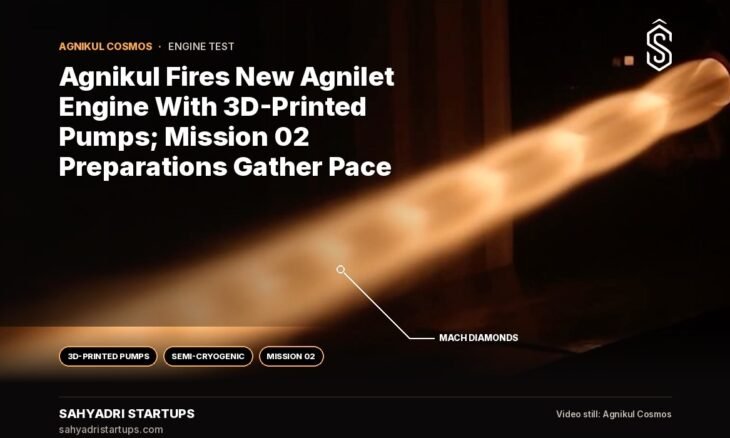
He shared a video of the engine firing and pointed to the appearance of mach diamonds as the engine throttled up, which disappeared as it throttled down.
Mach diamonds, also known as shock diamonds, are shock-wave formations that appear in the exhaust plume of a propulsion system operating under supersonic conditions.
The new Agnilet engine retains its single-piece, fully 3D-printed and semi-cryogenic design. However, the incorporation of 3D-printed pumps and electric motors represents a change in its propellant delivery architecture.
The firing was conducted at Agnikul’s horizontal semi-cryogenic test facility, which Ravichandran described as “back in action”.
He said the facility would enable engine testing and flight qualification activities to proceed in parallel.
Why Agnikul’s Electric Pump-Fed Engine Matters for India’s Space Startups
Rocket propulsion is one of the most technically demanding areas of launch vehicle development, particularly for startups attempting to build indigenous launch systems.
Developing an engine is not limited to achieving ignition and thrust; it also involves reliable propellant delivery, thermal management, repeated ground testing and qualification for flight.
Agnikul’s transition from a pressure-fed configuration to an electric motor-driven pump system represents an advancement in the company’s engine development programme.
It also demonstrates how India’s private space startups are working on propulsion technologies rather than limiting their role to satellite manufacturing, components or downstream space applications.
Agnilet Engine’s Journey From ISRO Testing to India’s Private Launchpad
Founded in 2017 and incubated at the Indian Institute of Technology Madras (IIT Madras), Agnikul Cosmos is developing Agnibaan, an orbital-class launch vehicle designed to deploy small satellites into low Earth orbit.
The company’s Agnilet engine first flew aboard its Agnibaan SOrTeD sub-orbital vehicle during Mission-01 on May 30, 2024. The vehicle lifted off from Agnikul Launchpad-01 at the Satish Dhawan Space Centre in Sriharikota.
According to Agnikul, the flight marked India’s first launch from a private launchpad and the first flight of a single-piece 3D-printed rocket engine.
The company describes Agnilet as the world’s first single-piece 3D-printed rocket engine, developed and manufactured in-house.
Agnikul’s engine development programme had also received testing support from the Indian Space Research Organisation (ISRO). In November 2022, ISRO conducted a 15-second hot test of an Agnilet engine at its Vikram Sarabhai Space Centre.
ISRO described the engine tested at the time as a regeneratively cooled semi-cryogenic propulsion system using liquid oxygen and aviation turbine fuel. It was manufactured through 3D printing using Inconel-718.
That 2022 test involved an earlier engine configuration and should be distinguished from the electric motor-driven version fired in November 2026.