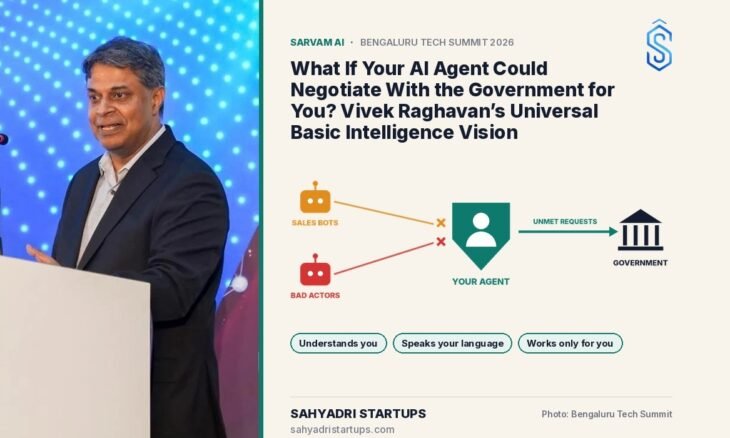
Bengaluru: Dr. Vivek Raghavan, co-founder of Sarvam AI, has proposed a vision of “universal basic intelligence”, under which every Indian would have access to a personal AI agent that understands them, speaks their language and acts exclusively in their interest.
Speaking at the Bengaluru Tech Summit 2026, Vivek Raghavan outlined how India can build its own AI capabilities, reduce dependence on global technology providers and make artificial intelligence accessible to its entire population.
Under the universal basic intelligence concept, every citizen would have an AI agent capable of understanding individual requirements, communicating in their preferred language and acting on their behalf.
Raghavan also envisioned these personal AI agents interacting and negotiating with other agents. He pointed out that some AI agents could attempt to sell products or services to citizens, while others might act maliciously.
A personal agent should therefore be able to protect the individual’s interests while navigating these interactions.
He added that such agents could pursue requests that remain unmet, including those directed at government authorities.
Universal Basic Intelligence: Why India Needs Its Own AI
Explaining why India needs a distinct approach to AI development, Vivek Raghavan identified four essential requirements: scale, Indian languages, voice and affordability.
India has nearly one billion active internet users, including more than 500 million rural users. According to Raghavan, AI systems designed for this population must account for the country’s linguistic diversity.
He argued that voice should become a primary interface for AI because many Indians speak multiple languages but do not necessarily type in them.
Affordability is another critical requirement. Raghavan pointed out that India’s digital economy expanded partly because consumers had access to some of the cheapest data services in the world. AI services must follow a similar approach if they are to achieve mass adoption.
The universal basic intelligence vision, therefore, rests on making AI accessible beyond businesses and technology users, allowing individual citizens to use personal AI agents for their everyday requirements.
Vivek Raghavan Says Sovereign AI Models Must Be Auditable
Raghavan’s vision of universal basic intelligence is closely connected to his argument that India needs sovereign AI models that it can inspect and control.
He proposed a fundamental test for determining whether an AI model is truly sovereign: whether the country can audit the data used to train it.
“Almost a definition of a sovereign model is a model where the sovereign can audit the data that was used to train the model,” he said.
Raghavan explained that open-weight models can be fine-tuned and operated under local control, but users do not necessarily know what data went into training them.
This becomes particularly important when AI systems are deployed in critical infrastructure. Even small amounts of data can poison a model, and hidden behaviours may be difficult to identify.
He said guardrails and the harness layer surrounding a model can help manage certain risks, but organisations operating critical infrastructure must consider whether they are willing to accept them.
India’s AI Future: Own the Stack or Rent It
Raghavan framed India’s larger AI challenge around whether the country will “own the stack or rent it”. While renting technology may be cheaper in the short term, he described the approach as “ruinous” in the long run.
He identified four layers India must develop or control to achieve AI sovereignty:
- Compute: India needs domestic GPU and cloud infrastructure, along with diversified sourcing. Raghavan said the country is still far from building chips relevant to AI and described GPU computing as “a 10-year game”.
- Operations and data: Sensitive functions in regulated industries should be hosted and operated by Indian entities, with data remaining within the country’s borders.
- Models: India should develop indigenous AI models from scratch while using the best available open models under local control in the interim.
- Harness layer: India must also control the technology surrounding AI models, including tool use, memory, permissions, context and evaluation. Raghavan noted that a weaker model with a strong harness can deliver state-of-the-art performance on a particular task.
He also warned that relying on overseas hardware creates risks because such infrastructure can be switched off.
Sarvam AI’s Training Data Strategy and Trillion-Parameter Model
Raghavan identified India’s public data resources as an important advantage in developing indigenous AI models.
He cited parliamentary debates, court judgments, Doordarshan archives, school textbooks and publicly funded scientific research as examples of Indian data that foreign AI laboratories cannot easily replicate.
According to Raghavan, approximately 15% of the training data in Sarvam’s model comes from Indian sources, compared with around 0.1% in most global models.
He said the values of an AI model are shaped during pre-training, making the composition of its training data important.
However, India also needs more Indic benchmarks to evaluate AI responses across Indian languages and contexts. Raghavan said models improve fastest where extensive benchmarks are available.
As part of its indigenous AI ambitions, Raghavan revealed that Sarvam AI plans to build a trillion-parameter model from scratch.
Vivek Raghavan Warns India Could Become a ‘Digital Colony’
Raghavan also cautioned that India’s dependence on global AI services could turn the country into a “digital colony”.
“we’re exporting our data and we’re importing intelligence,” he said.
Comparing this dependence with exporting cotton and importing cloth, he warned that India could continue contributing valuable data to global AI systems while relying on foreign companies for the intelligence developed using that data.