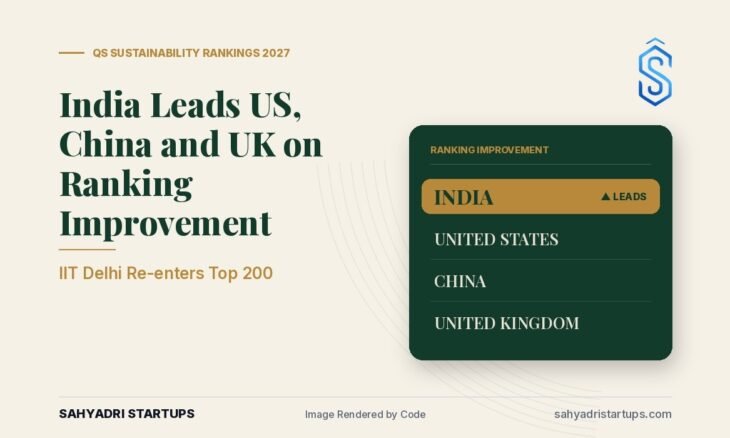
Pune: India has emerged as the most improved higher education system among the five countries with the highest representation in the QS Sustainability Rankings 2027, with 38 of its universities improving their global positions.
The country recorded a 4% net improvement despite a decline in its overall entries, while the Indian Institute of Technology Delhi (IIT Delhi) returned to the global top 200 at 194th, leading Indian institutions in the latest rankings released by QS Quacquarelli Symonds on November 17.
India has 99 universities in the 2027 rankings, compared with 103 in the previous edition. Of these, 38 improved their positions, 19 maintained their rankings and 34 slipped. Eight institutions made their debut.
The improvement comes as other major higher education systems recorded net declines. The United States registered a 47% decline, followed by the United Kingdom at 27% and Mainland China at 23%.
Among the five most represented systems, India was the only one to register a positive net improvement.
India also strengthened its representation among the world’s leading institutions. It now has 13 universities in the global top 500, up from 12 in 2026 and five in the inaugural 2023 edition. Its 42 institutions in the top 1,000 place it jointly third with Mainland China, behind the US (128) and the UK (84).
IIT Delhi leads Indian universities; VIT and Manipal make significant gains
IIT Delhi climbed to 194th from 205th in the previous edition, returning to the top 200 after having ranked 171st in 2025. IIT Kharagpur secured the second position nationally at 224th, improving from 236th, while the University of Delhi ranked third at 237th, its best position since 2024.
Among the other notable performers, Vellore Institute of Technology (VIT) entered the global top 300 for the first time at 293rd, moving up from 352nd. Manipal Academy of Higher Education made a significant jump from 467th to 384th, entering the top 400.
Jawaharlal Nehru University (JNU) returned to the global top 500 at 432nd, improving from 624th. Chandigarh University and Saveetha Institute of Medical and Technical Sciences also entered the top 600 for the first time.
Other Indian institutions in the global top 500 include IIT Bombay (267th), IIT Madras (312th), IIT Kanpur (315th), IIT Roorkee (346th), Indian Institute of Science Bangalore (419th), BITS Pilani (452nd) and Anna University (471st).
The following Indian institutions featured in the global top 500:
| Institution | 2027 Rank | 2026 Rank |
|---|---|---|
| IIT Delhi | 194 | 205 |
| IIT Kharagpur | 224 | 236 |
| University of Delhi | 237 | 241 |
| IIT Bombay | 267 | 235 |
| Vellore Institute of Technology | 293 | 352 |
| IIT Madras | 312 | 305 |
| IIT Kanpur | 315 | 310 |
| IIT Roorkee | 346 | 352 |
| Manipal Academy of Higher Education | 384 | 467 |
| Indian Institute of Science, Bangalore | 419 | 462 |
| Jawaharlal Nehru University | 432 | 624 |
| BITS Pilani | 452 | 487 |
| Anna University | 471 | 478 |
The eight new Indian entries include National Institute of Technology Warangal, Babasaheb Bhimrao Ambedkar University, SRM University – AP, Central University of Himachal Pradesh, Motilal Nehru National Institute of Technology Allahabad, GD Goenka University, Graphic Era University and Swami Rama Himalayan University. Delhi Technological University also made its debut in the 1,251–1,300 band.
Indian universities improve in social impact and employability
The category-wise results in the QS Sustainability Rankings 2027 show stronger performance by Indian institutions in Social Impact, which carries 45% weightage in the overall assessment.
Around 65% of Indian institutions improved their rankings in this category. More than 70% of Indian entries also recorded improvements in Equality and Employability & Outcomes.
In Knowledge Exchange, the University of Delhi ranked 66th globally, while IIT Kharagpur entered the top 100 at 96th. Fourteen Indian institutions featured among the global top 300 in this indicator, with all of them improving their positions.
IIT Delhi and IIT Kharagpur also performed strongly in Employability & Outcomes, securing the 66th and 93rd positions, respectively. Overall, 71 Indian institutions improved their rankings in this indicator.
However, Impact of Education and Health & Wellbeing remain areas of concern. Despite 56 Indian institutions improving their positions in Impact of Education, India continued to rank among the 18 lowest-scoring higher education systems on average in this category. The University of Delhi was the highest-ranked Indian institution at 674th.
IIT Kharagpur, VIT lead in environmental sustainability
Environmental Impact accounts for another 45% of the QS assessment. IIT Delhi was the only Indian institution among the global top 100 overall in this category, although Indian universities recorded strong performances in individual indicators.
In Environmental Sustainability, IIT Kharagpur climbed eight places to 41st globally, VIT improved 20 places to 43rd, and IIT Delhi advanced 73 places to 74th. Two Indian institutions featured among the global top 50 in this indicator.
The University of Delhi also improved its position to 51st in Environmental Education, while the Indian Institute of Science Bangalore ranked 70th. IIT Delhi, which had featured in the top 100 in the previous edition, slipped to 108th.
Governance, which accounts for 10% of the overall ranking, remains a weaker area for Indian universities. No Indian institution featured in the global top 200, with the University of Delhi ranking highest nationally at 255th after dropping 68 places.
Overall, 61% of Indian institutions recorded ranking declines in Governance. However, more than 70 Indian universities improved their scores in the category, suggesting that their performance is improving even as international peers progress at a faster pace.
Commenting on India’s performance, Jessica Turner, CEO of QS, said, “Overall, India’s higher education system continues to improve in key sustainability metrics, with more than 70% of entries rising in both Equality and Employability & Outcomes. Since 2023, the number of entries from India has risen from 14 to 99 in 2027. Over the same period, the average score among Indian institutions has risen from 26.9 to 55 in 2027.”
She also highlighted the areas requiring attention, stating that India’s higher education system remains behind its peers on average in Impact of Education and Health & Wellbeing.