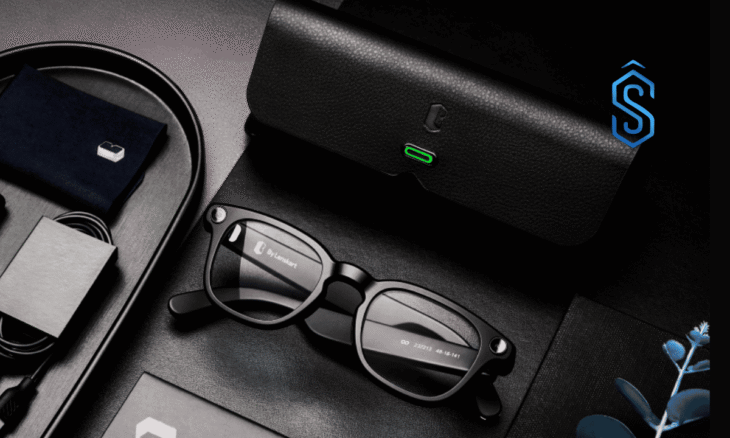
Pune: Nearly nine in 10 customers purchasing B by Lenskart, the eyewear retailer’s AI-powered smart glasses, are opting for prescription lenses after undergoing an eye test, indicating that buyers are using the product as prescription eyewear rather than simply as a standalone technology gadget.
Lenskart co-founder and CEO Peyush Bansal shared the figure recently during the company’s quarterly earnings call on November 4. The transcript was subsequently filed with the National Stock Exchange (NSE) on November 10.
The figure represents purchases made through Lenskart’s own sales channels, although the company did not disclose the total number of B by Lenskart units sold.
The high proportion of prescription purchases reflects the company’s approach to the smart glasses category, positioning the product as an extension of its existing eyewear business.
According to Bansal, Lenskart believes its established retail network, prescription capabilities and post-purchase services give it an advantage in the emerging category.
“At the end of the day, smart glasses are going to be glasses,” he said.
B by Lenskart expands to more than 500 stores
B by Lenskart is now available across more than 500 Lenskart stores, in addition to the company’s online platform. However, Bansal said the product had reached its full retail footprint only in the past few weeks.
The company has also started deliveries with multiple lens options, including single vision, progressive and powered sun lenses, according to its shareholder letter.
Bansal said demand for B by Lenskart has been slightly higher than the company initially anticipated, prompting it to increase production to meet customer requirements.
The company is also working on improving the product through regular software and firmware updates, which are being rolled out approximately every two weeks.
These updates are introducing features requested by customers, including daily nutrition tracking, reminders, and calendar and health integrations.
Battery life, however, remains the most common customer complaint. Lenskart said algorithm updates are helping improve battery performance, while a better charging case is also in development.
Lenskart not looking to undercut smart glasses rivals on pricing
While Lenskart has built a sizeable customer base in the affordable eyewear segment through products such as its Hustlr range, which offers a complete pair of glasses for ₹500, the company is taking a different approach to pricing B by Lenskart.
Rather than competing with rivals by offering smart glasses at lower prices, Lenskart is looking at the category as a long-term opportunity.
“We are not in a rush here to undercut on pricing,” Bansal said, describing the smart glasses category as a multi-year journey.
“We are not right now trying to over-accelerate this at all.”
B by Lenskart initially opened for early access in May at ₹22,000, while its reported commercial price was ₹27,000.
The smart glasses weigh approximately 40 grams and feature a 12-megapixel Sony camera. They run on Qualcomm’s AR1 chip and integrate Google’s Gemini AI.
Lenskart had reported more than 80,000 sign-ups for B by Lenskart as of August, indicating early interest in the product ahead of its wider retail expansion.
Lenskart’s Drysh eye-test technology targets higher optometrist productivity
Separately, Bansal discussed Drysh, Lenskart’s AI-assisted eye-testing technology, which is currently being piloted at a few stores.
According to Bansal, Drysh could eventually enable one optometrist to conduct up to 20 times as many eye tests as the conventional model.
This would be significantly higher than the approximately twofold productivity improvement currently achieved through the company’s existing remote-optometry setup, which is operational across 934 stores.
Under the Drysh model, an optometrist remotely supervises each eye test. However, Lenskart said it is still training the underlying AI model to improve accuracy before expanding the technology further.
“There is still time before we perfect it,” Bansal said.
Lenskart reports ₹2,845 crore revenue and ₹232 crore profit in September quarter
For the September quarter, Lenskart reported revenue of ₹2,845 crore and profit of ₹232 crore.
The company reported revenue growth of 32.5%, while profit more than doubled compared with the year-ago period.