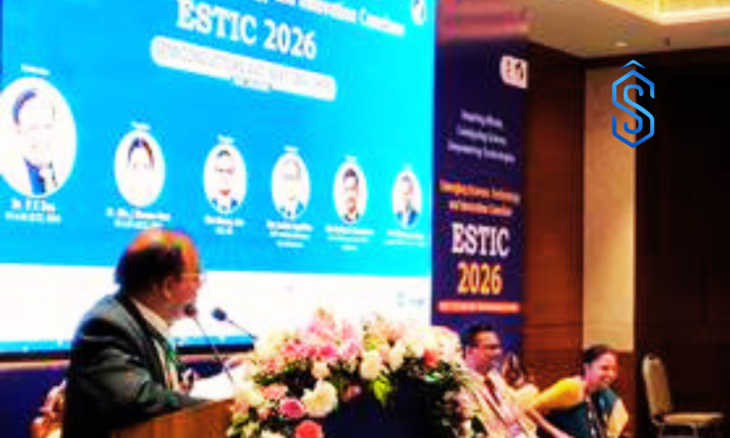
New Delhi: The Defence Research and Development Organisation (DRDO) participated in the Emerging Science, Technology and Innovation Conclave (ESTIC) 2026, held at Bharat Mandapam, New Delhi.
The conclave featured a thematic session on Semiconductors and Next-Generation Chips, led by DRDO, along with exhibitions showcasing indigenous technologies and advanced research.
The conclave, themed ‘Creative Minds, Catalysing Science, Empowering Society’, was inaugurated by Prime Minister Narendra Modi and jointly organised by 12 ministries and departments under the guidance of the Principal Scientific Adviser to the Government of India.
ESTIC 2026 brought together cutting-edge research, deep-tech breakthroughs and discussions involving Nobel Laureates, global experts, policymakers and emerging leaders.
DRDO, one of the key organisers of ESTIC 2026, led the thematic session on Semiconductors and Next-Generation Chips. The session was chaired by Distinguished Scientist and Director General, Electronics and Communication Systems (ECS), Dr BK Das.
It brought together leaders from industry, academia, the indigenous chip-development ecosystem and defence electronics.
A panel discussion moderated by Dr BK Das was also organised as part of the Semiconductors and Next-Generation Chips session. Distinguished Scientist and Director General (Micro Electronic Devices, Computational Systems & Cyber Systems), Dr Sheena Rani, was among the panellists.
The discussions covered emerging developments in semiconductor technologies, purpose-built Artificial Intelligence (AI) System-on-Chips (SoCs), intelligence at the silicon edge and the evolving microprocessor landscape.
The session also highlighted DRDO’s role in enabling industries and start-ups to develop game-changing solutions, accelerate next-generation chip design and strengthen indigenous core technologies.
DRDO Showcases Indigenous Technologies at ESTIC 2026
The DRDO Outreach Stall at ESTIC 2026 showcased key initiatives, achievements, research programmes and contributions of the Ministry of Defence towards science, technology and innovation.
The stall featured a range of indigenous technologies developed by DRDO laboratories, including advanced communication systems, quantum technology prototypes, extreme-cold-weather clothing, PRABALA female full-body protector, passive and powered exoskeletons, portable hybrid energy management systems, high-power pulse laser diodes and scramjet engine technology.
DRDO also participated in the Thematic and Departmental Exhibitions at the conclave.
Thematic Exhibition on Semiconductors and Next-Generation Chips
DRDO showcased achievements in two critical semiconductor technology domains:
- Monolithic Microwave Integrated Circuits (MMICs) and
- Infrared Focal Plane Arrays (IRFPAs), developed by the Solid State Physics Laboratory (SSPL), Delhi.
Gallium Arsenide (GaAs) and Gallium Nitride (GaN)-based MMICs, along with Multi-Chip Modules (MCMs), displayed at the exhibition have been employed in several strategic missions.
These semiconductor technologies serve as essential building blocks for advanced radar systems and Electronic Warfare (EW) applications.
The IRFPAs, meanwhile, serve as the sensing elements or ‘eyes’ of tactical missiles, enabling target detection and tracking during the terminal phase through Imaging Infrared (IIR) seekers.
The exhibits covered a broad range of infrared technologies, including Short-Wave Infrared (SWIR), Mid-Wave Infrared (MWIR) and Long-Wave Infrared (LWIR), demonstrating DRDO’s indigenous capabilities in advanced semiconductor technologies and Semiconductors and Next-Generation Chips.
Scramjet Technology, Neuromorphic Accelerators Among Other Exhibits
Other notable DRDO exhibits included scramjet engine technology and neuromorphic accelerators, highlighting developments in complex and emerging technological domains.
The exhibition also featured advanced communication systems, Quantum Random Number Generators (QRNGs), protective equipment, exoskeletons, portable hybrid energy management systems, Photonic Integrated Circuits (PICs) and laser proximity sensors.
The showcase of Semiconductors and Next-Generation Chips technologies reflected the role of indigenous semiconductor capabilities across defence and other advanced technological applications.
Semiconductor Technology and India’s Technology Goals
Semiconductor technology is a critical enabler of national sovereignty, economic strength and digital security. It plays a pivotal role in advancing the vision of Viksit Bharat by 2047 and Aatmanirbhar Bharat by strengthening indigenous technological capabilities.
From communication devices and advanced sensing systems to sophisticated defence platforms, semiconductor chips determine the performance, efficiency and reliability of modern technologies.
Beyond chip manufacturing, technological self-reliance requires comprehensive capabilities in chip design, fabrication, testing, industrial-scale production and resilient supply chains.
The development of Semiconductors and Next-Generation Chips is therefore linked to building broader indigenous technological capabilities.
India aspires to emerge as a globally competitive, dependable and technologically self-reliant semiconductor powerhouse by 2047, with leadership in selected next-generation chip technologies.
This vision encompasses the development of a vibrant and sustainable semiconductor ecosystem, generation of high-value employment opportunities and delivery of inclusive societal benefits.
DRDO Labs Develop Semiconductor Capabilities
Over the years, India’s strategic defence laboratories and specialised semiconductor foundries, including SSPL, Gallium Arsenide Enabling Technology Centre (GAETEC), Semiconductor Technology and Applied Research Centre (STARC) and Semiconductor Laboratory (SCL), have developed specialised competencies in Gallium Arsenide (GaAs), Gallium Nitride (GaN), Micro-Electro-Mechanical Systems (MEMS) and mature silicon process technologies.
The capabilities developed across these institutions contribute to India’s indigenous semiconductor ecosystem and its efforts in Semiconductors and Next-Generation Chips, particularly across strategic and defence applications.