
Noida: Nearly half of India’s women working in agriculture are not officially classified as farmers, highlighting a significant recognition and access gap in the country’s agricultural sector, according to Her Harvest 2026, a new report by Arya.ag.
The report, titled ‘Her Harvest 2026: The hidden cost of women’s invisible work in Indian agriculture’, finds that 50.5% of women working in agriculture are classified as unpaid helpers on family farms, compared with 21.7% of men.
The findings of Her Harvest 2026, released during the United Nations’ International Year of the Woman Farmer, point to a gap that is not linked to women’s ability to farm but to their access to land, finance, storage, technology, organised markets and other agricultural resources.
According to the report, applying the Food and Agriculture Organization’s (FAO) estimate that unequal access to productive resources can reduce agricultural output by 2.5–4% to India’s agricultural Gross Value Added (GVA) of ₹48.7 lakh crore, the country may be foregoing between ₹1.2 lakh crore and ₹2 lakh crore in agricultural output every year.
The Her Harvest 2026 report attributes this loss not to women farming less effectively, but to women having less access to the resources required to improve productivity and income.
Her Harvest 2026: Agriculture Employs 64.4% of India’s Working Women
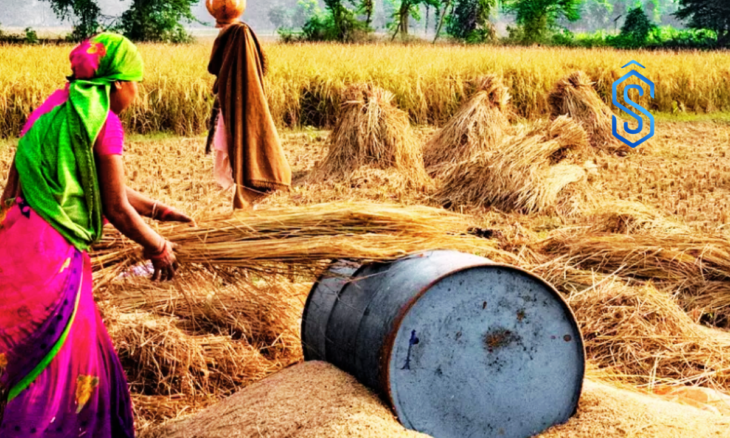
The scale of women’s participation in agriculture is significant. According to Her Harvest 2026, agriculture is the single largest employer of women in India, with 64.4% of the country’s working women engaged in the sector.
This proportion has increased from 57.0% in 2017–18. Among rural working women, the share is even higher, reaching 76.9%.
The report clarifies that these figures represent the share of working women engaged in agriculture and should not be confused with women’s share of the overall agricultural workforce, which stands at roughly 48%.
The changing nature of rural employment has contributed to this growing role. As men migrate to cities and increasingly move into non-farm employment, the responsibility for managing farms has increasingly shifted to women who remain in rural areas.
As highlighted by Her Harvest 2026, agriculture is therefore not a sector where Indian women are being left behind. Instead, it is the sector where the majority of working Indian women are engaged.
Why Women Farmers Are Often Recorded as ‘Helpers’
Despite their growing role in agriculture, women’s contribution is not always reflected in official classification systems.
The Her Harvest 2026 report finds that 50.5% of women working in agriculture are recorded as unpaid helpers, compared with 21.7% of men. The classification has significant implications because an unpaid helper is not officially treated in the same way as a cultivator or farmer.
According to the report, women now account for roughly 48% of India’s agricultural workforce, compared with about 30% in 2017–18.
Women operate 11.72% of India’s farmed area and hold 13.96% of operational holdings. This creates a significant gap between the amount of agricultural labour women contribute and the amount of land they control.
The Her Harvest 2026 report highlights that land ownership is not simply a question of legal ownership in Indian agriculture.
The name on the land title can determine access to several other agricultural services and opportunities, including formal credit, extension services, procurement systems, input subsidies and government schemes.
As a result, women without land titles can face difficulties accessing resources available to recognised farmers.
The report notes that women who are not recognised as farmers may be pushed toward informal credit at higher costs. They may also have limited ability to hold agricultural produce after harvest and can be forced to sell based on prevailing post-harvest prices.
This creates a cycle in which women carrying out substantial agricultural work have fewer opportunities to invest in improving the productivity and returns from that work.
Also Read: Garuda Aerospace Signs MoU with Timed Automation Solutions for Autonomous Drone Solutions
India’s Position Compared With Other Countries
The Her Harvest 2026 report also compares India’s position with other countries in terms of women’s landholding and agricultural operations.
Women hold 13.96% of India’s operational agricultural holdings, compared with a global average of around 14.5% of agricultural landholders.
India is also comparable with the United States on the measure of one holder per farm. According to the report, women accounted for 13.7% on the comparable measure in the last US census to count that way.
When measured by agricultural land area, India performs relatively better. Women operate 11.72% of the farmed area in India, compared with 8.5% in Brazil and 7% of American farmland under women principal operators.
However, the comparison with neighbouring Nepal highlights a wider gap. Women in Nepal hold 32.4% of agricultural holdings and operate 22.3% of agricultural area, more than double India’s figures on both measures, according to the same census concept and more recent data cited in Her Harvest 2026.
Italy records a women’s agricultural holding share of 31.5%, while the European Union stands at 31.6%.
The report argues that the issue is therefore not simply about India being an outlier.
Instead, it points to the global prevalence of a roughly 14% ceiling on women’s landholding and highlights countries that have moved beyond that level by changing the requirements attached to agricultural access rather than waiting for land titles to change hands.
Her Harvest 2026 Links Productivity Gap to Access
The productivity implications are also significant. According to Her Harvest 2026, farms operated by women can be 24% less productive than comparable farms of the same size operated by men.
The report attributes this difference to access to credit and agricultural inputs rather than differences in farming ability.
Women working across agrifood systems earn roughly ₹82 for every ₹100 earned by men. Women farm workers also earn 20–30% less for the same work.
For a country with one of the world’s largest agricultural workforces, the report links these differences in access, productivity and earnings to the estimated ₹1.2 lakh crore–₹2 lakh crore annual loss in agricultural output.
The findings of Her Harvest 2026 indicate that the productivity gap is closely connected to the resources available to women farmers and their ability to participate in formal agricultural systems.
Storage, Finance, FPOs and Technology Can Help Close the Gap
A key focus of Her Harvest 2026 is on measures that can improve women farmers’ access to agricultural resources without waiting for changes in land ownership.
The report maps pathways involving storage, warehouse-receipt finance, Farmer Producer Organisations (FPOs) and technology as ways to improve access and participation.
Access to storage can enable farmers to hold produce after harvest instead of being required to sell immediately. Warehouse-receipt finance can provide another route to financing, while FPOs can help farmers participate in organised markets.
Technology can also support access to agricultural systems and resources, providing additional pathways for women farmers to participate in markets and improve their economic position.
The Her Harvest 2026 report emphasises that these pathways can help address the access gap even where land titles remain unchanged.
Benefits Can Extend Beyond Individual Women Farmers
The report also highlights the wider impact of increasing women farmers’ earnings.
According to Her Harvest 2026, when women farmers earn more, the benefits can extend beyond the individual farmer to the household. Increased earnings can contribute to nutrition, schooling and reinvestment in the farm.
Arya.ag Managing Director and CEO Prasanna Rao said women have always played a central role in India’s agricultural story and highlighted the need to ensure that their contribution translates into greater ownership, income and influence.
“Women have always been central to India’s agricultural story as they have been playing a defining role in it. The opportunity ahead is to ensure that their contribution translates into greater ownership, income and influence.
Our report makes a compelling case: when women farmers have access to the right resources, from finance and storage to technology and organised markets, the gains extend well beyond the individual farmer to her household, community and the wider agricultural economy.
As we mark 2026 as the International Year of the Woman Farmer, this is an opportunity to build on the progress already underway and create an agricultural ecosystem where women can participate, lead and grow on equal terms.
At Arya.ag, we believe that strengthening these pathways that shift the role of women from labour to leadership is not only good for women farmers, but essential to building a more productive, resilient and inclusive agricultural economy.” said Prasanna Rao, Managing Director and CEO, Arya.ag.
The findings of Her Harvest 2026 place women’s recognition, ownership, income and access to agricultural resources at the centre of the report’s assessment of India’s farming economy.