
New Delhi: Researchers have successfully used Artificial Intelligence to analyze more than 100 years of hand-drawn solar observations from the Kodaikanal Solar Observatory, enabling them to trace the movement of magnetically active regions on the Sun from 1916 to 2007.
The breakthrough provides scientists with a significantly longer record to study how solar magnetic activity has evolved over time.
For more than a century, scientists have sought to understand the rhythmic rise and fall of the Sun’s magnetic activity.
These solar cycles influence sunspots, solar flares, and eruptions that can affect satellites, navigation systems, communication networks, and power infrastructure on Earth. However, long-term studies have been limited because many historical observations are incomplete or inconsistent.
This makes archival records from the Kodaikanal Solar Observatory especially valuable for understanding long-term solar behavior.
In a new study, researchers led by Dibya Kirti Mishra from the Aryabhatta Research Institute of Observational Sciences (ARIES), an autonomous institute under the Department of Science and Technology (DST), Government of India, collaborated with scientists from the Indian Institute of Space Science and Technology (IIST), Thiruvananthapuram, the Southwest Research Institute, Boulder, USA, and the Indian Institute of Astrophysics (IIA), Bengaluru.
The team demonstrated that more than a century of hand-drawn Sun records from the Kodaikanal Solar Observatory (KoSO) can be transformed into scientifically valuable datasets using modern machine learning techniques.
The observatory maintains a unique archive of daily “suncharts” spanning from 1904 to 2022. These charts carefully document solar features such as sunspots, plages, filaments, and prominences on a standardized grid, making them one of the world’s longest continuous collections of solar observations.
Before the advent of digital imaging, astronomers relied on detailed manual drawings to document solar activity.
Also Read: Stealth Coronal Mass Ejection: A Silent Solar Event Travelled 150 Million km and Hit Earth Hard
The Kodaikanal Solar Observatory suncharts are particularly significant because they capture solar activity across multiple solar cycles while marking different solar features in a consistent format.
However, variations in drawing styles, aging paper, and differences in scan quality have made it challenging to build a uniform digital dataset using conventional techniques.
To overcome these challenges, the research, published in the Astrophysical Journal, employed a supervised machine learning model known as U-Net in two stages.
First, the AI model automatically detected the Sun’s disk in each scanned drawing by identifying its center, diameter, and tilt. This ensured that every observed solar feature could be accurately mapped to its correct position on the Sun.
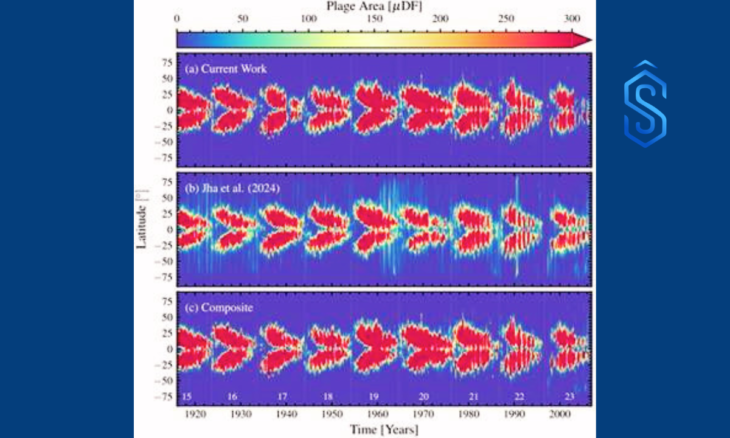
In the second stage, the model identified and traced plages—magnetically active bright regions on the Sun—across drawings covering nine solar cycles between 1916 and 2007.
Plages serve as reliable indicators of the Sun’s magnetic activity. Extracting these features from historical archives enables researchers to connect modern space-age observations with solar behavior recorded many decades ago.
By converting historical drawings into machine-readable scientific data, the researchers led by Dibya Kirti Mishra successfully tracked how plage activity shifted over time.
This enabled them to produce a “butterfly diagram,” a widely used visualization that illustrates the migration of solar activity throughout successive solar cycles.
The researchers also found that the plage areas extracted from the historical drawings closely matched those obtained from the Kodaikanal Solar Observatory‘s Ca II K full-disk observations.
This agreement demonstrates that the observatory’s historic suncharts can effectively fill observational gaps and strengthen long-term solar datasets.
According to the researchers, long-term and consistent records of the Sun’s magnetic activity are essential for comparing the strength and structure of different solar cycles.
Such datasets also improve reconstructions of historical changes in the Sun’s energy output and magnetic influence while enhancing the understanding of long-term space weather risks that can impact modern technological systems on Earth.
The study further demonstrates that Artificial Intelligence and machine learning can successfully transform uneven, hand-drawn historical records into reliable scientific datasets spanning many decades—something that traditional analytical methods have struggled to achieve.
By unlocking the scientific value of archival observations, the Kodaikanal Solar Observatory continues to contribute to advancing long-term solar physics research.
Publication link: https://doi.org/10.3847/1538-4365/ae381e