
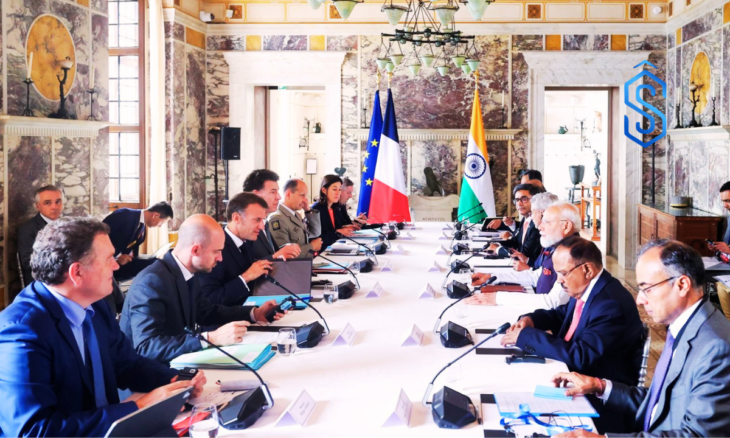
Prime Minister Narendra Modi and French President Emmanuel Macron have adopted the India France Innovation Roadmap 2030, marking a significant milestone in bilateral cooperation as both leaders elevated the relationship to a “Special Global Strategic Partnership” and jointly inaugurated the India-France Year of Innovation 2026 on February 17, 2026.
The India France Innovation Roadmap 2030 aims to expand and diversify collaboration across artificial intelligence, innovation, research, technology, digital technologies, cyberspace, health, culture, economy, education, and people-to-people exchanges.
The initiative builds upon the Horizon 2047 Roadmap and reinforces innovation as a key driver of economic resilience, sustainable development, strategic autonomy, and technological and industrial sovereignty.
According to the joint vision, both countries recognize that India’s Viksit Bharat 2047 vision and France’s France 2030 strategy offer strong convergence for creating a future-oriented innovation partnership while unlocking investment opportunities in disruptive technologies.
The India France Innovation Roadmap 2030 has been designed as a framework to guide collaborative efforts in advancing co-development of critical and emerging technologies, strengthening trusted technology ecosystems, enhancing academic and research mobility, and delivering benefits for citizens, the environment, and shared prosperity.
Trusted AI Positioned as Central Pillar of Partnership
Building upon the India–France Declaration on Artificial Intelligence signed in February 2025 and the AI Action and Impact Summits hosted by France and India during 2025 and 2026 respectively, both nations have agreed to make “trusted AI” a central pillar of their innovation partnership.
Under the India France Innovation Roadmap 2030, both countries will work together to promote safe, secure and trustworthy AI systems aligned with democratic values and human rights while preventing discrimination and misinformation.
The partnership will encourage collaboration between regulators, standards organizations and technical experts to develop interoperable, risk-based approaches for AI governance, including frontier and generative AI models without restricting innovation or national development.
A major priority within the AI partnership is child safety online. Recognizing the risks posed by AI-enabled services to children and other vulnerable groups, India and France have agreed to deepen cooperation on privacy-preserving age assurance technologies, safety-by-design architectures and outcome-based safety standards for AI systems interacting with children.
The roadmap also highlights the importance of privacy-preserving data-sharing frameworks to unlock AI-driven innovation while protecting fundamental rights.
India’s Data Empowerment and Protection Architecture (DEPA) and France’s trusted data space initiatives are expected to complement each other in supporting secure, consent-based data flows across research, healthcare and public services.
Also Read: Central University of Tamil Nadu Inks MoU with France’s University of Southern Brittany
Greater Focus on Academic Mobility and Talent Exchange
The India France Innovation Roadmap 2030 places significant emphasis on STEM education, research partnerships and institutional collaboration as essential elements for preparing future generations to address global challenges.
Both countries reaffirmed France’s objective of welcoming 30,000 Indian students by 2030 and recognized stronger people-to-people ties as the foundation of their strategic partnership.
India and France also expressed their intention to expand and modernize the Mutual Recognition of Qualifications (MRQ) framework first signed in 2018.
The updated framework is expected to cover additional academic disciplines, regulated professions and emerging technology sectors while facilitating dual-degree programmes, doctoral co-supervision arrangements and enhanced academic mobility.
In addition, several institutions from both countries have agreed to collaborate through student exchange programmes and joint research initiatives.
Strengthening Technological Sovereignty Through Industry-Academia Collaboration
The roadmap emphasizes closer cooperation among governments, industries, startups, universities and research institutions to promote innovation-led growth and resilient supply chains.
Both countries acknowledged the central role of the Indo-French Centre for the Promotion of Advanced Research (CEFIPRA) as a flagship scientific cooperation platform with increased focus on innovation and co-development of strategic technologies.
The newly established India-France Innovation Network (IFIN), launched during the India-France Year of Innovation, has been identified as a major platform connecting the innovation ecosystems of both nations.
India and France have committed to supporting its long-term development, including the possible formation of a joint Indo-French steering committee for governance.
The roadmap also recognizes the Franco-Indian Campus in Life Sciences for Health (FIC-LSH) as an important mechanism supporting biomedical research and health innovation collaboration.
Through reciprocal access to research laboratories, CEFIPRA, the Joint Science and Technology Committee, startup collaborations at Station-F, FRIND-X and the India-France Innovation Network, both countries aim to strengthen technological sovereignty and empower future researchers and entrepreneurs.
New Initiatives to Boost Innovation and Skills
As part of the India France Innovation Roadmap 2030, both governments announced several new initiatives.
- A Franco-Indian Campus for Aeronautics Training and Careers will be established in Kanpur in partnership with India’s Ministry of Skill Development and Entrepreneurship to enhance training opportunities in the strategic aviation sector.
- The proposed India–France InnoXchange Bridge will serve as a bilateral startup and innovation exchange programme connecting research laboratories, innovation clusters, investors and startup ecosystems across both countries.
The initiative seeks to provide structured research residencies, innovation immersion programmes and soft-landing support for entrepreneurs.
Both nations also intend to strengthen interactions between their small and medium enterprise ecosystems to encourage innovation, employment generation and inclusive economic growth.
Expanding Bilateral Space Cooperation
Space cooperation remains another important pillar under the India France Innovation Roadmap 2030.
India and France will host two major international space events during the same week: the Bengaluru Space Expo from September 7 to 9 in Bengaluru and the International Space Summit from September 9 to 10 in Paris.
The events are expected to lay the foundation for structured bilateral collaboration in Earth observation, human space exploration, French Zero-G capabilities, India’s future Low Earth Orbit space station and broader cooperation between public and private space ecosystems.
AI-Driven Health Solutions and Consent-Based Data Sharing
The roadmap also focuses on AI-powered research solutions addressing global health challenges.
Building upon collaborations between India’s ICMR and France’s Health Data Hub, both countries will work toward consent-based architectures for secure data sharing in compliance with national legal frameworks.
The initiative seeks to develop interoperable, rights-protecting data infrastructures supporting AI innovation, public-interest research and future expansion into additional sectors while enabling collaboration with interested Global South partners.
Partnership Guided by Trust and Shared Democratic Values
India and France have affirmed that the India France Innovation Roadmap 2030 will be implemented through a partnership based on mutual trust, shared democratic values, strategic autonomy and a common commitment to trusted, open, inclusive and human-centric innovation.
The roadmap seeks to deepen collaboration in artificial intelligence, education, research, startups, technology, health, space and industrial development while strengthening long-term bilateral cooperation between the two countries.