
Chennai: The Indian Institute of Technology Madras (IIT Madras) has unveiled the world’s most detailed 3D Atlas of human brainstem, marking a significant advancement in neuroscience research through its high-throughput brain imaging and computing platform that transforms whole human brains into 3D cell-resolution atlases.
Developed by the Sudha Gopalakrishnan Brain Centre (SGBC) at IIT Madras, ANCHOR (Atlas of Neurochemical Characterization of the Human Brainstem with 3D Reconstruction) represents the most comprehensive multi-modal 3D maps and atlases of the human brainstem created to date.
Covering developmental stages from the prenatal period to childhood and adulthood, the 3D Atlas of human brainstem offers unprecedented insights into the structure and organization of one of the body’s most critical neural regions.
The 3D Atlas of human brainstem encompasses more than 200 brainstem nuclei and fiber tracts reconstructed from hundreds of serial sections.
To distinguish different neurochemical cell types, researchers overlaid eight complementary immunostains across more than 500 sections, enabling highly detailed mapping at cellular resolution.
To maximize accessibility, the researchers have made ANCHOR publicly available through the website, allowing scientists, clinicians and patients across the globe to benefit from the 3D Atlas of human brainstem and its cutting-edge research capabilities.
The Sudha Gopalakrishnan Brain Centre aims to build the most comprehensive collection of cell-resolution human brain maps across different stages of life and neurological diseases.
The centre has evolved into a global interdisciplinary initiative with more than 200 researchers, engineers and technicians collaborating with 20 partners from various countries.
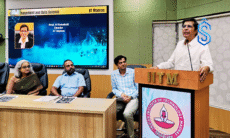
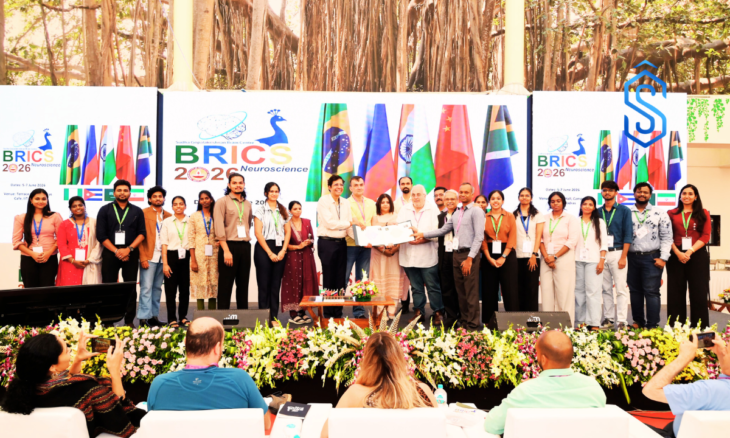
The official release of ANCHOR took place during the 3rd BRICS Neuroscience Symposium 2026, held from 5 to 7 June 2026 at the IIT Madras campus.
The symposium brought together leading neuroscientists, clinicians, academicians and researchers from BRICS nations to discuss advances in brain science and the significance of the 3D Atlas of human brainstem.
The 3D Atlas of human brainstem was unveiled in the presence of Prof. Ajay Kumar Sood, Principal Scientific Adviser to the Government of India, who attended as the chief guest.
Kris Gopalakrishnan, Co-founder of Infosys and a key supporter of SGBC, Prof. V. Kamakoti, Director of IIT Madras, and Prof. Mohanasankar Sivaprakasam, Head of SGBC, also attended the event along with industry leaders, donors, philanthropists and researchers from around the world.
Also Read: Amber Wings Powers India’s First Intra-City Drone Delivery Trials by FedEx and IIT Madras
Addressing the gathering virtually from Delhi, Prof. Ajay Kumar Sood, Principal Scientific Adviser to the Government of India, said: “This is a significant accomplishment in the field of neurobiology. This is a multimodal framework integrating MRI, histology and detailed chemo-architecture.
It will be the most detailed and comprehensive maps of the human brainstem and made available publicly in digital form. These maps will help in identifying specific cell populations affected in brain stem lesions which could be critical for clinical applications.”
He further added: “This is another milestone achieved by SGBC at IIT Madras after it had released ‘DHARANI’ last year. An important feature of SGBC is that it has been a multi-institutional, multinational and multi-disciplinary endeavour with the support of the Government, industry and philanthropy.
The Centre has become an exemplar of research and innovation through collaboration and diversified support system for long-term sustainability. The centre is a unique example of how risk taking by a public agency led to an advanced technology platform for doing big science and that was then scaled by private and philanthropic support to produce world-class results in frontier areas of human brain sciences.”
Highlighting the collaborative effort behind the project, Prof. Sood said: “Another noteworthy feature to talk about the collaborative aspect of this project is that various medical institutions in the country such as CMC Vellore, Kilpauk Medical College, MediScan Systems, Shri Ramachandra Institute of Higher Education and Research helped the Centre to acquire brains of different types and ages for this project.”
Congratulating the team on pushing research frontiers through the 3D Atlas of human brainstem, Prof. V. Kamakoti, Director of IIT Madras, said: “I always take pride that at IIT Madras we are exploring a lot of things but this particular exploration puts IIT Madras in the frontiers of the most complex creation that this world has witnessed – the human brain.
This Centre is also studying brains affected by different diseases like rabies, dementia and Alzheimer’s disease. We now have a way by which we can say what happens to the basic structure of the brain due to diseases. This is a very important first step in understanding what happens in the human brain.”
Congratulating the SGBC team on the successful launch of ANCHOR, IIT Madras Distinguished Alumnus Kris Gopalakrishnan, Co-founder of Infosys, said: “I laud the researchers for all the hard work and the effort that has gone in from conceptualization of this Centre to now releasing such detailed brain maps and making it fully public.
I hope this will make important contributions to neuroscience in the world. In India, we have the awareness of affordable science and affordable technology because ultimately technology must serve the society and the people. Accessibility, affordability and inclusiveness are very important.”
Prof. Mohanasankar Sivaprakasam, Head of SGBC, IIT Madras, emphasized the technological innovation behind the project, stating: “The key technology platform that makes these atlases widely accessible is our multi-modal image visualization framework that seamlessly integrates macro-scale volumetric data with micro-scale cellular images.
By establishing precise spatial correspondence across these modalities, the atlas enables a seamless transition from gross brain structures in the MRI to cellular-level features. We envision that these maps and atlases will have significant implications for neuroscience and neuromedicine.
This is an important scientific milestone for the Centre and is a big boost as we pursue our mission of imaging over 100 whole brains across the human lifespan and neurological diseases.”
Participating virtually in the symposium, Prof. Mu-Ming Poo, Scientific Director, Institute of Neuroscience, Chinese Academy of Sciences, said: “The choice to release the first Atlas in the brain stem is very important and a wise choice in this effort. I am particularly impressed with such rapid progress of the Sudha Gopalakrishnan Brain Centre in IIT Madras on the Human Brainstem Atlas. It is the beginning of a long journey.
The brainstem is very important to the human body. It is the connection between the brain and the spinal cord and for all our motor movements. It also controls very important aspects such as physiology, and how we awake, how we sleep and how we breathe – they are all controlled by centres in the brainstem.”
He further added: “I am also amazed by the perfect marriage of basic neuroscientists, clinical neuroscientists and the engineering and computing talents in India that has made this achievement possible.
This is a good example of interdisciplinary work that we all try for in brain science. I am sure we will be seeing more work coming out from this platform.”
With the public release of ANCHOR, IIT Madras has introduced a landmark 3D Atlas of human brainstem that combines MRI, histology and cellular-level imaging into an integrated digital resource.