
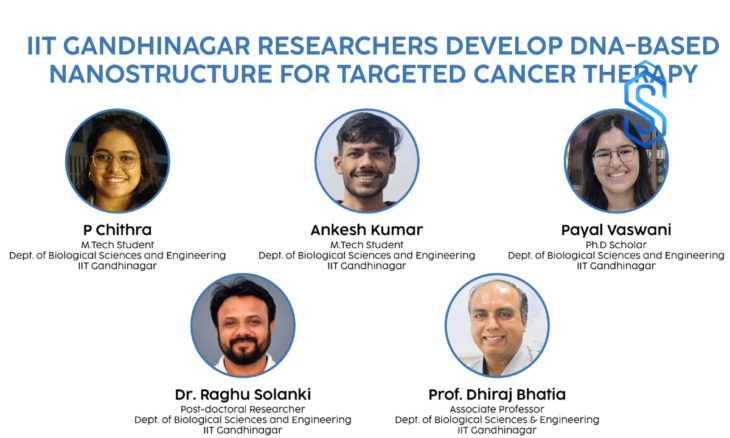
Ahmedabad: Researchers at the Indian Institute of Technology Gandhinagar (IITGN) have developed a DNA-based Nanostructure designed to improve targeted cancer therapy by enhancing the selective elimination of cancer cells while reducing damage to healthy tissues.
The study demonstrates how modifying DNA nanostructures with a Vitamin E-derived molecule can significantly improve cellular uptake and anticancer efficacy, offering a promising direction for future nanomedicine research.
Conventional cancer treatments such as chemotherapy often lack specificity, attacking both cancerous and healthy cells and causing severe side effects.
To address this challenge, IITGN researchers engineered DNA nanostructures known as tetrahedrons and modified them by attaching alpha-tocopherol succinate (αT), a Vitamin E-derived molecule capable of disrupting vital functions within cancer cells while acting protectively in healthy cells.
By integrating αT into the DNA tetrahedrons, the team significantly enhanced cellular uptake and improved anticancer activity, resulting in more selective and effective destruction of cancer cells.
At the core of this DNA-based Nanostructure research is DNA nanotechnology, which involves engineering DNA into precisely controlled nanoscale structures capable of carrying drugs, imaging agents, or therapeutic molecules.
Through programmable self-assembly, researchers can create nanoscale architectures with defined size, shape, and functionality.
Among these, DNA tetrahedrons have attracted considerable attention as drug delivery platforms because of their structural stability, biocompatibility, low immunogenicity, and ease of functionalisation.
However, their therapeutic application has often been constrained by inefficient cellular internalisation and limited intracellular delivery.
Addressing these limitations, the findings were published in ACS Applied Bio Materials in a paper titled “Alpha-Tocopherol-Conjugated DNA Tetrahedron with Enhanced Cellular Uptake and Cytotoxicity for Cancer Therapeutics.”
Explaining the broader significance of the research, corresponding author Prof Dhiraj Bhatia, Associate Professor at IITGN’s Department of Biological Sciences and Engineering, said:
“What makes this work exciting is that we are starting to see how intentional molecular design can influence biological behaviour in a very controlled way.
Even subtle changes at the surface level can shape how these nanostructures interact with living systems, which opens up interesting possibilities for how we think about designing future therapies.”
To determine whether αT modification altered the physicochemical properties of the DNA tetrahedrons, the researchers employed dynamic light scattering (DLS).
In this technique, a laser beam passes through a liquid sample containing nanoparticles, and fluctuations in scattered light are analysed as the particles move randomly in solution.
The method enabled the team to measure nanoparticle size and surface characteristics, providing valuable insights into stability, aggregation behaviour, and potential biological interactions.
Through cell culture experiments assessing cellular uptake and cytotoxicity, along with mechanistic studies, the researchers discovered that attaching αT significantly improved the cellular uptake of the DNA-based Nanostructure, likely due to enhanced interaction with the fatty outer layer of the cell membrane.
Fluorescence imaging further confirmed greater accumulation of the modified nanostructures in cancer cells compared to healthy cells, indicating preferential uptake by malignant cells.
Once inside the cancer cells, the αT-functionalised DNA tetrahedrons stimulated the production of reactive oxygen species (ROS), triggering oxidative stress and causing damage to DNA, proteins, and mitochondria.
This cascade ultimately resulted in programmed cell death, allowing damaged or unhealthy cells to shut themselves down in a controlled manner.
Lead author Ms P Chithra, an MTech student in the Department of Biological Sciences and Engineering, said: “What I found particularly encouraging was the consistency of the results across multiple experiments.
Seeing a conceptual design translate into measurable biological outcomes is extremely rewarding and motivates us to continue developing more effective nanomedicine-based therapeutic strategies.”
Reflecting on the wider significance of the study, Dr Raghu Solanki, Postdoctoral Fellow in the Department of Biological Sciences and Engineering and co-corresponding author, commented:
“One of the most exciting aspects of this research was observing how a simple design modification could significantly influence cellular behavior and therapeutic efficacy.
Such studies highlight the immense potential of DNA nanotechnology and demonstrate how fundamental insights into cell–nanomaterial interactions can guide the development of safer and more effective targeted cancer therapies.”
While the study demonstrates the promise of αT-functionalised DNA tetrahedrons as targeted anticancer nanocarriers, the research remains limited to laboratory-based investigations.
Additional studies involving animal models, comprehensive safety assessments, and clinical trials will be necessary to establish therapeutic efficacy and translational potential.
Nevertheless, by revealing how nanoscale surface modifications influence cellular uptake and biological responses, this DNA-based Nanostructure research contributes valuable insights into the rational design of next-generation DNA nanomedicines and targeted cancer therapies, potentially paving the way for more precise and effective cancer treatment approaches in the future.