
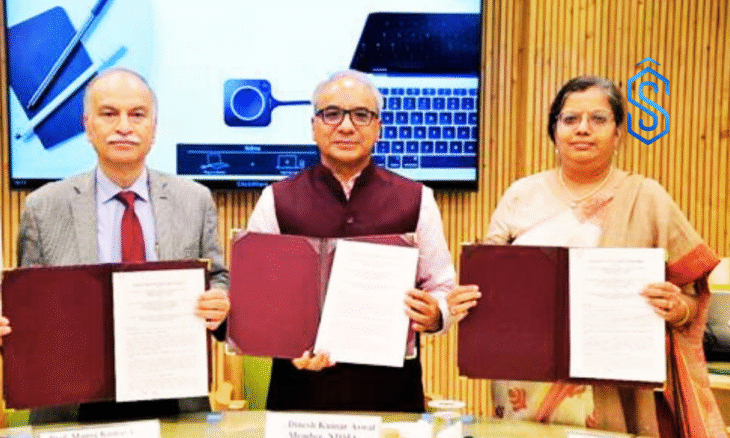
New Delhi: The National Disaster Management Authority (NDMA), Academy of Scientific and Innovative Research (AcSIR), and CSIR–National Institute of Science Communication and Policy Research (CSIR–NIScPR) have signed a Memorandum of Understanding (MoU) to establish a collaborative framework for academic programmes, capacity building, policy research, and communication in Disaster Management and Risk Reduction (DMRR).
The partnership on Disaster Management and Risk Reduction aims to integrate science, technology, and policy to build a disaster-resilient India through structured academic initiatives, interdisciplinary research, and enhanced public engagement.
Disaster Management and Risk Reduction MoU: Key Highlights
- Launch of a PhD Programme in Disaster Management under AcSIR at CSIR–NIScPR with the support of NDMA.
- Joint research and policy studies, including science communication and capacity-building initiatives in Disaster Management and Risk Reduction.
Speaking on the occasion, Dr Dinesh Kumar Aswal, Member, NDMA, highlighted NDMA’s vision of integrating science with societal preparedness for Disaster Management and Risk Reduction.
Aswal said, “In line with the Prime Minister’s Nine-Point Agenda on Disaster Risk Reduction, we are committed to developing a strong network of academic institutes that will work collaboratively on disaster-related research and academic programmes. We must fully utilise the transformative potential of communication channels to enhance early warning systems, risk communication, and community outreach.
Equally important is our resolve to learn from every disaster through systematic post-event studies and documentation. Only by institutionalising this culture of continuous learning can we strengthen preparedness, refine response mechanisms, and build a truly resilient nation. In this context, this MoU is a significant step toward fostering a strong bridge between scientists and policy professionals to address the complex and evolving challenges associated with disasters.”
Also Read: Real Time Governance Society Wins Praise from Bill Gates During Andhra Pradesh Visit
Emphasising the academic and research opportunities created through this Disaster Management and Risk Reduction collaboration, Prof Manoj Kumar Dhar, Director, AcSIR, stated:
“AcSIR has over 7,000 enrolled students and ranks among the top research institutions in India. Our research spans nearly all scientific domains except space sciences, and we strongly encourage interdisciplinary collaboration.
This MoU opens new avenues for the students and researchers to develop innovative, research-based solutions to disaster management challenges. It will help nurture a new generation of experts dedicated to strengthening India’s disaster resilience framework towards Viksit Bharat 2047.”
Highlighting the importance of science communication and policy research in advancing Disaster Management and Risk Reduction, Dr. Geetha Vani Rayasam, Director, CSIR–NIScPR, said:
“CSIR–NIScPR is a unique institution that publishes 15 research journals, leads national initiatives in science communication, and engages in evidence-based policy research. Partnering with NDMA and AcSIR will enable us to integrate scientific knowledge into policy and public awareness frameworks for disaster management.
Through this collaboration, NIScPR will provide a vibrant platform for policy research and capacity-building efforts while advancing science communication for disaster preparedness.
By aligning rigorous scientific inquiry with policymaking, we aim to support development of solutions that are scientifically robust and socially responsive, thereby reinforcing the nation’s disaster resilience framework.”
NDMA, the apex body for disaster management policies under the Ministry of Home Affairs, will provide strategic direction and domain expertise for Disaster Management and Risk Reduction initiatives.
AcSIR, a premier research university, will anchor academic programmes and research initiatives. CSIR–NIScPR will host the academic programmes and drive policy research and public engagement on Disaster Management and Risk Reduction.
This tripartite collaboration marks a significant step towards embedding scientific research, science communication, and evidence-based policymaking into India’s Disaster Management and Risk Reduction ecosystem, reinforcing the country’s commitment to building a resilient and prepared nation.