

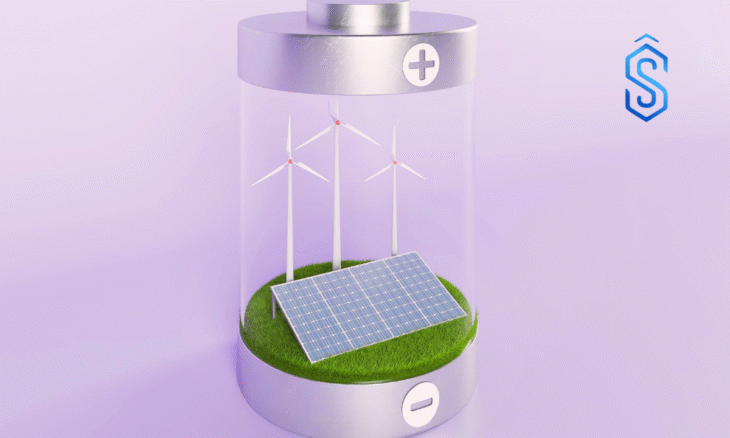
New Delhi: The Battery Energy Storage System cost in India has witnessed a steep decline over the past two years, driven by competitive bidding, government-backed VGF schemes, and policy incentives aimed at improving grid-scale storage affordability.
As per data shared in Parliament, the Battery Energy Storage System cost discovered through tariff-based competitive bidding during 2022–23 stood at around ₹10.18 per kWh, assuming utilisation of two charge-discharge cycles per day.
In contrast, recent bids have discovered tariffs as low as ₹2.1 per kWh without VGF support, again assuming two cycles daily.
Based on prevailing market trends, BESS is expected to operate at an average of 1.5 cycles per day, translating into an effective storage cost of approximately ₹2.8 per kWh.
This reduction places battery storage costs close to the average solar power tariff, which currently ranges around ₹2.5 per kWh based on recent tenders.
Also Read: Bengaluru: CeNS Researchers Create Flexible Aluminum Battery Technology as Lithium-Ion Alternative
Battery Energy Storage System Cost Supported by VGF Schemes
To accelerate large-scale adoption, the Ministry of Power is implementing a VGF scheme for the development of 13,220 MWh of BESS capacity, backed by budgetary support of ₹3,760 crore.
In addition, a second VGF scheme was launched in June 2025 for setting up 30 GWh of BESS capacity, offering financial assistance of ₹5,400 crore through the Power System Development Fund (PSDF).
ISTS Charges Waiver to Reduce Battery Energy Storage System Cost
Further policy support includes a waiver of Inter-State Transmission System (ISTS) charges for a period of 12 years for co-located BESS projects commissioned by June 2028.
For non-co-located BESS projects, ISTS charges waiver is applicable for projects commissioned before June 2025. Thereafter, the waiver will be reduced annually in graded steps of 25%.
Also Read: Plasma-Activated Coordination Polymer Electrocatalysts Boost Clean Hydrogen Production
PLI Scheme to Lower Battery Energy Storage System Cost Long-Term
The Ministry of Heavy Industries is also implementing the Production Linked Incentive (PLI) scheme titled the National Programme on Advanced Chemistry Cell (ACC) Battery Storage.
The initiative aims to establish 50 GWh of domestic ACC manufacturing capacity, with 10 GWh specifically allocated for Grid Scale Stationary Storage (GSSS) applications. Approved in May 2021, the scheme has a total outlay of ₹18,100 crore.
The PLI programme is expected to boost domestic manufacturing, reduce reliance on imports, and contribute to further reductions in the Battery Energy Storage System cost over the long term.
This information was provided by the Minister of State for Power, Shripad Yesso Naik, in a written reply in the Rajya Sabha.