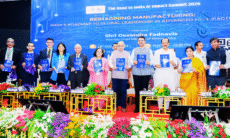

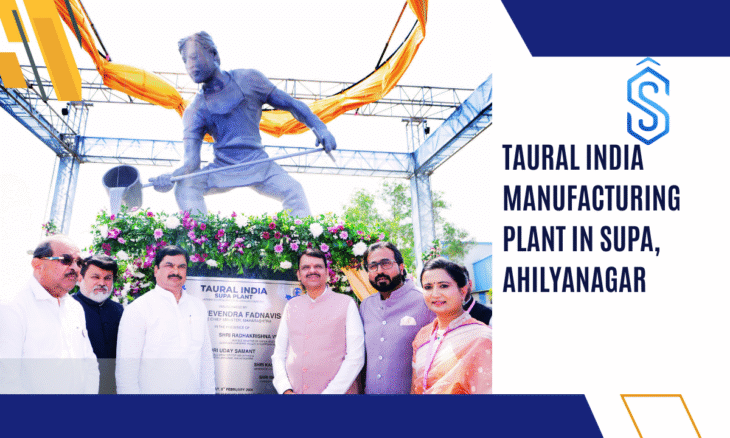
Ahilyanagar: Taural India inaugurated its new manufacturing facility in Supa MIDC, Ahilyanagar, marking a major milestone in Maharashtra’s push toward decentralized industrial development and import-substitution manufacturing.
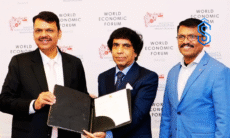
This facility is part of investment agreements signed during the World Economic Forum in Davos 2026.
The plant was inaugurated by Maharashtra Chief Minister Devendra Fadnavis in the presence of industry leaders and government officials.
The new facility reflects the state’s broader strategy to strengthen manufacturing capabilities, create regional industrial hubs, and accelerate employment generation across North Maharashtra.
Also Read: Mumbai Eastern Waterfront Set to Become Global Maritime Hub Under ₹22,672-Crore Plan
Taural India Plant: Boosting Industrial Growth in North Maharashtra
Speaking at the inauguration, Chief Minister Devendra Fadnavis described the project as a symbol of Maharashtra’s growing industrial confidence.
“It gives me immense joy to inaugurate this project today, because I truly feel that this project is a celebration of Maharashtra’s industrial confidence. Especially, I would like to wholeheartedly congratulate an entrepreneur like Bharat Gite, who has built this entirely on his own strength and has accomplished this work in record time.”
Highlighting regional industrial development, the Chief Minister emphasized the scale of investment coming into North Maharashtra.
“I am pleased to share that this time, we successfully attracted investment to all five districts of North Maharashtra, bringing in nearly ₹50,000 crore of investment. If we look at Ahilyanagar district alone, investments of around ₹11,519 crore are expected, generating employment for 18,000 people. Across North Maharashtra, nearly 75,000 jobs will be created.”
He noted that Supa MIDC was developed with the vision of creating new industrial magnets outside traditional hubs like Mumbai, MMR, and Pune.
“We made efforts to decentralize industrial development and spread it across all regions. Supa MIDC was developed with this vision, and today we see industries coming up there.”
Also Read: Hirschvogel Components India to Invest INR 750 Crore in Maharashtra, Create 1,000 Jobs
Import Substitution and Manufacturing Growth
The Chief Minister emphasized the importance of domestic manufacturing in building an Atmanirbhar Bharat, noting that industries like Taural India are enabling import substitution.
“Last year in Davos, we signed investment agreements worth ₹16 lakh crore, of which 75% have already become active and are progressing toward completion. Today’s project is one such agreement.”
Fadnavis also assured strong government support for entrepreneurs and emphasized the importance of law and order in industrial zones.
“If we want industries to succeed, only three things matter: ease of doing business, cost of doing business, and law and order.”
Fadnavis also highlighted India’s economic progress and the critical role of manufacturing and technology in sustaining long-term growth.
“Whatever we are compelled to import today, creating import substitutes for those products is truly the need of the hour. This entire industry that Bharat Gite has built is precisely doing that—acting as an import substitute.”
“We have moved from 11th position to 4th, and soon we will be at 3rd. We are heading toward a $5 trillion economy. But to sustain this economic momentum, the sectors that will truly support this growth are technology and manufacturing.”
Also Read: Maharashtra Investment MoUs at WEF 2026 Touch $173 Billion on Day 1
Bharat Gite, Founder and CEO of Taural India, said, “The manufacturing currently contributes around 10–12% to India’s GDP, while the national vision is to increase this share to 25%. He pointed out that Maharashtra has already achieved a manufacturing contribution of approximately 16% under the leadership of the state government, positioning it as a leading industrial hub in the country.
Gite recalled that Taural India’s journey began in 2016 and has expanded fourfold over the past decade. Drawing from his professional experience in Germany, where he worked with companies such as BMW, he said the decision to return to India was driven by the belief that world-class manufacturing capabilities could be developed domestically as well.
Gite also recounted his first interaction with Chief Minister Fadnavis at the Hannover Messe in 2015, which he said played a key role in Taural India’s decision to invest in Maharashtra. The company signed its first memorandum of understanding (MoU) in 2016 and commissioned its Chakan plant within two years.
According to the company, the Chakan facility reached full capacity by 2025, employing around 900 people and producing nearly 300 tonnes per month. Taural India has been involved in manufacturing critical components for sectors such as energy conservation, railways, healthcare, and defense.
The company cited projects such as Sarath Tank and Amrit Bharat, and stated that it has successfully manufactured engine blocks and gear cores for defense and railway applications that were previously not produced in India.
In 2025, Taural India signed another agreement at the World Economic Forum in Davos, in the presence of the Chief Minister and Industries Minister Uday Samant. Within a year, the Supa plant was completed and made operational.
Gite acknowledged the challenges faced during the company’s early years, including workforce training, technology adaptation, and financial constraints. He credited family support and strong local roots for sustaining the company’s long-term growth.
He also announced that Taural India’s growth journey will be featured as a case study at Harvard Business School in April 2026, showcasing the company’s evolution and its collaboration with global partners and the Maharashtra government.