
Indian scientists have demonstrated that relatively compact gamma-ray detectors could help expand the global monitoring of extreme solar events, potentially reducing the dependence on conventional neutron-monitor infrastructure.
The approach was tested using observations from research stations in the Arctic and Antarctica, where researchers detected signatures of a rare solar particle event recorded in November 2025.
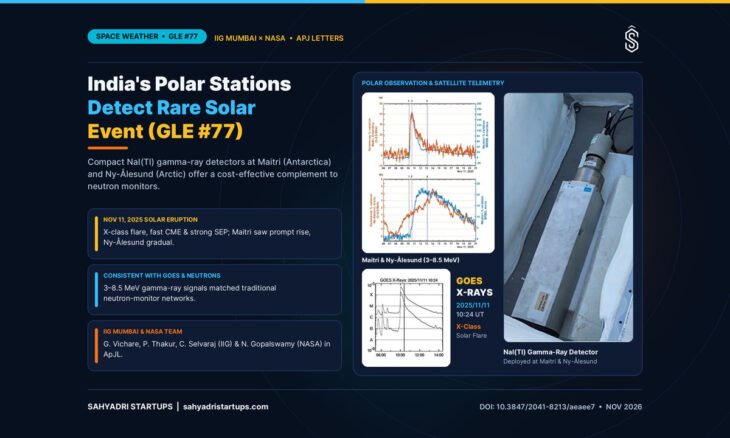
The study, led by scientists at the Indian Institute of Geomagnetism (IIG), Mumbai, identified Ground-Level Enhancement (GLE) signatures associated with the November 11, 2025, solar event, designated GLE #77.
The detection was made using gamma-ray detectors installed at India’s Maitri research station in Antarctica and Ny-Ålesund in the Arctic.
The findings point to a potentially wider role for ground-based gamma-ray observations in space-weather monitoring.
If deployed across strategically selected locations, these instruments could complement existing neutron-monitor networks and improve the geographical coverage of observations of high-energy solar particles.
Gamma-ray detectors offer an alternative to conventional monitoring
Ground-Level Enhancements are among the most extreme manifestations of solar energetic particle events.
They occur when highly energetic particles, primarily protons released during powerful solar eruptions, reach Earth and interact with its atmosphere, producing secondary particles that can be detected from the ground.
The November 2025 event was associated with an intense X-class solar flare, a fast coronal mass ejection (CME) and a strong solar energetic particle event.
Neutron monitors have traditionally been used to identify GLEs. However, the IIG study demonstrates that gamma-ray detectors can also capture signatures of these events, offering another instrument for ground-based observations.
Unlike conventional neutron-monitor installations, gamma-ray detectors are relatively compact and cost-effective. Their potential deployment across a wider geographical network could help researchers monitor solar particle events from locations that are not adequately covered by existing observation systems.
Different responses recorded at Arctic and Antarctic stations
The research team analysed measurements from sodium iodide (NaI(Tl)) scintillation gamma-ray detectors installed at Maitri and Ny-Ålesund.
The instruments were set up by IIG as part of its programme to study cosmic rays and space-weather-related phenomena at polar latitudes.
Both stations recorded distinct temporal signatures of GLE #77. The Antarctic station Maitri registered a prompt response, while Ny-Ålesund recorded a more gradual enhancement.
Researchers also compared the gamma-ray observations with measurements from conventional neutron-monitor networks and particle data from the Geostationary Operational Environmental Satellites (GOES). The results were found to be consistent with the traditional monitoring systems.
An important part of the analysis involved establishing that the recorded enhancement was linked to the solar event rather than other sources of gamma-ray activity.
These included terrestrial background radioactivity, terrestrial gamma-ray flashes, thunderstorm ground enhancements associated with lightning, gamma-ray bursts and other solar activity.
The research involved Prof. G. Vichare, Ms. P. Thakur and Mr. C. Selvaraj from IIG, along with Prof. N. Gopalswamy from NASA. The team processed detector readings across different energy ranges and examined variations against pre-event background levels.
Implications for global space-weather research
The detection at two polar stations provides an opportunity to study how high-energy solar particles interact with Earth’s atmosphere under different geographical and geomagnetic conditions.
Such observations are relevant to understanding the Sun–Earth connection and assessing the potential consequences of extreme space-weather events.
A wider distribution of gamma-ray detectors could provide additional data points, helping scientists build a more geographically representative picture of solar particle activity.
For India, the findings also demonstrate the research value of its polar observation infrastructure. The installations at Maitri and Ny-Ålesund have contributed to an international effort to improve the detection and understanding of extreme solar events.
Published in The Astrophysical Journal Letters, the study establishes ground-based gamma-ray observations as a promising complementary approach to conventional GLE detection.
Further expansion of the detector network could help determine how effectively this method can support global space-weather monitoring.
Research publication: https://doi.org/10.3847/2041-8213/aeaee7