
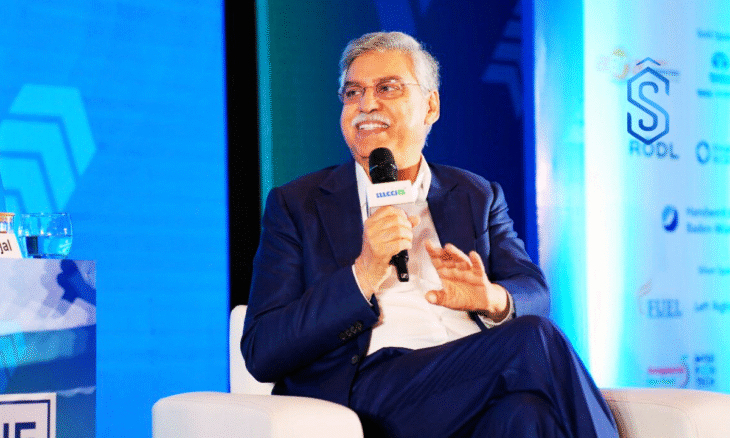
Pune: Sunil Kant Munjal, Chairman of Hero Enterprises, called for leadership rooted in values, disciplined execution, and nation-building beyond balance sheets during a wide-ranging conversation at the Pune International Business Summit 2026.
Speaking alongside Arvind Goel, Vice Chairman of Tata AutoComp Systems Ltd., Sunil Kant Munjal addressed an audience of entrepreneurs, industry leaders, and family business owners, outlining lessons from the Hero Group’s journey and presenting a roadmap for India’s next phase of economic growth.
Throughout his address, Sunil Kant Munjal emphasized that long-term competitiveness must be anchored in culture, governance, and execution excellence.
From Refugees to Global Leadership: Sunil Kant Munjal on the Hero Journey
Recounting the origins of the Hero Group, Sunil Kant Munjal said his family migrated to India during Partition and settled in Ludhiana. Beginning as traders of bicycle components, the family transitioned into manufacturing in 1956.
In a defining moment, his father, Brijmohan Lall Munjal, returned a government-issued small-scale manufacturing license because it capped growth. “We did not want to limit our future,” Sunil Kant Munjal said, describing the decision as bold at a time when licenses guaranteed profitability.
Hero Cycles went on to become the world’s largest bicycle manufacturer by 1986. Sunil Kant Munjal explained how early capital constraints shaped a culture of efficiency. Without resources to maintain large inventories, the company adopted what would later be recognized as just-in-time production—shipping products the same day they were assembled and avoiding warehouses altogether.
Sunil Kant Munjal also highlighted the creation of a supplier ecosystem in Ludhiana. By encouraging entrepreneurs to establish ancillary businesses – offering technical guidance but no capital – the group helped build one of the world’s most extensive bicycle component manufacturing networks.
Also Read: PIBS 2026: Sanjeev Krishan Outlines India’s Growth SCRIPT for the Next Decade
Why Honda Chose Hero: Sunil Kant Munjal Reflects on the Partnership
Reflecting on the landmark collaboration with Honda in the early 1980s, Sunil Kant Munjal said that although more than 140 Indian companies sought partnerships, Honda chose Hero for its culture rather than its size.
“They were impressed by our zero attrition, long-term supplier relationships, information sharing and discipline,” Sunil Kant Munjal noted.
The partnership went on to build the world’s largest two-wheeler company. Over time, Sunil Kant Munjal said, knowledge exchange became two-way, with Indian teams independently designing and executing entire manufacturing facilities.
Even after the partnership concluded, Sunil Kant Munjal stated that Hero retained leadership by focusing on customer insights, ergonomics, regional market nuances, and total cost of ownership.
Sunil Kant Munjal on the Family Business Imperative
Highlighting the role of family-owned enterprises, Sunil Kant Munjal said they generate the largest share of global employment and demonstrate superior capital efficiency. However, he cautioned that 94% of such businesses fail by the third generation.
According to Munjal, the differentiator lies in separating ownership from management, fostering open communication, and ensuring merit-based leadership. Within his own family, next-generation members must gain education and external work experience before joining the business.
“Entitlement is dangerous. Leadership must be earned,” he emphasized, noting that appraisal standards for family members are stricter than for professionals.
Diversification and Strategic Restructuring
Following two proactive family restructurings, Sunil Kant Munjal now leads a diversified portfolio under Hero Enterprises, spanning insurance, real estate, steel, and investments.
Hero Insurance Broking distributes over 10 million policies annually across motor, health, and reinsurance segments. The group’s real estate arm focuses on sustainable, middle-income housing in North India, while its steel business serves automotive and industrial sectors.
Through its investment office, Munjal said the group backs ventures across financial services, healthcare, advanced manufacturing, consumer technology, and sustainability. He emphasized investing in founders rather than just business models, while offering active mentorship.
Sunil Kant Munjal on India’s Trade Moment and Execution Responsibility
On India’s expanding trade agreements, Sunil Kant Munjal described them as a “runway to take flight,” but stressed that industry must ensure execution excellence.
He pointed to data management, product traceability, deep customer understanding, and continuous improvement as decisive factors in capturing global opportunities.
He underscored that India’s economic transformation must be measured by rising per capita income rather than GDP alone, highlighting persistent income disparities.
Emerging Opportunities: Sunil Kant Munjal on AI and the Elderly Economy
Looking ahead, Sunil Kant Munjal identified high-growth sectors including health management, wealth management, leisure, infrastructure, AI-driven technologies, and formalization of the informal sector.
Munjal also highlighted India’s demographic transition, noting that the country will soon have one of the largest elderly populations globally—creating demand for age-friendly products, services, and infrastructure.
He added that India’s infrastructure expansion is among the largest in the world today, presenting multi-layered opportunities across industries.
Also Read: Building for Bharat’s Stores: How Zithara AI Is Rewriting the Offline Retail Playbook
Business Beyond Profit: Sunil Kant Munjal on Nation-Building
Deeply engaged in philanthropy, Sunil Kant Munjal said private enterprise must apply operational excellence to social sectors such as education, healthcare, skilling, and rural development.
Through the Serendipity Arts Foundation and the Serendipity Arts Festival, Munjal is championing arts and culture as engines of economic growth and soft power. Reviving India’s artisanal traditions, he said, could generate millions of sustainable livelihoods.
Munjal concluded with a call to action: nation-building begins with individual responsibility. Even supporting the education of children from underprivileged backgrounds, he said, can catalyze generational transformation.