
Pune: Intangles, a global AI-powered predictive intelligence company focused on the commercial vehicle sector, has released a new analysis highlighting the impact of the Mumbai-Pune Connecting Link on commercial vehicle operations.
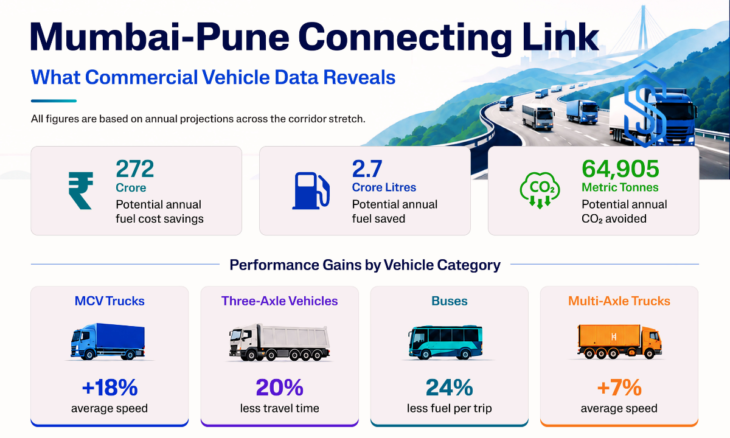
According to the Intangles report, improved traffic movement on the corridor could generate potential annual fuel savings of 2.7 crore litres, translating into approximately ₹272 crore in annual fuel cost reductions across the corridor stretch.
The findings from Intangles also suggest that the projected fuel savings could help prevent an estimated 64,905 metric tonnes of carbon dioxide (CO₂) emissions every year.
The company noted that the results underline the broader economic and environmental benefits of smoother traffic movement on a strategically important route that forms part of the Mumbai-Pune-Bangalore corridor and supports Maharashtra’s freight and passenger transport ecosystem.
The Intangles analysis recorded measurable performance improvements across four commercial vehicle categories: buses, medium commercial vehicle (MCV) trucks, three-axle vehicles, and multi-axle trucks.
Among the categories studied, MCV trucks registered the highest increase in average speed, recording an 18% improvement. These vehicles also demonstrated a 19% reduction in travel time and a 17% decline in fuel consumption.
Three-axle vehicles achieved the highest reduction in travel time at 20%, while buses recorded the strongest improvement in fuel efficiency, with fuel consumption per trip decreasing by 24%.
Multi-axle trucks also posted improvements in average speed, travel time, and fuel usage. According to Intangles, these gains indicate that enhanced corridor movement can deliver operational benefits across heavier commercial vehicle segments as well.
Also Read: Innefu Labs Secures $30 Million Series B Investment from Panthera Growth Partners
Anup Patil, CEO, Intangles, said: “Fuel is a direct measure of operational efficiency, and on a corridor carrying this volume of freight, even modest per-trip savings compound into material economic impact. What this analysis demonstrates is that vehicle data, collected and processed at scale, can quantify infrastructure value in the terms that actually matter to fleet operators: litres saved, minutes recovered, emissions reduced.
At Intangles, we build predictive intelligence using our proprietary digital twin technology that helps fleets capture this value continuously, not just when a new road opens, but across every route, every trip, and every vehicle in operation. India’s infrastructure investment is accelerating. It is just a matter of time that the fleets that deploy advanced intelligence will benefit vastly alongside India’s growth story.”
The Intangles study relied on vehicle-generated data and advanced analytics to evaluate operational performance before and after the opening of the Connecting Link.
Hariharan Ravishankar, Chief AI Scientist, Intangles, said: “Most infrastructure impact assessments rely on modelled assumptions with fixed consumption rates applied to traffic volumes. What makes this analysis different is that every fuel figure comes from actual vehicle sensor streams, processed through terrain-aware algorithms that account for gradient, load behaviour, and real-time driving patterns.
The finding that heavier vehicle categories showed the strongest proportional gains is not intuitive, but it is exactly what the physics predicts. Vehicles most constrained by stop-go conditions on steep gradients benefit most when that constraint is removed. As India’s transport infrastructure expands, this kind of sensor-based measurement framework gives planners, operators, and policymakers something they have not had before: infrastructure ROI expressed in operating terms, not projections.”
In addition to efficiency improvements, Intangles observed an early decline in hard braking events across the commercial vehicle categories included in the study.
While the company noted that longer-term monitoring is required before drawing conclusions regarding sustained road safety outcomes, the initial findings provide an indication of improved driving conditions on the corridor section under consideration.
Also Read: TrendAI Joins Anthropic’s Project Glasswing to Strengthen AI-Powered Software Security
Methodology
The Intangles analysis tracked 1,849 unique commercial vehicles, including buses, MCV trucks, three-axle vehicles, and multi-axle trucks. The dataset covered more than 2,200 trips through the ghat section of the Mumbai-Pune corridor.
Vehicle performance was compared across two distinct periods: April 26–30, 2026, before the opening of the Connecting Link, and May 2–15, 2026, after the opening, with one day allowed for traffic stabilisation.
Speed and travel time metrics were measured using GPS and geo-location data. Fuel consumption estimates for the assessed commercial vehicle categories were derived using Intangles’ proprietary algorithms, which incorporate terrain analysis and real-time driving behaviour data.
According to Intangles, the study demonstrates how sensor-driven intelligence and vehicle data analytics can be used to quantify infrastructure outcomes in operational terms, including fuel savings, travel time reductions, and emissions impact.