
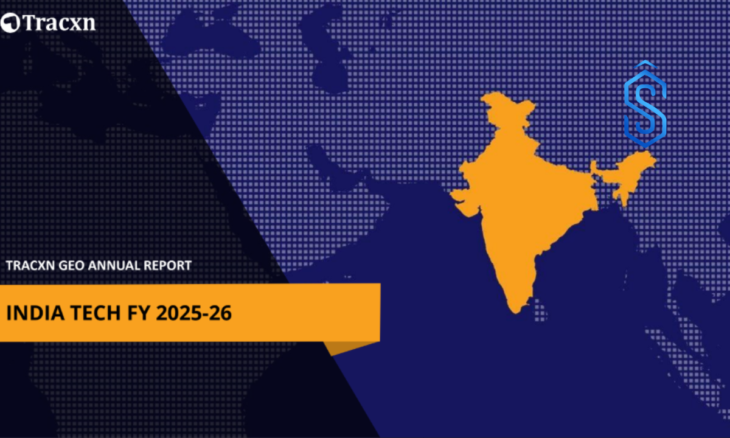
Bengaluru: Tracxn, a startup intelligence and market data platform, has released its Tracxn Geo Annual Report: India Tech FY 2025-26, presenting a comprehensive, data-backed analysis of India’s startup funding, IPO activity, unicorn creation, and investor sentiment for the financial year ending March 31, 2026.
According to Tracxn, India retained its position as the world’s fourth-largest funded startup ecosystem, trailing only the United States, United Kingdom, and China.
The ecosystem attracted $11.7 billion across 1,632 funding rounds, highlighting a structural shift where investors are making fewer but higher-conviction bets, rather than withdrawing capital from the market.
Commenting on the findings, Neha Singh, Co-Founder of Tracxn, said, “The FY 2025-26 data tells a story of deliberate recalibration. When deal volume falls 34% but funding fell only 18%, it means investors aren’t leaving – they’re choosing differently.
The surge in IPO activity and the 50% rise in new unicorn formation all point to an ecosystem that is growing up: more focused, more fundamentals-driven, and increasingly capable of generating durable value rather than just headline valuations.”
Also Read: Tracxn India Tech Annual Funding Report 2026: India Ranks 4th Globally with $11.7B Funding
Capital Concentration Trends Highlight Tracxn Insights
The Tracxn report reveals that while total funding declined 18% from $14.3 billion in FY 2024-25, it still marked a 20% increase from FY 2023-24 levels, indicating recovery momentum.
A notable highlight from Tracxn is the 33% surge in early-stage funding to $4.8 billion, despite a drop in the number of early-stage rounds from 492 to 420. This indicates that fewer startups are securing larger Series A and B investments, reflecting rising quality benchmarks.
Meanwhile, late-stage funding declined by 38%, reinforcing the shift toward selective capital deployment. Sector-wise, Enterprise Applications ($3.6 billion), FinTech ($2.4 billion), and Retail ($2.4 billion) led investment inflows.
Among the largest funding rounds tracked by Tracxn were:
- Nxtra raising $710 million
- Neysa raising $600 million
- Inox Clean Energy raising $344 million
These large deals underscore that capital is flowing into infrastructure-heavy and foundational technology opportunities.
Tracxn Data Shows Record IPO Momentum
The Tracxn report highlights a significant milestone for public markets, with 47 tech IPOs in FY 2025-26, marking a 52% increase from 31 IPOs in the previous year – the highest in a decade.
Notable companies that went public include:
- Lenskart ($7.9 billion market cap at IPO)
- Groww ($7.0 billion)
- Meesho ($5.6 billion)
- Physics Wallah ($3.6 billion)
- Pine Labs
The sectoral composition of IPOs also evolved, with Retail leading with 15 listings, followed by Enterprise Applications with 11 listings. Late-stage IPO participation increased from 36% to 44%, reflecting investor preference for scaled and revenue-generating companies.
Unicorn Growth: Faster and More Capital Efficient
According to Tracxn, six new unicorns emerged in FY 2025-26:
- Neysa
- Raise
- Navi
- Jumbotail
- JSW One MSME
- Juspay
This represents a 50% year-on-year increase, taking India’s total unicorn count to 125, making it the third-largest globally.
Geographically, Bengaluru (53 unicorns), Mumbai (20), and Gurugram (20) account for over 74% of the total. However, Tracxn notes that only 17 out of 94 unicorns with available financials are profitable, highlighting the growing importance of margin discipline alongside revenue growth.
Investor Outlook: AI and Deep Tech Take Center Stage
The Tracxn report also captures forward-looking investor sentiment. A survey of approximately 30 India-focused venture capital firms reveals that 74% expect improved market conditions in 2026.
Key Investment Themes Identified:
- AI/ML and Deep Tech as top priorities (71% each)
- Vertical AI (79%) and Enterprise AI (54%) as preferred investment categories
These findings suggest that the next phase of growth in India’s startup ecosystem will be driven by how intelligence is embedded across industries, rather than standalone technology deployments.