
New Delhi: India’s flagship maternal health research initiative GARBH-INi is set to strengthen the country’s response to preterm births through indigenous, AI-driven solutions, Union Minister Dr. Jitendra Singh announced.
The GARBH-INi programme, which includes India’s largest pregnancy cohort study involving 12,000 women, aims to address one of the leading causes of neonatal mortality and long-term morbidity.
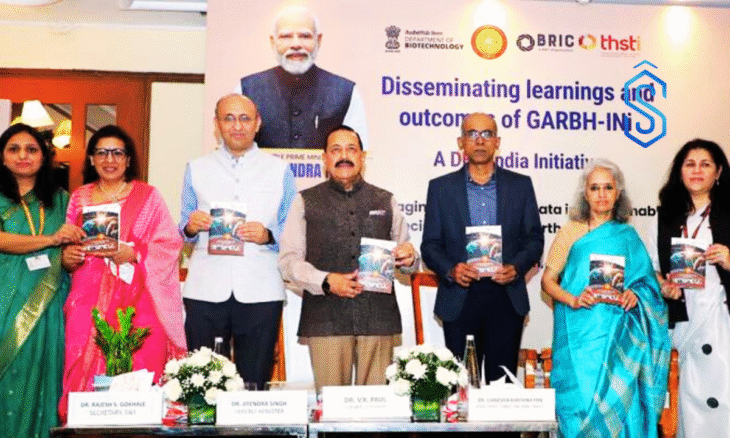
Speaking at the programme on “Disseminating Learnings and Outcomes of GARBH-INi (Interdisciplinary Group for Advanced Research on Birth Outcomes)” held at India Habitat Centre, New Delhi, Dr. Jitendra Singh highlighted the growing importance of GARBH-INi in advancing maternal and child healthcare through scientific innovation.
The event, organised under the Department of Biotechnology (DBT), witnessed participation from senior officials and scientists, including Dr. Rajesh S. Gokhale, Dr. V.K. Paul, and Dr. Ganesan Karthikeyan.
Also Read: Hexaware, CareInsight Launch AI Healthcare Partnership for Scalable AI Deployment
Focusing on the impact of GARBH-INi, the Minister noted that India carries a significant share of the global burden of preterm births, making it critical to develop solutions tailored to Indian conditions.
He said the GARBH-INi initiative represents a comprehensive and data-driven approach, integrating clinical epidemiology, multi-omics biomarkers, and artificial intelligence to enable personalised predictions for better birth outcomes.
Highlighting the scale of the initiative, Dr. Jitendra Singh said GARBH-INi has successfully enrolled around 12,000 pregnant women, creating one of South Asia’s largest pregnancy cohorts.
The programme has also generated a vast repository of over 1.6 million well-characterised biospecimens and more than one million ultrasound images, providing a strong foundation for advanced research.
The outcomes of GARBH-INi include the development of AI-based pregnancy dating models tailored for Indian populations, identification of microbiome-based predictors of preterm birth, rapid diagnostic tools, and genetic markers for early risk assessment.
The Minister emphasised that such indigenous innovations under GARBH-INi are crucial for improving maternal and child health outcomes across the country.
During the event, Dr. Jitendra Singh released a compendium documenting key learnings and outcomes of the programme.
He noted that the initiative has also established a national biorepository and the GARBH-INi-DRISHTI data-sharing platform, enabling broader access for researchers and contributing to global scientific publications.
Also Read: Indo French Centre for AI in Health Launched to Boost AI-Driven Healthcare Collaboration
GARBH-INi Programme: Significant Progress in Partnerships and Technology Transfer
The GARBH-INi programme also marked significant progress in partnerships and technology transfer. Microbiome-based biotherapeutics technology was transferred to Sundyota Numandis Probioceuticals Pvt. Ltd., while Letters of Intent were signed with DOTO Health Private Limited and Qure.ai Technologies Private Limited.
These collaborations aim to develop AI-enabled ultrasound reporting systems and risk stratification platforms under the GARBH-INi-AnandiMaa initiative.
Dr. Jitendra Singh also felicitated participating families for their contribution to the success of GARBH-INi, recognising their role in advancing scientific research.
Emphasising the long-term significance, the Minister said maternal and child health remains central to India’s growth trajectory. He noted that children born today will define the country’s productivity and strength in 2047, and initiatives like GARBH-INi are aligned with the broader national vision of building a developed India.
Referring to India’s bioeconomy growth—from nearly USD 10 billion in 2014 to about USD 195 billion—Dr. Jitendra Singh said biotechnology has played a leading role, with programmes like GARBHINi contributing to India’s global recognition in preventive and primary healthcare through indigenous innovation.
Dr. V.K. Paul, Member, NITI Aayog, highlighted that the next phase of the programme should focus on effective utilisation of the tools, predictive models, and platforms developed so far.
He emphasised the importance of continued scientific efforts, stronger collaborations, and deeper outcome analysis to further strengthen the initiative.
Concluding, Dr. Jitendra Singh said that by advancing maternal and child health through science-driven initiatives, India is laying the foundation for a healthier and more productive generation, reinforcing its vision of becoming a developed nation by 2047.