New Delhi: The Digital India BHASHINI Division (DIBD), under the Ministry of Electronics & Information Technology (MeitY), Government of India, has signed a Memorandum of Understanding (MoU) with Kathmandu University’s Centre for Digital Public Infrastructure & Artificial Intelligence (DPI-AI), Nepal,
to jointly develop a voice first language translation platform and strengthen collaboration in Language AI, multilingual Digital Public Infrastructure (DPI), and inclusive digital ecosystems across India and Nepal.
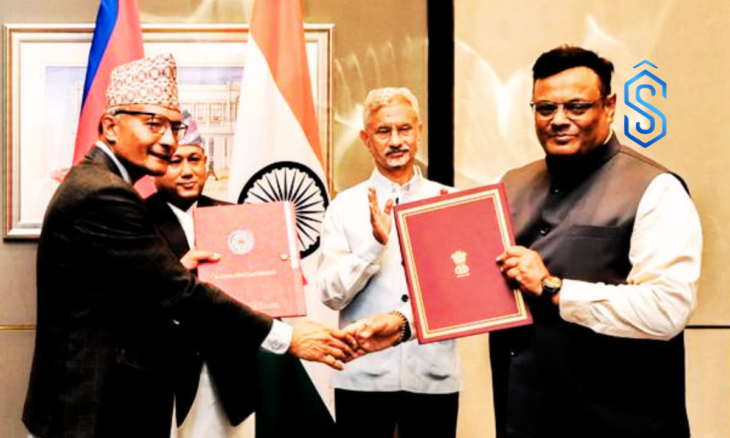
The MoU was signed by Amitabh Nag, CEO, Digital India BHASHINI Division, and Prof. Bal Krishna Bal, Associate Dean, Kathmandu University, establishing a collaborative framework aimed at advancing multilingual AI capabilities and creating a voice first language translation platform that can support citizens across linguistic and geographical boundaries.
The exchange of the MoU took place in the presence of Dr. S. Jaishankar, External Affairs Minister of India, and Shri Shishir Khanal, Minister of Foreign Affairs of Nepal, during bilateral engagements held in New Delhi.
The event highlighted the commitment of both nations to strengthening cooperation in emerging technologies, Digital Public Infrastructure, and inclusive digital transformation through initiatives such as a voice first language translation platform.
The partnership reflects the shared vision of India and Nepal to leverage technology for inclusive growth, social empowerment, and regional cooperation.
Beyond technological collaboration, the initiative seeks to strengthen people-to-people connections, preserve linguistic heritage, and ensure equitable access to opportunities by overcoming language, literacy, and digital barriers across the region.
The proposed voice first language translation platform is expected to play a key role in achieving these objectives.
Also Read: Banking BHASHINI to Power AI-Driven Multilingual Banking Across 22 Indian Languages
Under the terms of the MoU, the two institutions will collaborate on the development of high-quality Nepali language datasets, speech corpora, and multilingual AI resources.
These efforts will include speech-to-text, text-to-speech, machine translation, and multilingual conversational AI capabilities that will contribute to the creation of a robust voice first language translation platform for Nepal and the broader region.
The collaboration will also support the preservation and digitization of linguistic and literary heritage, particularly for low-resource and underrepresented languages across the India-Nepal region.
The initiative aims to ensure that communities whose languages face the risk of digital extinction gain access to AI-enabled tools and services in their native languages through a scalable voice first language translation platform.
Leveraging BHASHINI’s open and interoperable language technology ecosystem, the partnership will support the Government of Nepal in extending digital public services to citizens in their preferred languages.
By reducing language, literacy, and digital access barriers at the last mile, the voice first language translation platform is expected to improve accessibility and inclusivity in public service delivery.
The MoU also outlines plans for joint research, capacity building initiatives, training programmes, and pilot projects in Natural Language Processing (NLP), multilingual AI, and Digital Public Infrastructure.
These activities will bring together universities, researchers, language experts, and technology practitioners from both countries to advance the development and deployment of the voice first language translation platform.
The collaboration is further expected to generate new economic and social opportunities for Nepali citizens, students, entrepreneurs, and professionals by enabling multilingual access to education, skilling, digital commerce, and public services.
The voice first language translation platform is envisioned as a catalyst for broader participation in both regional and global digital economies.
Amitabh Nag, CEO, Digital India BHASHINI Division, said: “This partnership with Kathmandu University represents a significant step in India’s commitment to building inclusive language technology for the region.
BHASHINI’s open Digital Public Infrastructure model has the potential to transform digital access for millions of citizens across South Asia, and this collaboration will help us extend that vision beyond India’s borders, strengthening our shared linguistic and cultural heritage while building the next generation of multilingual AI for the Global South.”
Also Read: Sarvam Startup Program Launched to Support AI Builders with Credits, APIs, and Infrastructure
Prof. Bal Krishna Bal, Associate Dean, Kathmandu University, said: “This MoU reflects a shared commitment between Nepal and India to harness the power of artificial intelligence for linguistic inclusion and social impact.
Through collaboration between the DPI-AI Center at Kathmandu University and Bhashini, we seek to advance research, innovation, and capacity building in multilingual AI, ensuring that our rich linguistic heritage becomes a catalyst—not a barrier—for participation in the digital future.”
About Digital India BHASHINI Division (DIBD)
The Digital India BHASHINI Division (DIBD), operating under the Digital India Corporation (DIC) and the Ministry of Electronics and Information Technology (MeitY), serves as India’s national initiative for AI-driven multilingual digital inclusion and language technology.
Through the National Hub for Language Technology (NHLT), BHASHINI enables scalable speech and text-based AI services across Indian languages for governance, public platforms, and institutions.
The platform currently powers more than 800 government websites, processes over 15 million inferences daily, and supports 36 Indian text languages, 23 Indian voice languages, and 35 international languages.
DIBD also promotes open-source innovation, multilingual AI research, dataset creation, startup enablement, and academic collaboration, strengthening India’s Digital Public Infrastructure ecosystem while expanding the reach of multilingual solutions such as the voice first language translation platform.