
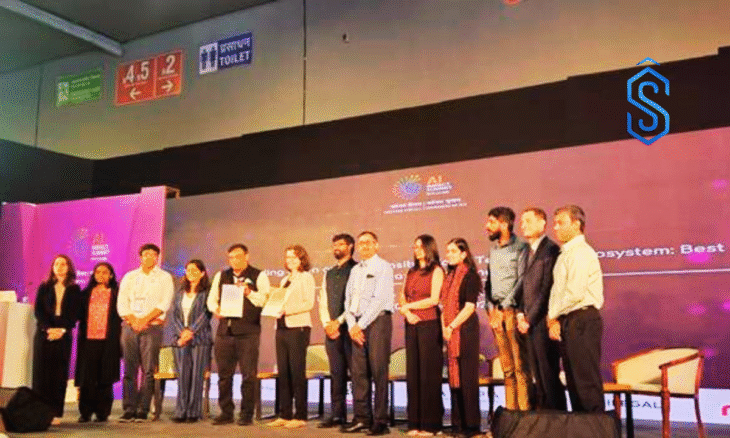
New Delhi: The launch of a new Policy Report and Developers’ Toolkit on Inclusive Voice Technologies in India at the India AI Summit Expo 2026 marks a significant step toward strengthening India’s voice-first digital ecosystem.
Unveiled on February 20, 2026, the initiative outlines a comprehensive policy and practice framework to support open, inclusive, and responsible voice technologies across the country.
As voice technologies increasingly become foundational to digital inclusion, Inclusive Voice Technologies in India are reshaping how millions access public services, information, and participate in the digital economy.
The newly launched Policy Report and Developers’ Toolkit aim to align policy frameworks, technical standards, and ecosystem collaboration to advance responsible speech technologies at scale.
The Policy Report and Developers’ Toolkit were jointly developed by ARTPARK @IISc, Digital Futures Lab and Trilegal, with support from Digital India BHASHINI Division and the FAIR Forward – AI for All initiative.
FAIR Forward is implemented by GIZ and funded by the German Federal Ministry for Economic Cooperation and Development (BMZ). The collaboration brings together research, technical expertise, and ecosystem partnerships to strengthen Inclusive Voice Technologies in India.
Also Read: India Introduces VoicERA Open Voice AI Stack on BHASHINI Infrastructure
Voice Technologies as Digital Public Infrastructure
In a linguistically diverse country like India, Inclusive Voice Technologies in India represent a critical layer of digital public infrastructure.
Speech-based applications reduce barriers to digital access, especially for citizens with limited literacy or digital familiarity. However, as voice technologies expand, they raise complex challenges related to data governance, representativeness, openness, quality assurance, and responsible deployment.
The Policy Report examines key barriers to building open and responsible speech systems—from data collection and model development to infrastructure design and governance practices.
Accelerating Inclusive Voice Technologies in India
The report proposes targeted policy recommendations, including:
- Treating foundational speech datasets as digital public goods
- Improving openness and representativeness of language models
- Investing in sustainable public digital infrastructure
- Embedding safeguards to prevent misuse while enabling innovation
By addressing ecosystem-level coordination and governance, the report aims to build stronger foundations for Inclusive Voice Technologies in India.
Developers’ Toolkit: Addressing Structural Gaps in Speech AI
Complementing the policy analysis, the Developers’ Toolkit focuses on practical implementation challenges faced by developers working with Indian-language voice datasets. It identifies structural gaps within India’s speech and language technology ecosystem, including:
- Uneven data representation across languages and dialects
- Weak quality assurance mechanisms
- Limited evaluation practices
- Fragmented governance structures
Recognising that exclusionary outcomes often emerge throughout the development lifecycle, the toolkit introduces a layered, lifecycle-oriented approach to building inclusive and robust speech AI systems.
It highlights practical approaches currently adopted across India’s voice-technology ecosystem – from product conceptualisation and dataset design to model training, deployment, and governance—further strengthening Inclusive Voice Technologies in India.
Also Read: Bartronics India to Launch Voice-First AI Agritech App for Rural Farmers
Speaking at the launch, Amitabh Nag, CEO, Digital India BHASHINI Division, said: “As India moves decisively toward a voice-first digital ecosystem, it is imperative that we build this transition on strong policy foundations and practical implementation frameworks. In a country of immense linguistic diversity, voice technologies are not merely an innovation, they are an instrument of digital inclusion.
The Policy Report and Developers’ Toolkit launched today provide a structured roadmap for building open, inclusive, and responsible speech technologies in India.
While the policy recommendations guide ecosystem alignment, the Developers’ Toolkit translates these principles into actionable practices across the AI lifecycle—from data collection and model development to deployment and governance.
As voice technologies mature, standards, evaluation frameworks, and technical toolkits will continue to evolve. This journey will also require systematic re-engineering of existing digital and IT infrastructures to make voice journey enabled, multilingual, and interoperable.
Through collaborative ecosystem efforts, we can ensure that voice becomes a foundational layer of India’s Digital Public Infrastructure, bridging language, literacy, and digital divides at scale”.
Dr Ariane Hildebrandt, Director-General of the department for global health, equality of opportunity, digital technologies and food security at the German Federal Ministry for Economic Cooperation and Development (BMZ), added:
“The Report is full of best practices and lessons learned – from and for policymakers and the tech community alike. For BMZ, it is also about advancing a shared vision for digital inclusion and bridging the digital divide.
For millions of people, voice is the most natural and powerful interface to the digital world, especially for those with limited literacy or access to digital infrastructure. When voice AI works in local languages and dialects, it becomes a gateway to public services, health care, education, and economic participation.”
These insights reinforce the urgency of scaling Inclusive Voice Technologies in India through structured policy frameworks and ecosystem-wide collaboration.
Strengthening BHASHINI’s Voice-First Multilingual Mission
Curated through a series of interactions with linguists, technical experts, and AI ethicists, the Policy Report and Developers’ Toolkit represent an important addition to the expanding work of the Digital India BHASHINI Division in advancing voice-first multilingual solutions.
By bridging communication gaps and breaking down linguistic and digital barriers, the initiative positions Inclusive Voice Technologies in India as a core pillar of India’s Digital Public Infrastructure strategy.
With a growing emphasis on openness, representativeness, and responsible governance, the framework sets the stage for scaling speech AI systems that are inclusive, interoperable, and aligned with India’s multilingual realities.