New Delhi: India’s push to develop indigenous artificial intelligence models has gained another entrant with the launch of Chariot-1 foundation models, a suite of language and speech AI technologies developed by Delhi-based Chariot Artificial Intelligence Pvt. Ltd. under the IndiaAI Mission.
The models, unveiled at Bharat Mandapam in New Delhi on November 26, include an 11-billion-parameter large language model (LLM) and a multilingual text-to-speech (TTS) system.
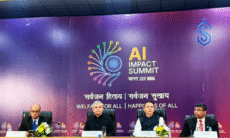
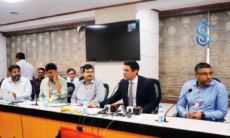
The launch was inaugurated by S. Krishnan, Secretary of the Ministry of Electronics and Information Technology (MeitY).
Chariot is among the first four teams selected under the government-backed initiative to develop sovereign foundation models.
A key feature of the Chariot-1 development is its focus on making AI models work across Indian languages and different computing environments.
Chariot-1 foundation models were pre-trained from scratch in India, with the company also introducing three research techniques designed to improve training efficiency and Indian-language processing.
Chariot-1 Foundation Models: Three Configurations
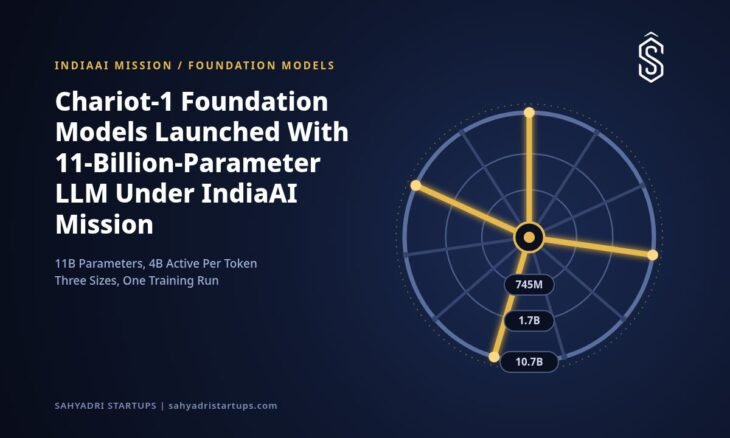
The Chariot-1 LLM is an 11-billion-parameter mixture-of-experts model, with 4 billion active parameters per token. It is available in three configurations containing 10.7 billion, 1.7 billion and 745 million parameters.
The multiple configurations are intended to accommodate different deployment requirements, from data-centre infrastructure to laptops, smartphones and edge devices.
This flexibility is supported by Nested Training, one of the research techniques developed by the Chariot team. It enables three complete model sizes to be trained simultaneously in a single training run using one set of weights. The method improves training speed by 62% compared with training the three configurations separately.
Multilingual Speech Model Supports 10 Indian Languages
The Chariot-1 TTS model supports speech generation in English and 10 Indian languages: Hindi, Bengali, Marathi, Tamil, Telugu, Kannada, Malayalam, Gujarati, Punjabi and Odia.
Unlike basic text-to-speech systems that convert written text into spoken output, Chariot’s model is designed to interpret how different elements should sound in context. This includes numbers, dates, currencies, measurement units, URLs and abbreviations.
The model recorded more than 97% verbalisation accuracy on the Async TTS Pronunciation Benchmark, which contains 1,029 real-world sentences and 2,251 instances of non-standard text across 42 categories.
It also achieved a Hindi character error rate (CER) of 7.60% and an average CER of 6.47% across nine other Indian languages. PIB described these as the lowest results among the systems evaluated in the reported tests, without identifying the competing systems.
Chariot says its first models, Chariot-1 TTS and Chariot-1-ASR Realtime, are already live in English, Hindi, Tamil, Bengali and other languages. Its longer-term ambition is to develop AI models that “reason in speech”.
Three Research Techniques Target Indian-Language AI Efficiency
Alongside the two Chariot-1 foundation models, Chariot presented three research innovations incorporated into their training. These address the challenges of representing Indian scripts, training multiple model sizes and reducing the computational effort involved in language processing.
IndicShift: Reducing Token Requirements for Indian Languages
IndicShift is an open-source approach that introduces a shared alphabet across Indian scripts, allowing AI models to use similarities between languages instead of processing each script independently.
The system covers 1,012 characters across 12 Indian scripts through 350 letters.
IndicShift requires up to 2.5 times fewer tokens for Indian-language text than OpenAI’s GPT tokeniser. It also reported a 5% to 8% improvement in model performance on Indian languages using the same computing resources, while maintaining English and code performance.
Nested Training: Multiple Model Sizes From One Training Run
Nested Training allows three complete model configurations to be developed simultaneously using a single set of weights. Besides reducing the need for separate training runs, the technique is intended to make deployment across different hardware environments more practical.
A 62% improvement in training speed was reported compared with training each configuration separately.
Mixture of Vocabularies: Lower Computational Requirements
The third technique, Mixture of Vocabularies, divides the model’s vocabulary into 11 groups and scores only the relevant group at a time.
This reduces the number of vocabulary entries scored per word by 5.7 times and improves training speed by 38% on the same GPUs, with negligible changes in model loss.
MeitY Secretary Highlights Contribution of Returning AI Researchers
Speaking at the launch, MeitY Secretary S. Krishnan congratulated the team on the development of “Chariot One”, describing it as a significant achievement for India’s technology ecosystem.
He highlighted the team’s approach to Indian-language representation and its contribution to developing advanced AI technology in the country. Krishnan also appreciated the decision of the two Stanford graduates behind the venture to return to India.
He said Chariot One demonstrates the potential of India’s young innovators and the country’s growing capability to develop cutting-edge technologies.
The event also included a fireside conversation between Vishal Dhupar, Managing Director, South Asia, NVIDIA, and Suvrat Bhooshan, Co-Founder of Chariot, on emerging AI research and developments in the technology landscape.
Chariot’s Work Extends to Commercial Voice Applications
Founded by Parth Sarthi and Suvrat Bhooshan, Chariot describes itself as a frontier AI research lab headquartered in Delhi.
Its work extends beyond foundation model development to commercial speech and voice applications. The company has worked on personalised voice advertisements for Zomato, dubbing the Prime Minister’s Mann Ki Baat for Doordarshan’s regional channels and voice applications for Hindustan Unilever’s Shikhar platform.
NVIDIA also featured Chariot’s real-time text-to-speech technology on its NeMo framework in February 2026.
Bhooshan previously worked as a Research Engineer at Facebook AI Research (FAIR), where he co-authored the Multimodal Bitransformers (MMBT) research paper.
Chariot Joins India’s Expanding Foundation Model Programme
The Chariot-1 foundation models launch adds another development to the IndiaAI Mission’s efforts to establish domestic capabilities across the AI technology stack.
Approved by the Union Cabinet on March 7, 2024, with a budget outlay of ₹10,371.92 crore, the mission covers several areas, including computing infrastructure of 10,000 or more GPUs, indigenous foundation model development, datasets, AI applications, FutureSkills, startup financing and safe and trusted AI.
The government invited proposals for foundation model development on January 30, 2025, receiving 506 applications by April 30 that year.
The first four selected teams were Sarvam AI, Soket AI, Gnani AI and Gan AI. The programme subsequently expanded to include additional startups and research organisations like Avaatar AI, BharatGen (IIT Bombay consortium), Zenteiq, Gen Loop, Intellihealth, Shodh AI, Fractal Analytics and Tech Mahindra Maker’s Lab.
Models from Sarvam AI, BharatGen, Gnani and Soket had been launched at the IndiaAI Impact Summit 2026.