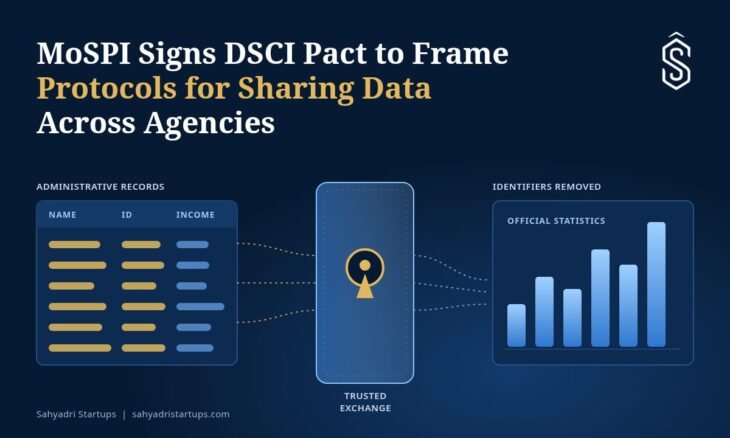
New Delhi: The Ministry of Statistics and Programme Implementation (MoSPI) has partnered with the Data Security Council of India (DSCI) to develop protocols for sharing data across government agencies, as India seeks to expand the use of administrative and alternative datasets for official statistics without compromising individual privacy.
The two organisations signed a memorandum of understanding (MoU) in New Delhi on 25 November 2026. The proposed framework will focus on trusted data exchange, data governance and safeguards for maintaining data quality and statistical confidentiality.
The immediate priority is a joint policy paper on trusted data flows and data management. The exercise will draw on international practices in data protection and cybersecurity.
The agreement comes as the government prepares for the phased implementation of the Digital Personal Data Protection (DPDP) Act, 2023, with key provisions scheduled to take effect in 2027.
Why MoSPI is focusing on data-sharing safeguards
Government statistical agencies increasingly depend on information generated outside conventional statistical systems. Administrative records and alternative datasets can help improve the availability and coverage of information used to prepare official statistics.
However, the reuse of such information also raises questions about how personal identifiers are handled when datasets move between institutions.
Some of the data sources used by statistical agencies contain personal identifiers. Data-producing agencies therefore need to review their data-management practices while ensuring that privacy and confidentiality are maintained.
The MoSPI–DSCI partnership is intended to address this gap by developing protocols for sharing data that can support institutional collaboration without exposing sensitive personal information or affecting the reliability of official statistics.
AI, Privacy Technologies Among Areas of Collaboration
The agreement extends beyond the proposed policy paper. MoSPI and DSCI will also collaborate on research into data governance and provide technical support for adopting privacy-enhancing technologies (PETs).
Responsible use of artificial intelligence (AI) is another identified area of cooperation.
The two organisations will also facilitate pilot projects involving industry, academic institutions, research organisations and international bodies. These initiatives are expected to help explore the application of emerging technologies within the national statistical ecosystem.
Privacy-enhancing technologies are designed to reduce the exposure of sensitive information while allowing data to be analysed or shared for legitimate purposes. The United Nations has separately established a PET Task Team and a PET Lab to support the use of such technologies by national statistical offices.
MoSPI’s wider push to improve access to government data
The agreement with DSCI follows a series of MoSPI partnerships aimed at strengthening the country’s statistical and research infrastructure.
At a brainstorming session on non-conventional data sources on 20 March 2025, MoSPI Secretary Dr Saurabh Garg had urged central ministries and departments to explore the reuse of datasets generated by other government agencies. He also called for a culture of data sharing while maintaining the sanctity of Personally Identifiable Information (PII).
The ministry subsequently entered into agreements with research institutions and government bodies in 2026.
These included two MoUs signed on 10 August with the Institute of Data Engineering, Analytics and Science Foundation (IDEAS) and the Indian Statistical Institute (ISI), Kolkata, for research studies.
On 29 September, MoSPI signed an agreement with the Ministry of Micro, Small and Medium Enterprises to facilitate the exchange of unit-wise Udyam Registration data through application programming interfaces (APIs). The initiative is intended to support the National Statistical Business Register.
Another MoU was signed with the Pahle India Foundation on 8 October for cooperation in official statistics, research and data analysis.
The DSCI agreement adds a data protection and governance dimension to these efforts, with a specific focus on establishing protocols for trusted data sharing.
Who is DSCI?
Established by Nasscom in 2008, the Data Security Council of India is a not-for-profit industry body and think tank working in cybersecurity, data protection, privacy and critical technologies.
The organisation undertakes policy advocacy, capacity building and outreach initiatives. Vinayak Godse is its Chief Executive Officer, while Dr Kamlesh Bajaj served as its founding CEO from 2008 to 2015.