
Washington: SpaceX has received regulatory approval to establish an orbital data centre network (SpaceX Starmind) comprising up to 1 million satellites, taking its plan to move large-scale artificial intelligence (AI) computing infrastructure into space a step closer to implementation.
However, the US Federal Communications Commission (FCC) has attached deployment, communication and satellite disposal conditions to the authorisation, leaving some parts of the company’s proposal unresolved.
The decision, issued by the FCC’s Space Bureau on November 25, 2026, authorises the proposed SpaceX Starmind constellation to use radio-frequency links for backup and emergency communications. The satellites are expected to rely primarily on optical, or laser-based, links to exchange data.
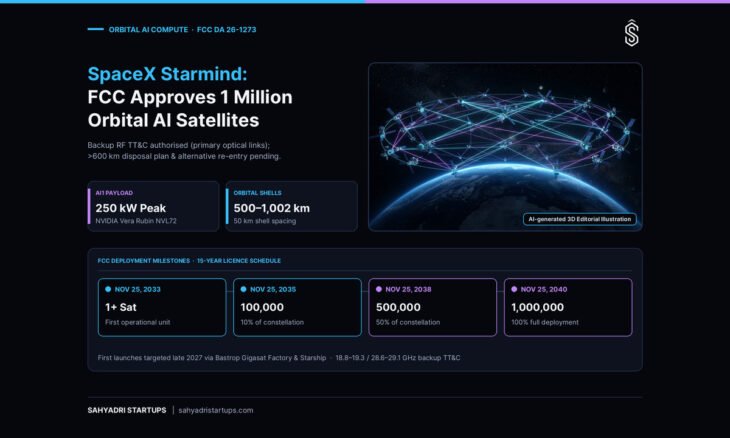
The regulator has deferred SpaceX’s request for an alternative debris disposal arrangement and will require additional approval before satellites operating above 600 km can be deployed. It has also established milestones requiring the company to complete deployment by November 25, 2040.
The FCC described the decision as the first US authorisation of its kind, opening a regulatory pathway for large-scale computing infrastructure in orbit.
FCC Approval Covers Backup Communications, Not Unrestricted Operations
The authorisation, issued under order DA 26-1273, permits SpaceX to establish a constellation of up to 1 million non-geostationary orbit (NGSO) satellites operating as data centres. However, its immediate scope is specifically limited to radio-frequency communications for backup and emergency telemetry, tracking and command (TT&C).
SpaceX plans to use optical inter-satellite links as its primary communication system. The FCC order notes that radio connections would serve as an alternative when optical links become unavailable.
For this purpose, the regulator has approved the 18.8-19.3 GHz downlink and 28.6-29.1 GHz uplink frequency bands. The permissions have been granted on an “unprotected and non-interference basis”, meaning SpaceX cannot claim protection against interference from other operators and must ensure its transmissions do not disrupt existing services.
The company must also coordinate with federal agencies responsible for national security and safety-of-life services before using the 18.8-19.3 GHz band.
FCC Chairman Brendan Carr said: “America is leading the world into the era of super intelligence. Under President Trump’s leadership, the United States is moving decisively to ensure that this breakthrough technology creates opportunity, drives investment, and delivers lasting benefits for the American people.”
Carr added: “Compute campuses or data centers are essential to sustaining America’s leadership in SI. By moving compute capacity beyond Earth, SpaceX and the many competitors working on their own orbital data centers are meeting the moment.”
The authorised satellites will operate at altitudes between 500 km and 1,002 km, across orbital shells spaced 50 km apart. This is narrower than SpaceX’s original application, which had sought permission to operate at altitudes of up to 2,000 km.
Satellite Disposal Remains a Regulatory Hurdle
Orbital debris management is one of the principal conditions that SpaceX must address before expanding the Starmind network.
The FCC has accepted the company’s debris mitigation plan for satellites operating below 600 km. However, satellites planned for higher altitudes will require a separate application containing a final disposal plan before deployment.
More importantly, the regulator has deferred SpaceX’s request to depart from the existing requirement for atmospheric re-entry disposal of satellites completing their missions below 2,000 km.
SpaceX had proposed moving decommissioned satellites into disposal or heliocentric orbits instead. The FCC said the company had not provided sufficient information to establish whether the alternative would meet its requirements.
In its application, SpaceX committed to designing satellites that would completely disintegrate during atmospheric re-entry and directing their re-entry paths over the ocean.
The deferred request means the company will need to provide further technical justification before the regulator can determine whether its proposed alternative disposal approach is acceptable.
FCC Sets SpaceX Starmind Deployment Milestones Through 2040
The approval comes with a phased deployment schedule under which SpaceX must progressively establish the authorised constellation.
The 15-year licence period will begin once the company certifies that its first satellite is in orbit and operating in accordance with the FCC’s conditions.
The deployment milestones are:
- November 25, 2033: At least one operational satellite in orbit.
- November 25, 2035: Deployment of 10% of the authorised constellation, or 100,000 satellites.
- November 25, 2038: Deployment of 50%, equivalent to 500,000 satellites.
- November 25, 2040: Completion of the remaining deployment.
SpaceX must submit reports twice a year, by January 1 and July 1, detailing the number and orbital positions of deployed satellites, conjunction events, satellites removed from service or re-entered into the atmosphere, and the use of authorised radio frequencies.
Missing the prescribed deployment milestones will render the authorisation null and void. SpaceX also has 30 days from the order’s release to reject the approval under the conditions imposed by the FCC. Failure to respond within that period will constitute acceptance.
Amazon Leo and Viasat Challenge SpaceX’s Application
The proposed constellation faced opposition from satellite operators and the astronomical community during the FCC’s review.
Kuiper Systems LLC, associated with Amazon Leo, Viasat Inc. and the American Astronomical Society filed petitions seeking denial of the application. Their objections covered potential radio interference, orbital congestion, environmental effects and the impact of the satellites on astronomical observations.
The FCC rejected the principal interference arguments, finding insufficient technical evidence to establish that the constellation would create the alleged problems. It also considered it unlikely that an outage affecting optical communications would force all 1 million satellites to switch to radio-frequency links simultaneously.
On orbital congestion, the regulator said existing rules do not restrict the number of authorised satellites operating in similar orbital configurations. It declined to introduce a new restriction through the proceedings.
The FCC also declined to impose additional conditions relating to optical astronomy, citing SpaceX’s commitment to coordinate with the National Science Foundation. Concerns about satellite waste heat were considered outside the scope of the radio-frequency authorisation.
Environmental objections were similarly set aside. The regulator said space-based operations do not trigger a US environmental review requirement under its October 2026 rules order. It also noted that rocket-launch emissions fall under the Federal Aviation Administration’s jurisdiction.
SpaceX Plans First Starmind Satellite Deployments From Late 2027
SpaceX’s application for the Starmind constellation was filed on January 30, 2026, and accepted for review by the FCC on February 4. The company subsequently outlined its broader ambitions for orbital computing infrastructure as part of its February 2 announcement concerning the acquisition of xAI.
Elon Musk said at the time that “within 2 to 3 years, the lowest cost way to generate AI compute will be in space”.
The company has proposed using solar-powered satellites equipped with high-capacity computing systems. According to SpaceX’s project website, its planned AI1 satellite will have a computing payload with peak capacity of up to 250 kW and average capacity of 175 kW.
The satellites are expected to connect through laser links to Starlink. SpaceX is also developing plans for its Gigasat Factory in Bastrop, Texas, which it says will support the production of thousands of AI satellites, with deployment potentially beginning in late 2027.
The company has identified Starship’s launch capacity as a critical requirement for establishing the network.
NVIDIA announced on August 24, 2026, that the first-generation Starmind satellite is planned to use an optimised NVIDIA Vera Rubin NVL72 system. The announcement was made in connection with SpaceXAI’s adoption of NVIDIA’s Vera CPU.
These specifications and timelines are based on company announcements. The proposed computing capacity, manufacturing scale and commercial economics of the orbital network have yet to be demonstrated in operational deployments.