Pune: Automotive manufacturers are increasingly dealing with a problem that extends beyond building vehicles: managing the growing volume of software, testing and compliance work required to keep software-defined vehicles (SDVs) operational.
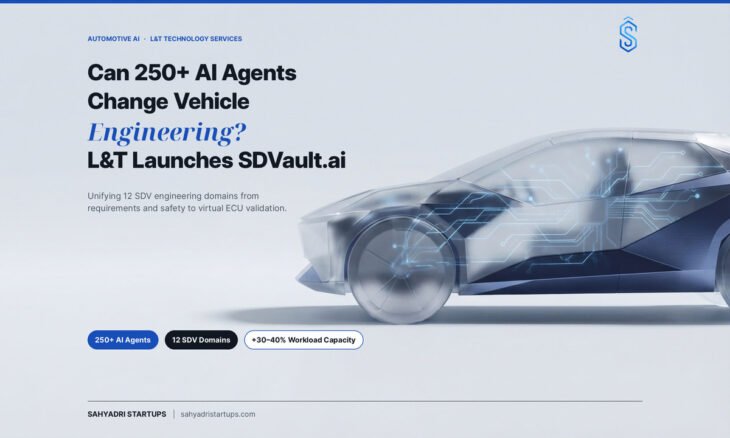
L&T Technology Services (LTTS) is targeting this challenge with SDVault.ai, a new AI-powered engineering platform that the company says could help engineering teams handle 30–40% additional workload without proportionately expanding their workforce.
Announced on November 23, 2026, through a regulatory filing, SDVault.ai combines more than 250 domain-specific AI agents with rule-based engineering automation.
The platform is designed for automotive original equipment manufacturers (OEMs) and Tier-1 suppliers, bringing together 12 engineering domains covering the software-defined vehicle development and validation lifecycle.
The launch reflects LTTS’ growing focus on applying artificial intelligence to complex engineering processes, particularly where software development intersects with functional safety, cybersecurity and regulatory compliance.
One of the challenges in SDV development is that engineering activities are often distributed across multiple systems. Requirements, vehicle architecture, software code, testing, failure analysis and release documentation may be managed through separate workflows.
A change in one area can affect several others, requiring engineers to identify the impact and establish whether the necessary checks have been completed.
SDVault.ai attempts to address this disconnect by linking these engineering activities through a common traceability framework. It connects requirements and system architecture with software code, test results, identified failures, corrective actions and release evidence.
This allows engineering teams to track the consequences of changes across the development lifecycle rather than treating individual engineering tasks as isolated activities.
The 12 domains covered by the platform include requirements management, electrical and electronic architecture, functional safety, cybersecurity, process assurance, software and code intelligence, verification, embedded debugging, virtual ECU validation, trace and network analysis, root-cause intelligence, and regression and release assurance.
LTTS Reports Faster Engineering Workflows in Early SDVault.ai Pilots
The productivity improvements reported from early deployments provide an indication of the use cases LTTS is targeting with SDVault.ai.
According to the company, engineering teams participating in early pilots demonstrated the potential to absorb 30–40% additional workload. In one workflow example, ticket triage time was reduced from approximately four hours to 10 minutes.
However, LTTS has not identified the pilot customers or disclosed the number of deployments supporting these results. The figures are company-reported outcomes and should not be treated as independently verified performance benchmarks.
Rather than positioning AI as a replacement for engineering expertise, LTTS is combining AI-driven assistance with deterministic, rule-based automation.
The distinction is important in automotive development, where engineering decisions can have implications for vehicle safety and cybersecurity.
The company says engineers will retain control over engineering decisions, verification and certification.
SDVault.ai can also be deployed as a complete toolchain or through individual modules alongside existing OEM and Tier-1 engineering systems.
Customers can retain sensitive engineering information within their own controlled environments, addressing concerns around intellectual property and enterprise data security.
15 Patents Filed as LTTS Builds Its Automotive AI Portfolio
LTTS has filed 15 patents related to SDVault.ai, although these are patent applications and not necessarily granted patents.
The platform is part of the company’s EI for Engineering suite and is built on EIOne, its Engineering Intelligence platform.
LTTS positions SDVault.ai as an evidence layer for software-defined vehicle development, with capabilities aligned to key automotive engineering standards.
These include ISO 26262 for functional safety, ISO/SAE 21434 for automotive cybersecurity, with UN R155 and R156 requirements in view, and continuous Automotive SPICE conformance.
The underlying challenge is particularly relevant as vehicle manufacturers move towards more frequent software updates and continuous development cycles.
Engineering assessments and compliance documentation can become outdated when vehicle architecture or software changes, creating additional work for teams responsible for validating each release.
By connecting engineering changes with testing and supporting evidence, LTTS is seeking to reduce the gaps between development, verification and compliance.
SDVault.ai Fits Into LTTS’ Larger Engineering Intelligence Strategy
The launch is also part of a broader repositioning at LTTS, which has identified Engineering Intelligence as a major technology investment area under its five-year Lakshya roadmap.
In March 2026, the company announced its decision to sharpen its focus on Engineering Intelligence and divested its erstwhile Smart World and Communication business to AMI Paradigm Solutions.
The move was intended to enable capital allocation towards its identified technology priorities.
LTTS subsequently launched AgenticIQ in August 2026, an agentic AI platform covering engineering, manufacturing and customer experience. The company described it as the foundation for its next-generation Engineering Intelligence solutions.
Its automotive engineering capabilities have also been built through earlier technology partnerships. In October 2023, LTTS announced the use of AWS generative AI services to help global automotive manufacturers accelerate SDV development.
In February 2024, it partnered with BlackBerry to leverage the latter’s QNX automotive software portfolio for software-defined vehicle programmes.
The relationship between AgenticIQ and EIOne, which LTTS identifies as the underlying platform for SDVault.ai, has not been clearly detailed in the company’s public announcements.
Amit Chadha, CEO and Managing Director of L&T Technology Services, said: “Software-defined vehicles are dramatically increasing the complexity of automotive engineering. AI can help, but in safety-critical engineering, AI alone is not enough. It requires deterministic engineering, domain knowledge, traceability and engineers firmly in control.”
“SDVault.ai brings these together as Engineering Intelligence across the SDV V-cycle, connecting requirements, architecture, software, verification and evidence. It gives OEMs and Tier-1 suppliers a practical path to engineer more software, validate it with greater confidence and take more vehicle programs to production with the teams they already have,” Chadha added.
Automotive Engineering Remains Important to LTTS’ Mobility Business
For the second quarter of FY27, ended September 30, 2026, the Mobility segment reported revenue of ₹981.9 crore, accounting for 32.3% of LTTS’ total revenue. The segment grew 13.5% year-on-year and 2.3% sequentially.
Automotive contributes approximately 50% of Mobility revenues, according to Chadha’s comments during the company’s earnings call.
LTTS reported consolidated revenue of ₹3,040.4 crore for the quarter, up 12.1% year-on-year and 3.4% sequentially.