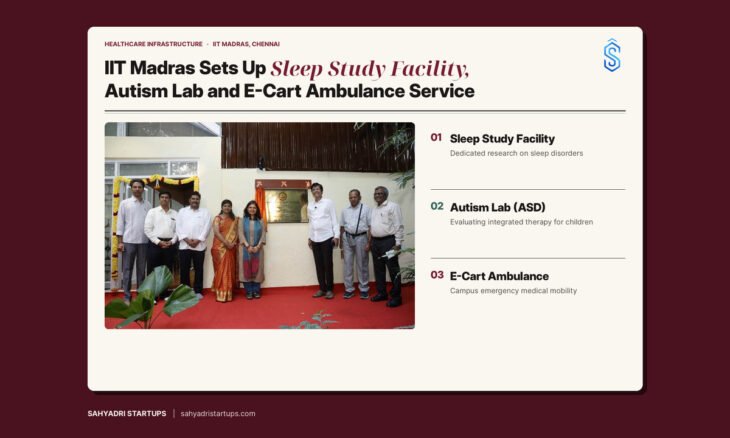
Chennai: IIT Madras has expanded its healthcare research infrastructure with a new sleep study facility and an Autism Lab, introducing dedicated facilities to investigate sleep disorders and evaluate an integrated therapy for children with Autism Spectrum Disorder (ASD).
The initiatives were inaugurated by Union Health Secretary Punya Salila Srivastava during her visit to the institute, where an E-cart Ambulance service was also launched at the campus hospital.
The sleep study facility, established at the Campus Health Centre, will provide specialised assessment, consultation and treatment for sleep-related disorders affecting students, faculty, staff and researchers.
Clinical support will come from specialists associated with Chennai-based Kauvery Hospitals.
Beyond clinical services, the facility is expected to support research into sleep patterns and different sleep disorders, subject to institutional ethics approval and informed consent.
IIT Madras also plans to develop indigenous, cost-effective sensors that can monitor and analyse sleep, potentially supporting more accessible sleep assessment technologies.
The Autism Lab, meanwhile, will focus on the scientific evaluation of Integrated Varmam Therapy, drawing on traditional Indian medical knowledge, clinical expertise and technology.
The initiative is part of the institute’s efforts towards establishing the Centre for Indian Medical Knowledge (CIMK).
IIT Madras plans to work with the Paediatric Neurology team at AIIMS Jodhpur, which has experience administering the integrated therapy to more than 800 children.
The proposed collaboration will examine the treatment protocol, while researchers will investigate possible genetic, molecular and epigenetic mechanisms associated with the therapy.
Another component involves developing indigenous pressure-sensing gloves to provide practitioners with real-time feedback during treatment. The proposed research and evaluation will be subject to the requisite ethical approvals.
IIT Madras Expands Brain and Cancer Research
Srivastava’s visit also covered the Sudha Gopalakrishnan Brain Centre, which is developing high-resolution, three-dimensional digital maps of the human brain at cellular resolution.
Dedicated to the nation by Prime Minister Narendra Modi on October 11, 2026, the centre is pursuing a mission to map more than 100 human brains across different stages of life, including those affected by neurological diseases.
The Prime Minister also released C-STROKE, described as the world’s first human ischaemic stroke atlas, containing more than 1,000 annotated brain sections.
At the Department of Medical Sciences and Technology, the Health Secretary reviewed research combining medical sciences, engineering and technology to address unmet healthcare needs.
Established in 2023, the department works on developing physician-scientists and engineering physiologists, with research covering cardiovascular medicine, neurology, oncology, medical imaging, artificial intelligence in healthcare and medical devices.
The visit also included the National Cancer Tissue Biobank, a joint initiative of the Department of Science and Technology and IIT Madras.
The facility collects and preserves cancer tissue samples with patients’ informed consent to support research into cancer biology, diagnosis and treatment.
Its wider research ecosystem includes the Bharat Cancer Genome Atlas, launched in February 2025 to build an India-specific cancer genomic database. The initiative aims to support early diagnosis, targeted therapies and personalised cancer treatment.
Indigenous Medical Technology and Assistive Devices
At the Healthcare Technology Innovation Centre (HTIC), Srivastava reviewed technologies being developed to improve access to affordable healthcare.
These include the Mobile Eye Surgical Unit for cataract procedures in remote locations, 3nethra for early detection of eye diseases, the Neonatal Transport Unit, iQuant for rapid diagnostic testing and ArtSens for cardiovascular health assessment.
The National Centre for Assistive Health Technologies (NCAHT) showcased mobility and accessibility solutions for persons with disabilities and elderly people.
Its portfolio includes lightweight wheelchairs, power-assisted mobility devices, swimming pool lifts and walking aids for children with cerebral palsy. YD One, an ultra-lightweight active wheelchair, is among its key developments.
Separately, the newly introduced E-cart Ambulance service at the IIT Madras Institute Hospital is intended to improve access to medical assistance across the campus. It will provide transportation support, particularly for elderly residents and patients who have difficulty moving independently.
Srivastava was accompanied by IIT Madras Director Prof. V. Kamakoti and Dean (Planning) Prof. R. Sarathi during the visit.