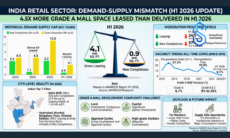

New Delhi: India’s organised retail market is preparing for a substantial expansion, with nearly 43.7 million sq. ft. of new retail space expected across the country’s top seven cities by 2030, according to JLL estimates.
The development pipeline comes as retail leasing reached 9.36 million sq. ft. between January and September 2026, growing 5.6% year-on-year and recording its strongest performance for the first nine months of a year in four years.
However, the scale of upcoming supply is only one part of the story. The changing distribution of retail demand, growing preference for mixed-use destinations and infrastructure constraints are emerging as important considerations for developers planning the next generation of retail projects.
Delhi-NCR led retail leasing during the January-September period, accounting for 26% of the total, followed by Mumbai and Bengaluru.
Fashion and apparel remained the largest demand segment, contributing 31% of leasing, while food and beverage accounted for 18% and entertainment for 15%.
The preference for different retail formats was also evident in leasing activity. High streets accounted for 46.3% of the space leased, marginally ahead of shopping malls at 45.9%.
The figures indicate that retail demand is not concentrated in conventional shopping centres, with retailers continuing to consider high-street locations alongside organised developments.
Organised Retail Market: Demand Moves Beyond Conventional Shopping Formats
The composition of leasing demand is influencing how developers approach the planning of retail projects. Dining, entertainment and leisure facilities are increasingly being incorporated into shopping destinations to encourage longer visits and repeat footfall.
Harinder Singh Hora, Founder Chairman, Reach Group, said, “With fashion and apparel accounting for 31% of retail leasing between January and September 2026, followed by food and beverage at 18% and entertainment at 15%, the demand profile clearly indicates that consumers are looking beyond conventional shopping formats.
This is also influencing how retail developments are being conceptualised, with greater emphasis on creating spaces that encourage discovery, interaction and longer visits.
“Architectural planning plays a critical role here. Double-height atriums, open-to-sky spaces, wider circulation corridors, well-positioned anchor stores and clearly defined dining and entertainment zones can significantly influence how visitors navigate a development and engage with its offerings.
Equally important is ensuring that the tenant mix is planned around the consumption patterns of the catchment, rather than simply filling available space. Developers must look at how retail, food, entertainment and leisure complement one another to create a cohesive destination.
The real measure of a successful retail development will be its ability to generate consistent footfall, encourage repeat visits and remain relevant as consumer preferences evolve.”
For retailers, the decision to occupy space increasingly involves evaluating the overall potential of a destination rather than considering rental space and location in isolation.
Deepak Kapoor, Director, Gulshan Group, said, “Retailers today are quite conscious of where they set up shop, the catchment they cater to and what else a retail destination has to offer. Beyond shopping, food, entertainment and leisure have become important in shaping the overall visitor experience.
A well-curated mix of offerings, supported by thoughtful planning, can make a destination more appealing and give people reasons to visit beyond a single purchase.
For us, the focus is on creating spaces that people enjoy coming back to, while also ensuring that the environment works well for the brands and businesses operating within it.”
This is also bringing mixed-use developments into greater focus, with developers integrating retail spaces into residential, commercial and lifestyle projects.
Such developments can draw consumers from their immediate surroundings while positioning retail as part of everyday urban activity.
Abhishek Trehan, Executive Director, Trehan IRIS, said, “India’s new retail supply will be judged less by its scale and more by its relevance. Space is being added faster than well-planned destinations, so the real test is whether developments are designed around their catchment.
That means seamless access, the right mix of shopping, dining, entertainment and leisure and the flexibility to adapt as consumer habits change. This is the approach we follow across our mixed-use developments where the aim is to create destinations that become part of everyday urban life.”
Organised Retail Market: Urban Infrastructure Emerges as a Key Constraint
The projected supply also puts the spotlight on whether cities can accommodate the additional retail activity. Road connectivity, parking, utilities and public accessibility will influence the performance of new developments, particularly as retail construction moves beyond established metropolitan markets.
Umang Jindal, CEO, Homeland Group, said, “India’s retail infrastructure is entering a phase of significant expansion, but the real question is whether the country’s urban infrastructure can keep pace with it. Adding retail space alone will not be enough.
The next phase of growth will require better connectivity, planned urban development, adequate parking, reliable utilities and supporting infrastructure that can sustain increasing consumer footfall.
As retail expands beyond established metros into emerging cities, the focus must be on creating developments that are supported by genuine consumption demand and can integrate with the city’s long-term growth.
The opportunity is clearly there, but the sector’s readiness will depend on how well infrastructure, urban planning and retail development progress together. This will be critical in determining the long-term sustainability of India’s retail growth.”
Beyond the major metropolitan centres, emerging urban markets are attracting developer interest as organised consumption and purchasing power spread to new locations. However, the availability of land and the potential to add retail space do not necessarily translate into sustainable demand.
Dr. Amish Bhutani, Managing Director, Group 108, said, “The addition of 43.7 million sq. ft. of retail supply by 2030 points to the scale of opportunity emerging in India’s retail sector. The focus now needs to be on how well our infrastructure can support this growth.
Beyond the availability of retail space, factors such as connectivity, efficient layouts, thoughtful spatial design and well-planned amenities will play an important role in shaping the next generation of retail destinations.
As consumer preferences evolve, the integration of shopping, dining, leisure and social experiences will become increasingly relevant. The opportunity lies in creating developments that respond to these changing needs while contributing to the growth of India’s urban market.”