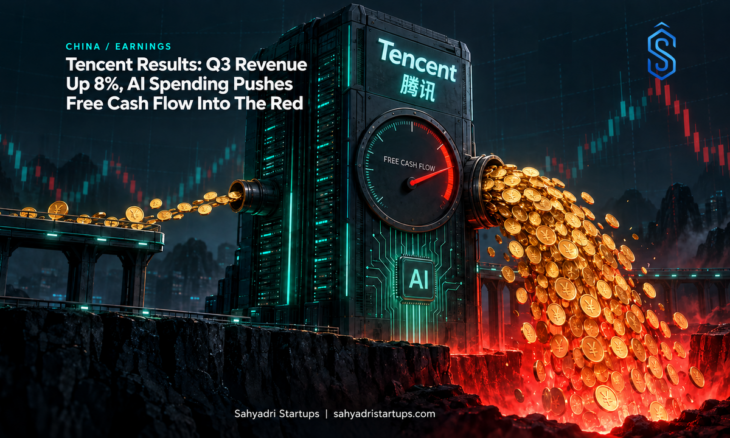
Hong Kong: Tencent results for the third quarter of 2026 show revenue rising 8% year on year to RMB207.3 billion, even as a sharp rise in spending on artificial intelligence infrastructure pushed the company’s free cash flow into negative territory.
The Chinese internet and technology company, which owns Weixin and QQ, announced its unaudited consolidated results for the quarter ended 30 September 2026 on Wednesday.
Gross profit rose 7% year on year to RMB115.9 billion, while operating profit on an IFRS basis fell 7% to RMB59.1 billion, with operating margin declining to 29% from 33% a year earlier.
Ma Huateng, Chairman and CEO of Tencent, said, “Our recent significant achievements across models and applications have accelerated Tencent’s evolution for the new AI era.
Hy4 has achieved China state-of the-art AI model status, and Hy4 flash brings down inferences cost to deliver cost performance for real-world use cases. We believe WorkBuddy has grown to become the largest AI application in China, measured by total daily large language model token consumption by users.
Our cloud services revenue growth rate increased, driven by WorkBuddy and as we allocated more compute to Model as a Service and GPU rental.
Our core businesses remained resilient and vibrant as several evergreen games reached lifetime highs in DAU, and as Video Accounts increased engagement rapidly, particularly among young users, by enriching its content offering.”
Tencent Results: Capex Payments Jump 225%, Free Cash Flow At Negative RMB69.1 Billion
The highlight of the Tencent results was the scale of its artificial intelligence infrastructure push. Capital expenditure payments jumped 225% year on year to RMB65.1 billion in the quarter.
Tencent recorded negative free cash flow of RMB69.1 billion, as net cash generated from operating activities of RMB2.6 billion was more than offset by capital expenditure payments, media content payments of RMB4.6 billion and lease liability payments of RMB2.0 billion.
The company said its operating cash flow included significant prepayments for compute procurement to support enhancements to its Hy model family, WorkBuddy inference needs, and development of AI capabilities across its products and services, as well as to meet external demand for its cloud services.
Excluding the prepayments for compute procurement, Tencent said its free cash flow would have been positive RMB16.9 billion.
On a non-IFRS basis, which excludes certain one-time and non-cash items, operating profit was RMB68.1 billion, down 6% year on year, and net profit attributable to equity holders was RMB66.5 billion, also down 6%.
Excluding new AI products (primarily Hy, Yuanbao, CodeBuddy, WorkBuddy and Xiaowei), non-IFRS operating profit rose 8% to RMB83.3 billion, with operating margin stable at 40%. On an IFRS basis, net profit attributable to equity holders of the company rose 0.8% to RMB63.6 billion.
Segment Performance In Tencent Results For Q3 2026
Revenues from Value Added Services increased 3% year on year to RMB98.3 billion. Domestic Games revenues were RMB47.6 billion, up 11%, driven by growth in revenues from games including Delta Force, VALORANT MOBILE and Honour of Kings.
International Games revenues were RMB18.9 billion, down 9% (or down 4% on a constant currency basis), reflecting a high base period arising from social media excitement around certain Supercell games and from copy sales of Dying Light: The Beast released in the year-ago period. Social Networks revenues decreased 1% to RMB31.8 billion.
Marketing Services revenues rose 19% year on year to RMB43.0 billion. Tencent said it enhanced its AI-driven advertising and content recommendation capabilities and introduced an AI-powered advertising solution for content publishers that automates ad insertion and optimises placement timing and duration.
Within the Weixin ecosystem, major industry categories, notably consumer goods and local services, increased marketing spending on its platforms during the quarter.
FinTech and Business Services revenues rose 9% year on year to RMB63.7 billion.
FinTech Services revenue growth arose from higher revenues from consumer loan and wealth management services, while Business Services revenue growth was primarily driven by a 35% year-on-year increase in cloud services revenues, underpinned by increased demand for AI-related services and continued international expansion.Key Tencent results figures (RMB billion) 3Q2026 YoY change Revenues 207.3 +8% Gross profit 115.9 +7% Operating profit (IFRS) 59.1 -7% Operating profit (non-IFRS) 68.1 -6% Net profit attributable to equity holders (IFRS) 63.6 +0.8% Capital expenditure payments 65.1 +225% Free cash flow -69.1 Negative (positive 16.9 excluding compute prepayments)
The Tencent results also showed combined MAU of Weixin and WeChat reaching 1,449 million, up 2% year on year, while mobile device MAU of QQ was 533 million, up 3%. Fee-based VAS subscriptions averaged 253 million per day, down 5%.
In its business review, Tencent said it released the Hy4 model in November, which ranked first among Chinese models at launch by Agent Arena.
WorkBuddy became the most used AI product in China, measured by large language model token consumption, with over 10 million DAU collectively consuming over 100 trillion tokens per day.
Video Accounts’ total time spent grew over 20% year on year, while Delta Force and VALORANT MOBILE each achieved lifetime-high DAUs. Tencent also launched TenPayGo, a payment app that enables foreigners traveling in China to make purchases using overseas cards and digital wallets.
The Tencent results showed that during the quarter, the company repurchased approximately 15.9 million shares on the Hong Kong Stock Exchange for an aggregate consideration of approximately HKD7.0 billion.
Total cash stood at RMB525.7 billion, up 7% year on year, with a net debt position of RMB13.7 billion.
Tencent was founded in Shenzhen, China, in 1998 and has been listed on the Stock Exchange of Hong Kong since 2004.