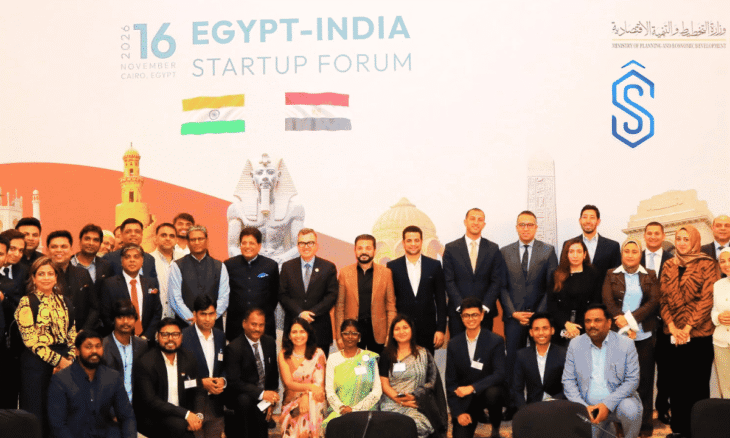
Cairo: The India-Egypt Startups Forum has put cross-border market access, government procurement and technology partnerships at the centre of efforts to strengthen startup collaboration between the two countries, with Commerce and Industry Minister Piyush Goyal calling for Indian and Egyptian companies to explore opportunities in each other’s markets.
Goyal proposed closer cooperation in fintech, agriculture, healthcare and emerging technologies, urging officials to examine how startups could enter the other country’s market, demonstrate products and participate in government procurement.
The discussions come as India and Egypt explore the possibility of a preferential trade agreement (PTA) or free trade agreement (FTA), which could provide a broader framework for improving bilateral business opportunities.
The India-Egypt Startups Forum was attended by Goyal and Egypt’s Minister of Planning and Economic Development Ahmed Rostom, along with Indian Ambassador Suresh K. Reddy. Representatives of 55 Indian and Egyptian companies also participated in the discussions.
Beyond identifying sectors for cooperation, the forum highlighted practical issues facing startups seeking international expansion, including market entry, investment, access to talent, mentorship and the ability to navigate government procedures.
Market Access and Government Procurement Emerge as Key Priorities
A major focus of the India-Egypt Startups Forum was the need to make it easier for startups to operate beyond their domestic markets.
Goyal said “We will discuss the entry of startups in each other’s territories,” pointing to opportunities in government procurement and platforms where companies could showcase their ideas.
Access to public procurement could offer startups an opportunity to demonstrate their products and build institutional relationships.
The discussions also touched on incubators, mentorship and investment support, indicating that cross-border startup collaboration would require more than trade concessions.
Companies would also need to understand local regulations, identify commercial partners and establish routes to customers in unfamiliar markets. The proposed trade agreement could provide a broader context for these efforts.
India-Egypt Fintech Collaboration Could Focus on UPI, InstaPay and Remittances
Cross-border payments emerged as one of the most prominent areas of potential cooperation at the India-Egypt Startups Forum.
Piyush Goyal highlighted India’s Unified Payments Interface (UPI) and Egypt’s InstaPay as examples of digital payment infrastructure that could provide a foundation for collaboration between fintech companies in both countries.
He called on fintech startups to co-create and co-build cross-border payment systems that could facilitate trade and make digital transactions more accessible.
Remittances were another area discussed during the roundtable. Technology-led solutions could help people working abroad transfer money to their families more quickly and at lower costs.
Goyal encouraged Indian and Egyptian fintech companies to work together on solutions addressing these requirements.
Agriculture, Water Management and Healthcare Offer Opportunities for Startups
In agriculture and water management, Goyal identified precision irrigation, desalination and cold-chain infrastructure as potential areas for collaboration.
These technologies could support agricultural productivity, improve water utilisation and strengthen supply-chain infrastructure.
Healthcare was another priority, with discussions covering affordable diagnostics, medical devices, digital health services and telemedicine.
Piyush Goyal proposed that Indian and Egyptian startups explore solutions that could serve not only their respective domestic markets but also wider markets across Africa and Asia.
Participants also discussed the role of local pharmacies in an interconnected healthcare system, highlighting opportunities for technology-enabled healthcare delivery.
Heritage Tourism, AI and Green Hydrogen Among Emerging Technology Opportunities
Beyond traditional startup sectors, Goyal identified heritage tourism and emerging technologies as additional areas where Indian and Egyptian entrepreneurs could collaborate.
He suggested that startups use augmented reality (AR), virtual reality (VR) and smart travel platforms to develop tourism experiences around iconic destinations, including Egypt’s pyramids and India’s Taj Mahal.
The India-Egypt Startups Forum also discussed opportunities in artificial intelligence (AI), quantum computing and green hydrogen.
Goyal emphasised the importance of developing technology solutions in regional languages, including Arabic, Hindi, Tamil and Marathi, to improve accessibility across the Global South.
Other areas identified for potential cooperation included solar energy, sustainable construction materials, industrial inspection and agricultural services.
Egypt Looks to India’s Startup Ecosystem for Its ‘5 in 5’ Ambition
The India-Egypt Startups Forum also provided an opportunity for Egypt to examine India’s experience in developing a large startup ecosystem.
The discussions were linked to Egypt’s ambition of developing five billion-dollar companies within five years, an initiative described as the “5 in 5” target.
Goyal highlighted the scale and geographical spread of India’s startup ecosystem, saying nearly 250,000 startups were registered with the Commerce and Industry Ministry across approximately 770 districts.
He said more than half of these startups came from non-metro areas, while 48% had at least one woman director, founder or co-founder.