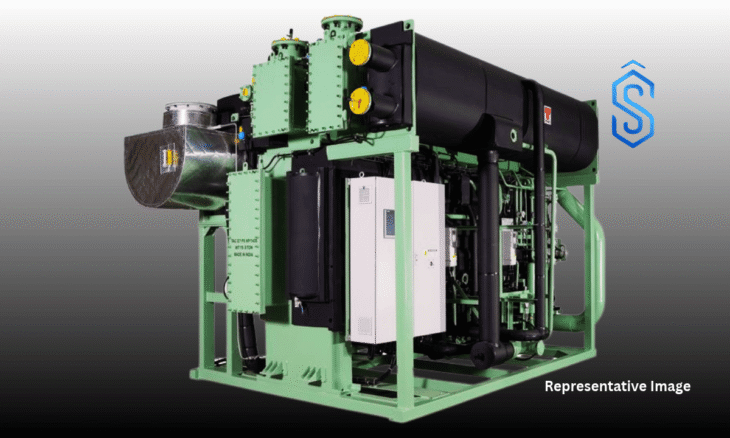
Pune: Thermax is finding opportunities in India’s data centre cooling market, but its experience in the US highlights a different challenge for Indian engineering companies: winning large orders does not necessarily mean projects will move according to schedule.
Delays in environmental clearances, local authority approvals and customer-side readiness have pushed shipments and expected order closures into subsequent quarters, forcing the company to recalibrate its timelines.
The Pune-based engineering and energy solutions company has already secured two data centre cooling orders in India across Q2 and Q3 FY27.
Speaking during the company’s earnings call on 6 November 2026, Managing Director and CEO Ashish Bhandari said Thermax had secured one data centre cooling order in India during Q2 FY27 (July-September 2026) and closed another in Q3 FY27 (October-December 2026).
A typical Indian data centre cooling order is valued between ₹40 crore and ₹100 crore, although the company did not disclose the value of the two orders.
“In Q2, we got an order in India. Q3 also we got, we have already closed one more order, and we see continued activity on the India front,” Bhandari said.
Why Environmental Clearances Are Delaying Thermax’s US Data Centre Projects
The company’s first US data centre project, valued at slightly more than $20 million, was initially expected to see shipments during Q2 FY27.
However, shipments have now moved into Q3 FY27, with a portion expected to spill over into Q4 FY27 (January-March 2027).
The delay is not attributed to a lack of demand for Thermax’s solutions. Instead, Bhandari pointed towards local environmental clearances and approvals from authorities as the primary reasons behind the shifting timelines.
According to him, almost every US data centre project the company is involved in has experienced a delay of at least one to three months.
“What I have been disappointed with is on the timing of these things. In every project, we see stuff moving to the right, completely driven by US-specific issues,” he said.
For an engineering company supplying specialised cooling and boiler systems, such delays can affect more than the project completion date. They can also push back equipment dispatches, shipment schedules and the timing of revenue recognition.
Securing an Order Is Not the Same as Getting the Project Moving
Another important operational challenge emerging from Thermax’s US experience is the uncertainty around converting its project pipeline into confirmed orders.
Earlier, the company had expected to close two US data centre orders within FY27. However, the delays in project timelines have made that target more difficult.
Bhandari now considers closing one order within the financial year ending March 2027 more likely, although additional closures remain possible.
“Close one within the year seems more likely. Could be more,” he said.
He described himself as “slightly more pessimistic on the timing perspective, more optimistic on the size of the overall opportunity”.
Thermax Is Getting Into Design Specifications for Major Data Centre Companies
Despite the delays, Thermax is continuing to pursue opportunities with some of the largest players in the data centre industry.
Bhandari said prospective cooling and boiler orders in the US could each be worth hundreds of crores. The company is also getting into design specifications for “some of the biggest names in the industry”.
Getting specified during the design stage is significant for engineering solution providers because their equipment and systems become part of the technical planning for upcoming projects.
Can Thermax Convert Its Order Backlog Into Revenue?
The execution of existing projects will also be important for Thermax as it moves into the second half of FY27.
The company reported an order balance of ₹14,250 crore as of 30 September 2026, up 16% year-on-year. Its management expects revenue of more than ₹7,000 crore during H2 FY27 (October 2026-March 2027), supported by execution of the existing order backlog.
The company’s Q2 FY27 consolidated operating revenue stood at ₹2,756 crore, up 11% year-on-year. However, profit after tax declined 5% to ₹113 crore.
Profitability was affected by product mix and higher input costs in the Industrial Products segment, along with a ₹15 crore impairment provision in one of its hybrid renewable energy projects.
For Thermax, the immediate challenge is not just expanding its order pipeline but ensuring that projects move from technical specifications and customer approvals to equipment shipments and execution.