
Pune: The green jobs sector is expected to create more than four million jobs by 2030, spanning renewable energy, environment, forestry, climate change, waste management, ESG, the circular economy and greenhouse gas emissions accounting and reporting, according to Arpit Sharma, CEO, Skill Council for Green Jobs.
Sharma said the scope of green jobs extends well beyond renewable energy sectors such as solar, wind, biomass, green hydrogen and small hydropower.
“I would like to mention that green jobs are not limited to renewable energy. They are not just about solar, wind, biomass, green hydrogen or small hydropower. A huge number of jobs will be created in the environment, forestry and climate change sectors,” he added.
“For example, a parataxonomist is one of the green jobs. A parataxonomist is someone who maintains records of species that are at risk of extinction or are becoming extinct. Another kind of green job could be that of a water hyacinth specialist. You must have seen green vegetation growing on the surface of water. This vegetation can be extracted and used to make tables and chairs. It represents a significant economy in states such as Assam,” Sharma said.
Green jobs also include waste management, ESG, the circular economy, and greenhouse gas emissions accounting and reporting. All these areas fall under the green jobs sector. More than four million jobs would be created across the green jobs sector by 2030. These opportunities also support entrepreneurship in this domain,” stated Sharma.
According to Sharma, the expanding green jobs ecosystem is also creating opportunities for entrepreneurship, particularly across emerging areas linked to environmental sustainability and climate action.
Solar Sector Creating Opportunities for Entrepreneurs
The solar energy sector is emerging as an important source of green jobs, with opportunities spread across both utility-scale projects and rooftop solar installations.
Sharma said the rooftop solar segment requires smaller businesses to install smaller systems under the PM Surya Ghar scheme, creating opportunities for entrepreneurs and MSMEs.
“If we talk about solar energy, it has both a utility-scale market and a rooftop segment. The rooftop segment requires smaller businesses to install smaller systems under the PM Surya Ghar scheme. This is creating and supporting many entrepreneurs, including MSMEs. These entrepreneurs may not be capable of undertaking utility-scale projects independently because utility-scale projects are now measured in gigawatts rather than megawatts.
Large companies operate in utility-scale projects, including open-access and captive or closed-access segments. Meanwhile, the rooftop solar segment is supporting and creating many entrepreneurs. I would not be in a position to share the numbers right now. I would have to refer to the study, but the information is available in the public domain.
If we talk about the number of jobs that would be created in the solar sector alone between 2026 and 2030, I would say that the number of jobs in green hydrogen would be around 600,000, while the number of jobs created in the solar sector alone would be around 2.4 million.”
The solar sector is therefore expected to account for a significant share of green jobs between 2026 and 2030, with around 2.4 million jobs projected to be created in solar alone. Green hydrogen is expected to generate around 600,000 jobs during the same period, according to Sharma.
The rooftop solar segment is also supporting the participation of smaller businesses and MSMEs, while utility-scale projects are increasingly being undertaken at gigawatt scale by larger companies. These include open-access and captive or closed-access projects.
Also Read: Bengaluru-Based wudhomes Raises ₹2.5 Crore in Pre-Seed Funding Led by AJVC
SEPA’s Sustainable Bharat 2026 Workshop Opens in Pune
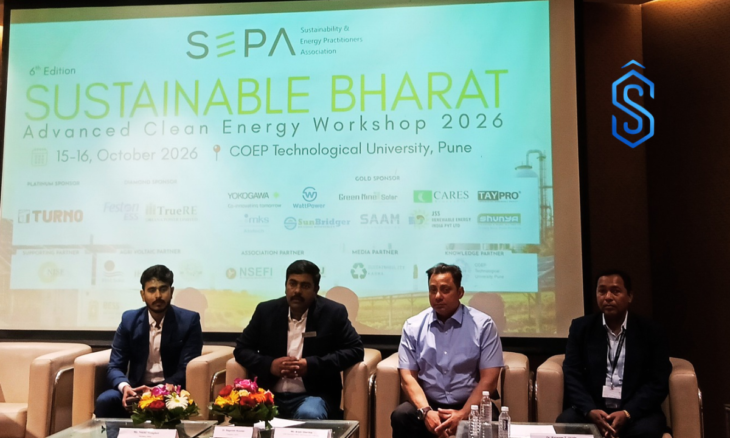
The discussion on Green Jobs and clean energy opportunities comes as the Sustainability and Energy Practitioners Association (SEPA) inaugurated the sixth edition of Sustainable Bharat 2026 – Advanced Clean Energy Workshop at COEP Technological University, Pune.
The two-day workshop, being held on October 15 and 16, brings together industry experts, academicians, researchers and energy practitioners to discuss technological advancements and solutions for India’s clean energy transition.
The workshop places particular emphasis on Battery Energy Storage Systems (BESS), including utility-scale and Commercial and Industrial (C&I) applications. Technical sessions and expert panel discussions are covering battery storage technologies, renewable energy integration, grid flexibility, project viability, safety, policy and emerging business opportunities.
The inaugural session featured Dr. Raguram Arjunan, President, SEPA; Krishnan Komandur, Mentor, Adar Poonawalla Clean City Initiative; Arpit Sharma, CEO, Skill Council for Green Jobs; Prof. Sunil Gangadhar Bhirud, Vice-Chancellor, COEP Technological University; and Nikhil Manglori, Secretary, SEPA.
“Battery Energy Storage Systems are essential for improving renewable energy integration and building a reliable power sector. Sustainable Bharat 2026 provides a platform for industry dialogue on emerging technologies, commercial opportunities and research priorities. The SEPA Students Council will further promote innovation, industry-academia collaboration and the development of future clean energy professionals,” said Dr. Raguram Arjunan, President, SEPA.
SEPA Launches Students Council in Pune
As part of the Sustainable Bharat 2026 workshop, SEPA also announced the launch of its Students Council in Pune. The initiative aims to encourage student participation in research, training and industry engagement while building technical skills and nurturing talent for the clean energy sector.
The Students Council is expected to support the development of future professionals in areas connected with clean energy and Green Jobs, while strengthening engagement between students and the industry.
Through the SEPA Consortium, the association also promotes collaborative research and technology development between industry and academic institutions. These initiatives are supported by research funding from national agencies.
The focus on Battery Energy Storage Systems, renewable energy integration and emerging clean-energy business opportunities at Sustainable Bharat 2026 adds to the broader ecosystem around green jobs, entrepreneurship and skills development in India’s clean energy transition.