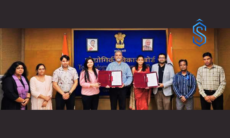

New Delhi: The Common Research and Technology Development Hub (CRTDH) on Affordable Healthcare at IIT Kharagpur has entered its sustainable phase, marking a new stage in technology development, commercialisation and last-mile healthcare delivery.
The sustainable phase of the CRTDH was inaugurated by Dr. (Mrs.) N. Kalaiselvi, Secretary, Department of Scientific and Industrial Research (DSIR) and Director General, Council of Scientific and Industrial Research (CSIR), at the Ben Gupta Auditorium, IIT Kharagpur.
Established in 2019 under the CRTDH Scheme of the Department of Scientific and Industrial Research, Ministry of Science and Technology, Government of India, the CRTDH on Affordable Healthcare has completed its initial grant-supported phase and transitioned into a self-sustaining model.
The CRTDH is now operating as a self-sustaining national facility for affordable healthcare technology development and translation.
Its operational costs are being met through user fees, industry sponsorships and translational partnerships, while the facility continues to provide infrastructure and technical support to innovators.
The facility will continue to offer state-of-the-art infrastructure, technical expertise and technology development support to MSMEs, startups, innovators and other stakeholders.
The transition of the CRTDH to a self-sustaining model marks a significant milestone in strengthening industry-academia collaboration, technology translation and innovation-led healthcare solutions.
The programme was organised as part of the Platinum Jubilee celebrations of IIT Kharagpur.
DSIR, CSIR Highlight Role of in Indigenous Medical Technology
Chief guest Dr. (Mrs.) N. Kalaiselvi, Secretary, DSIR and DG, CSIR, emphasised the role of DSIR and the network of CRTDHs in enabling MSMEs, startups and individual innovators to strengthen indigenous capabilities in medical technology.
She said that the continued functioning of a CRTDH beyond the period of DSIR support demonstrates the intended outcome of the programme, namely, to serve industry and innovators in a self-sustaining mode.
Dr. (Mrs.) Kalaiselvi also emphasised that wider utilisation of these facilities would contribute to strengthening India’s indigenous technological capabilities, advancing self-reliance in medical device technologies and supporting the vision of the Prime Minister of India for Viksit Bharat 2047.
On the occasion, Dr. (Mrs.) Kalaiselvi visited the CRTDH wet and dry laboratories and the THRIVE Centre along with Prof. Suman Chakraborty, Director, IIT Kharagpur and Principal Investigator, CRTDH, and DSIR officials.
Dr. (Mrs.) N. Kalaiselvi also planted a sapling on the IIT Kharagpur campus, symbolising the beginning of the sustainable phase of the DSIR-CRTDH at IIT Kharagpur.
The activity also reaffirmed the commitment towards the continued growth, sustainability and long-term contribution of the facility to innovation and technology development.
Also Read: Kerala Launches Keralam GCC Boilerplate to Attract 150 GCCs by 2031
CRTDH Facilitates Technology Transfers and Commercialisation
Presenting the journey of the Hub from 2019 to 2026, Prof. Suman Chakraborty highlighted the importance of frugal innovation in addressing constraints faced in real-world healthcare delivery.
He stated that designing technologies for settings without sophisticated infrastructure and for use by frontline health workers requires engineering solutions that are both robust and accessible.
Operating from a 5,000-square-foot facility, the CRTDH has facilitated more than 20 technology transfers, with many of these technologies already commercialised.
The Hub has also partnered with clinical and non-governmental organisations to establish rural health units supporting the deployment of affordable healthcare technologies.
The CRTDH has thus continued to connect technology development with healthcare delivery by supporting the translation of laboratory innovations into products and solutions that can be deployed in settings with limited infrastructure.
MSMEs and Startups Share Commercialisation Experiences
During the MSME Voices session, enterprises mentored by the Common Research and Technology Development Hub shared their experiences of translating laboratory prototypes into commercial products.
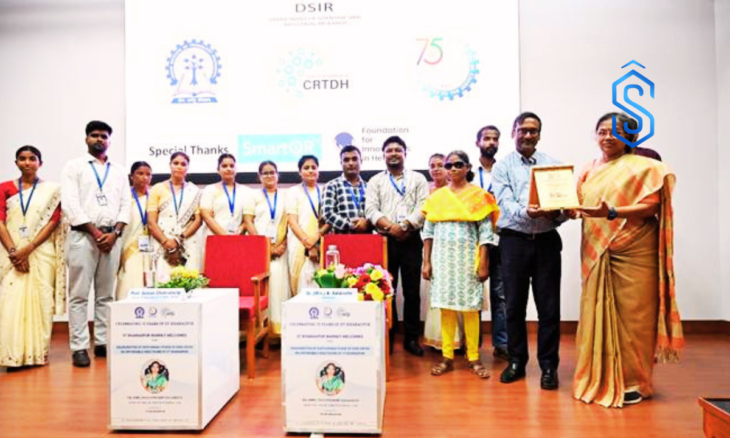
The participating enterprises were felicitated by the Chief Guest and the Director, IIT Kharagpur.
The session highlighted the journey of technologies from laboratory development towards commercialisation, with the CRTDH supporting enterprises and innovators through infrastructure, technical expertise and technology development assistance.
Supporting Rural Health Workers in Last-Mile Healthcare
Fifteen frontline health workers from remote villages, including the Sundarbans and Birbhum, shared their experiences of deploying affordable diagnostic technologies at the community level.
The health workers were trained and certified under the CRTDH’s skilling programmes, in line with the objectives of Skill India. They are now operating rural health units alongside health delivery structures under the National Health Mission.
Through these rural health units, the trained health workers support screening, referral and follow-up services for communities where access to diagnostic facilities remains limited or intermittent.
The work of the CRTDH demonstrates the role of local skilling alongside affordable technology in extending healthcare delivery to underserved communities.
DSIR Officials Acknowledged
Dr. Vipin Shukla, Scientist ‘G’ and Head of the CRTDH Scheme of DSIR, whose guidance has been instrumental in the development of the CRTDH initiative, was also acknowledged during the event.
Dr. Ranjeet Bairwa, Scientist ‘F’ and Member Secretary – CRTDH, DSIR, and Dr. Kailash Petkar, Scientist ‘D’, DSIR, who closely monitored the implementation of the project, were also present and participated in the proceedings.
The continued association of the DSIR-CRTDH team with the project was duly acknowledged, followed by a screening of the film on Common Research and Technology Development Hub.
The proceedings highlighted the convergence of frugal technology, local skilling and public health delivery as an important pathway for achieving the objectives of Viksit Bharat to the last mile.
The initiative demonstrates how self-reliance in medical devices, employment opportunities for rural youth and equitable access to healthcare can be addressed through an integrated innovation and delivery ecosystem.
At the conclusion of the programme, DSIR officials were felicitated by the Director, IIT Kharagpur. The proceedings were coordinated by Mr. Sohom Banerjee, Project Manager, CRTDH, IIT Kharagpur.
Approximately 200 participants attended the programme, including senior DSIR officers, delegates from chambers of commerce and MSME associations, officials of government MSME development institutions, MSMEs, startups, innovators, clinical partners, rural health workers, faculty members, researchers and students of the Institute.
Technologies developed at the Common Research and Technology Development Hub and products commercialised by partner enterprises were also exhibited during the event, providing participants an opportunity to interact with the innovators.