
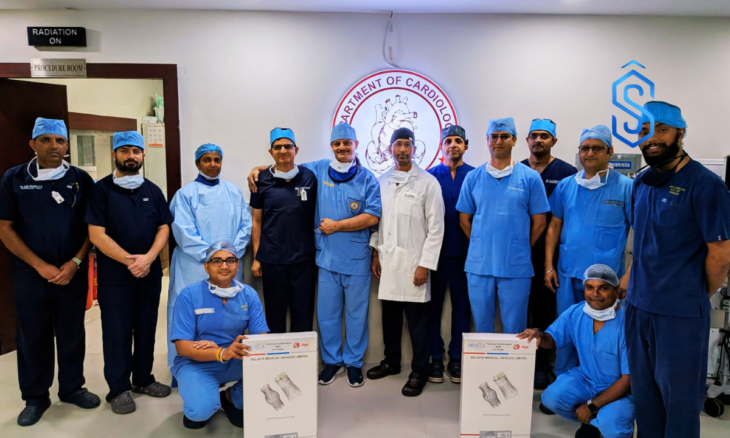
Pune: Specialists at the Army Institute of Cardio-Thoracic Sciences (AICTS), Pune, have successfully performed a rare and highly complex minimally invasive heart procedure on a patient with a history of heart valve replacement surgery and severe leakage of the right-sided heart valve.
The achievement marks a significant milestone in advanced cardiac care within the Armed Forces Medical Services.
The AICTS team carried out the procedure without resorting to repeat open-heart surgery by simultaneously implanting two prosthetic valves in the superior and inferior vena cava – the two major veins that carry blood into the right side of the heart.
The intervention was performed to treat severe tricuspid regurgitation using a minimally invasive catheter-based approach.
The procedure, known as bicaval transcatheter valve implantation (CAVI), is regarded as one of the most complex catheter-based interventions in structural heart disease.
Such procedures are currently performed only at a limited number of highly specialised cardiac centres across the world.
According to AICTS, the patient had previously undergone heart valve replacement surgery but later developed severe tricuspid valve leakage.
This condition causes blood to flow backward into the body’s venous circulation, leading to serious complications if left untreated.
Patients suffering from severe tricuspid regurgitation commonly experience swelling of the legs and abdomen, liver congestion, fatigue and breathlessness.
In such cases, undergoing a second open-heart surgery carries a significantly higher risk of complications, making minimally invasive alternatives increasingly important.
Also Read: Apollo Hospitals Partners with The ePlane Company to Launch Electric Air Ambulances in India
The AICTS medical team adopted a catheter-based approach by implanting two prosthetic valves simultaneously in the veins leading to the right atrium.
These newly implanted valves prevent the backward flow of blood, thereby improving circulation while avoiding the trauma associated with conventional open-heart surgery. The patient recovered successfully following the procedure.
Cardiologists describe bicaval transcatheter valve implantation as an emerging treatment option for patients with severe tricuspid regurgitation who are considered unsuitable for repeat surgery due to age, previous cardiac operations or multiple medical conditions.
Unlike transcatheter aortic valve replacement (TAVR), which has become a widely established procedure, bicaval valve implantation remains an evolving intervention with relatively limited global experience.
The successful procedure performed by AICTS reflects the growing adoption of advanced structural heart interventions in India, particularly within specialised tertiary care institutions.
It also highlights the increasing expertise available in catheter-based management of complex heart valve diseases that previously had limited treatment options.
This achievement further strengthens AICTS’ expanding portfolio of advanced cardiac procedures and reinforces its position as one of India’s leading centres for complex cardiothoracic care.
For patients considered too high-risk for repeat open-heart surgery, such minimally invasive interventions could provide a safer and potentially life-changing treatment alternative while showcasing India’s growing capabilities in the rapidly evolving field of structural heart medicine.