
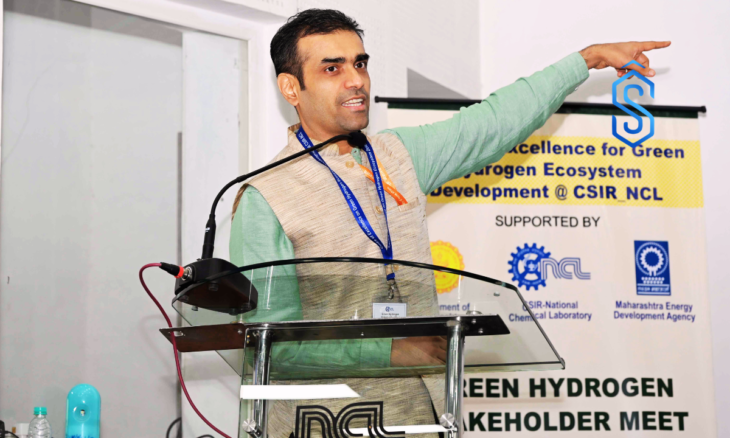
Pune: CSIR-National Chemical Laboratory (CSIR-NCL), Pune, through its Centre of Excellence (CoE) in green hydrogen ecosystem development, successfully organized a Stakeholder Meet on Green Hydrogen Ecosystem Development at the CSIR-NCL campus.
Supported by the Maharashtra Energy Development Agency (MEDA) and the Government of Maharashtra, the event brought together policymakers, industry leaders, researchers, technology developers, academia, and hydrogen ecosystem stakeholders from across the country.
Welcoming the participants, Dr. Ashish Lele, Director, CSIR-NCL, Pune, said that the true cost of conventional energy extends beyond market prices, as society ultimately bears the economic burden of climate change, environmental degradation, and energy insecurity.
He emphasized that green hydrogen ecosystem initiatives should be evaluated in this broader context and highlighted their potential to play a key role in India’s transition towards a sustainable and self-reliant energy future.
Dr. Lele underlined the importance of continuous dialogue among researchers, technology developers, policymakers, and industry to address the challenges of scaling up the green hydrogen ecosystem.
He noted that stakeholder platforms such as this meeting foster candid discussions, encourage innovation and collaboration, and help develop practical solutions and policies that can make green hydrogen technologically viable, economically competitive, and widely adoptable across the country.
The inaugural session was graced by Dr. Prashant Dhakephalkar, Director, Agharkar Research Institute (ARI), who delivered the Guest of Honour address.
He emphasized that green hydrogen is not only a clean fuel for the future but also an essential feedstock for the chemical industry amid emerging global carbon regulations.
Stressing the importance of energy self-reliance and indigenous technology development, he highlighted the need to reduce dependence on imports while accounting for the broader environmental and economic costs of conventional fuels.
Dr. Dhakephalkar also underscored the significant potential of biohydrogen, produced from agricultural residues and industrial organic waste through microbial processes, as a sustainable and cost-effective complement to conventional green hydrogen.
He called for greater research, innovation, and collaboration among academia, industry, and policymakers to develop scalable, indigenous hydrogen technologies that can strengthen India’s green hydrogen ecosystem while creating environmental and economic benefits.
The keynote address was delivered by Dr. Prasad Chaphekar, Director, Ministry of New and Renewable Energy (MNRE), who emphasized that the economics of green hydrogen must be assessed in the context of long-term energy security, geopolitical risks, and market volatility rather than only its upfront cost.
Citing global trends, he noted that while project announcements have moderated, investments in the hydrogen sector continue to grow, reflecting sustained global confidence in the hydrogen economy.
Dr. Chaphekar highlighted India’s strong position in the global hydrogen landscape and urged industry to move beyond isolated technology development towards integrated, end-to-end solutions through strategic partnerships across the value chain.
Stressing that collaboration is more valuable than working in silos, he called upon industry, academia, and policymakers to build interconnected green hydrogen ecosystem networks, actively engage in policy consultations, and work together to accelerate the commercialization and deployment of indigenous green hydrogen technologies under India’s National Green Hydrogen Mission.
The first technical session focused on Green Hydrogen Policy, Financing and Priority Sectors. It featured an invited talk by Amol Bansode, General Manager (Projects), MEDA, on incentives, subsidies, and Maharashtra’s Green Hydrogen roadmap.
Also Read: Revamped CSIR NCL Skill Development Center to Advance Industry-Relevant Scientific Skills
A panel discussion explored opportunities to deploy green hydrogen in transportation, ammonia production, and the steel sector, with participation from leading industry representatives including KPIT, Hygenco, ARAI, H2E Power, and Tata Steel.
The afternoon session, titled “Advancing Hydrogen Technologies: Valleys, R&D, and Emerging Applications,” showcased experiences from all four hydrogen valley initiatives across India, with presentations from representatives of Pune, Kochi, Odisha, and Jodhpur Hydrogen Valley.
Another panel discussion examined emerging applications of green hydrogen in the chemical industry, data centres, and the dairy sector, highlighting the need for technology innovation and industry collaboration to strengthen the green hydrogen ecosystem.
A key highlight of the event was the showcase of a prototype 9-metre green hydrogen-powered bus equipped with three hydrogen cylinders with a combined hydrogen storage capacity of 21 kg, offering an estimated driving range of approximately 350 km on a single refuelling.
The event concluded with an interactive discussion on skill development requirements for expanding Maharashtra’s green hydrogen ecosystem, where participants stressed the importance of creating a skilled workforce, strengthening academia-industry partnerships, and promoting entrepreneurship in clean energy technologies.