
Pune: Astronomers have uncovered crucial clues about the origin of mysterious cosmic explosions known as Fast X-ray Transients (FXTs), tracing the mechanism behind a rare non-repeating X-ray flash detected on November 7, 2024.
The findings offer fresh insights into some of the most energetic and short-lived phenomena in the universe.
The study focused on an X-ray flash designated EP241107a, which researchers linked to either the collapse of a massive star or the merger of two neutron stars.
Understanding the origins of such Fast X-ray Transients could help scientists gain deeper insights into the physics governing these extreme cosmic events.
Fast X-ray Transients are energetic, non-repeating bursts of X-rays associated with violent processes in the universe.
Identified as a relatively new class of transient astronomical sources about a decade ago, these enigmatic events appear as sudden flashes of low-energy X-rays that last from a few minutes to several hours before rapidly fading from view.
Because of their brief duration, Fast X-ray Transients have remained difficult to study, leaving their origins largely uncertain. Over time, astronomers have proposed multiple explanations for these mysterious events.
Suggested progenitors include supernova shock breakouts from core-collapse supernovae, rapidly rotating neutron stars with extremely strong magnetic fields formed after binary neutron star mergers, and tidal disruption events involving white dwarfs and intermediate-mass black holes.
Many Fast X-ray Transients have been associated with high-redshift long-duration gamma-ray bursts (lGRBs), while others show no gamma-ray counterpart.
Such observations have led researchers to consider low-luminosity gamma-ray bursts or “orphan” afterglows as possible explanations.
Also Read: LIGO India Observatory: DAE Awards Project to L&T Heavy Civil and Engineering Arms
A new study led by Deepak Eappachen and Arvind Balasubramanian, both postdoctoral fellows at the Indian Institute of Astrophysics (IIA), an autonomous institution under the Department of Science and Technology (DST), examined the FXT event EP241107a.
The event was detected on November 7, 2024, by the Einstein Probe mission, a Chinese space observatory dedicated to monitoring the dynamic high-energy universe and detecting short-lived cosmic phenomena.
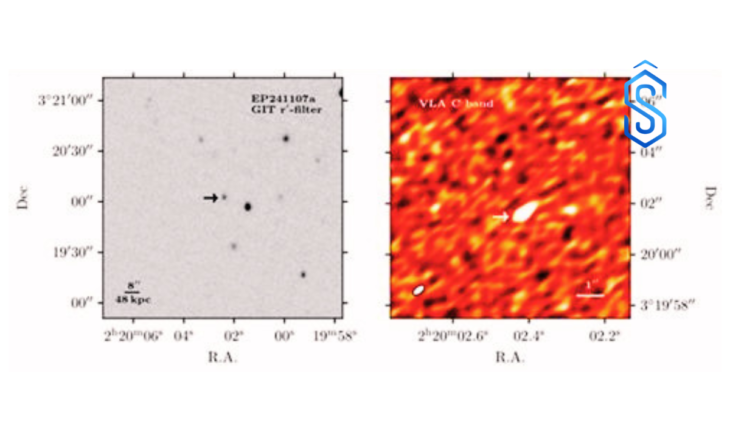
Using a multi-wavelength observational approach, the researchers identified a radio counterpart to the X-ray flash with the Karl G. Jansky Very Large Array in New Mexico, USA. The detection provided an important opportunity to investigate the nature of this rare event.
To strengthen their analysis of Fast X-ray Transients, the team combined observations from several leading astronomical facilities in India and abroad.
At the Indian Astronomical Observatory in Hanle, Ladakh, the Himalayan Chandra Telescope (HCT) and the GROWTH India Telescope (GIT) monitored the event in visible light under exceptionally clear observing conditions.
The HCT is operated by the Indian Institute of Astrophysics, while the GIT is jointly operated by IIA and IIT Bombay.
Researchers also conducted follow-up observations using the Upgraded Giant Metrewave Radio Telescope, operated by the National Centre for Radio Astrophysics.
Additional observations were obtained through the 10-metre Keck Observatory in Hawaii and the Southern Astrophysical Research Telescope, a 4.1-metre optical and near-infrared facility located in Chile.
By comparing the optical and radio signatures of EP241107a with those of other extragalactic transient events and studying the characteristics of its host galaxy, the researchers concluded that the explosion was likely associated with a gamma-ray-burst-like event. Their analysis suggests that the source was either the collapse of a massive star or the merger of two neutron stars.
Detailed modelling of the afterglow revealed that the burst generated a powerful jet with kinetic energy comparable to the total energy emitted by all stars in the Milky Way over several months, assuming the energy was radiated equally in all directions.
The researchers concluded that EP241107a most likely originated from a gamma-ray burst.
The event represents one of the rarest transient phenomena studied in detail—an explosion that was not directly detected in gamma rays but nevertheless exhibited strong evidence of a gamma-ray burst origin. Such events are often described as “orphan afterglows.”
According to the researchers, EP241107a may represent a gamma-ray burst occupying the lower-energy end of the known gamma-ray burst population, providing valuable insights into the diversity of these explosive cosmic events and their connection to Fast X-ray Transients.
The findings have been published in the Monthly Notices of the Royal Astronomical Society.
The study was authored by Deepak Eappachen, Arvind Balasubramanian, G. C. Anupama, D. K. Sahu and Sudhanshu Barway of the Indian Institute of Astrophysics, along with Vishwajeet Swain, V. Bhalerao, Tanishk Mohan and G. Waratkar from the Indian Institute of Technology Bombay.
The international collaboration also included researchers from the California Institute of Technology, the University of North Carolina at Chapel Hill, and the Center for Astrophysics, Harvard & Smithsonian.