

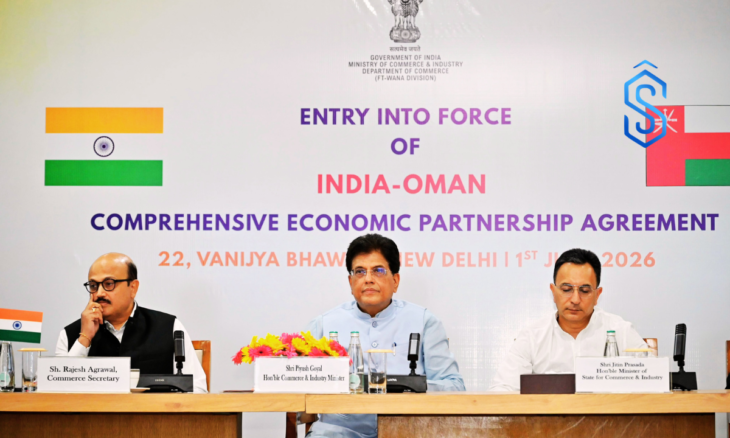
New Delhi: The India Oman CEPA (Comprehensive Economic Partnership Agreement) officially entered into force on June 1, 2026, marking a significant milestone in bilateral economic relations and opening a new era of strategic trade and investment cooperation between India and Oman.
The India Oman CEPA was signed on December 18, 2025, in Muscat in the presence of Prime Minister Narendra Modi and His Majesty Sultan Haitham bin Tarik Al Said. Following the completion of all internal procedures by both countries, the agreement has now become operational.
The operationalization ceremony was attended by Union Minister of Commerce and Industry Piyush Goyal and Oman’s Ambassador to India, H.E. Issa Saleh Al Shibani.
To commemorate the implementation of the agreement, the first consignments availing preferential tariff benefits under the India Oman CEPA, including agricultural products and gems and jewellery exports from Mumbai, Kolkata, and Chennai, were flagged off.
Oman is India’s second-largest trading partner in the Gulf region and serves as a strategic gateway to the wider GCC market through its advanced logistics and port infrastructure.
Bilateral trade between India and Oman reached USD 11.18 billion in FY 2025-26, compared with USD 10.61 billion in FY 2024-25, reflecting sustained growth.
The India Oman CEPA represents a comprehensive economic framework that extends beyond tariff reductions. It encompasses trade in goods and services, professional mobility, regulatory cooperation, safeguards against non-tariff barriers, and investment facilitation, strengthening India’s economic presence across the GCC region.
Also Read: Intel-Backed Substrate Manufacturing Facility Planned in Odisha Under New MoU
Piyush Goyal Calls CEPA a Force Multiplier
Speaking on the operationalization of the India Oman CEPA, Union Minister Piyush Goyal said: “The India–Oman CEPA marks a defining milestone in India’s engagement with Oman and reflects Hon’ble Prime Minister Shri Narendra Modi’s vision of forging trade partnerships that deliver gains for farmers, fishermen, youth, women, entrepreneurs and MSMEs.
This Agreement will be a force multiplier in the Gulf region. With 99.38% of India’s exports receiving duty-free access, the Agreement unlocks new opportunities for our exporters and professionals gain opportunities. Oman is our trusted partner, a bridge for our people and a gateway to the Gulf and East Africa.
Our opportunities will be elevated and CECA will strengthen India’s integration into regional and global value chains. By delivering significant benefits to labor-intensive sectors, it will support job creation, drive investment and enable Indian enterprises to compete on an equal footing with suppliers from countries enjoying preferential market access.”
Commerce Secretary Rajesh Agrawal highlighted the strategic significance of the agreement amid evolving global trade dynamics.
“At a time when global trade patterns are being reconfigured by supply-chain diversification, shifting production networks and the emergence of new economic corridors, the CEPA positions India and Oman to leverage these structural changes. By fostering closer integration across trade, services, investment, and logistics, the Agreement creates a framework for more resilient value chains, greater economic competitiveness and a stronger strategic partnership with regional and global relevance.
The India-Oman CEPA brings new energy to our bilateral economic engagement, anchored in complementary strengths, deeper regulatory cooperation and a shared commitment to growth. The agreement is tariff liberalization PLUS: it enhances market access, facilitates service trade and provides greater predictability for businesses operating across both markets.”
India Oman CEPA Provides Duty-Free Access for 99.38% of Exports
One of the most significant features of the India Oman CEPA is the provision of duty-free access for 99.38% of India’s exports by value, covering 98.08% of Oman’s tariff lines.
Under the earlier Most Favoured Nation (MFN) regime, only 15.33% of Indian exports entered Oman duty-free. The agreement provides immediate implementation of all zero-duty concessions, improving competitiveness for Indian exporters in Oman’s nearly USD 28 billion import market.
The benefits are expected to be particularly significant for labor-intensive sectors such as:
- Gems and jewellery
- Textiles
- Leather products
- Footwear
- Marine products
- Engineering goods
- Processed foods
- Pharmaceuticals
The agreement also positions Indian exporters to leverage Oman’s strategic logistics hubs at Sohar, Duqm, and Salalah for access to broader GCC and East African markets.
Safeguards for Sensitive Sectors
While opening market access, the India Oman CEPA also protects sensitive domestic sectors.
India has offered tariff liberalization on 77.79% of tariff lines covering 94.81% of imports from Oman while retaining protections for key sectors such as dairy products, cereals, fruits, vegetables, edible oils, oilseeds, rubber, leather, spices, and other agricultural products.
The agreement incorporates Tariff Rate Quotas and Minimum Import Price mechanisms to safeguard domestic manufacturing and agriculture while balancing export ambitions with food security and farmer welfare concerns.
Major Gains for Marine Products
The India Oman CEPA grants immediate duty-free access to all marine products, including shrimp, fish, and cuttlefish, replacing previous duties of up to 5%.
With Oman’s marine imports valued at USD 35.3 million and India’s exports accounting for only USD 10 million, substantial growth opportunities exist for exporters from Andhra Pradesh, Kerala, Tamil Nadu, and Gujarat.
The agreement is expected to strengthen India’s position in regional seafood value chains and improve integration into Gulf food supply networks.
Boost for Gems and Jewellery Exports
Import duties of up to 5% on gems and jewellery have been eliminated from the first day of implementation under the India Oman CEPA.
India’s exports in this category to Oman stood at USD 25.78 million in 2025, including polished natural diamonds and gold jewellery. Exports are projected to increase sixfold to approximately USD 150 million within three years.
Major production centres such as Surat, Jaipur, Mumbai, Kolkata, and Chennai are expected to benefit from increased demand and employment opportunities.
Agriculture and Processed Foods to Gain Momentum
India currently holds a 17.8% share of Oman’s agricultural imports and remains the country’s second-largest agricultural supplier.
The India Oman CEPA eliminates duties on products including honey, condiments, cashews, basmati rice, butter, and sweet biscuits, strengthening India’s competitiveness.
India already accounts for more than 94% of Oman’s bovine meat imports and over 98% of fresh egg imports. The agreement is expected to further benefit farmers and exporters across Uttar Pradesh, Punjab, Haryana, Maharashtra, Gujarat, Andhra Pradesh, and Tamil Nadu.
Mango exports, including Alphonso, Kesar, and Dasheri varieties, are also expected to gain from duty-free access.
Pharmaceutical Sector Receives Regulatory Advantages
The India Oman CEPA provides binding zero-duty access for medicines, vaccines, and pharmaceutical ingredients.
Products approved by regulatory authorities such as USFDA, EMA, UK MHRA, and TGA will qualify for marketing authorization within 90 days without prior inspection, while approvals requiring inspections will target completion within 270 working days.
The agreement also recognizes GMP and inspection reports, reducing compliance burdens and accelerating market entry for Indian pharmaceutical companies.
Oman’s pharmaceutical market, valued at USD 302.84 million in 2025, is projected to reach USD 473.71 million by 2031.
Electronics and Engineering Exports Set for Growth
All engineering products receive zero-duty access under the India Oman CEPA, replacing MFN tariffs of up to 5%.
Key sectors expected to benefit include:
- Machinery
- Automobiles
- Electrical equipment
- Iron and steel
- Industrial machinery
- Electronics
India’s engineering exports to Oman reached USD 875.83 million in FY 2025-26 and are projected to grow to between USD 1.3 billion and USD 1.6 billion by 2030.
The agreement also creates significant opportunities for Indian electronics manufacturers, particularly those operating under the Production Linked Incentive (PLI) framework.
Best-Ever Services Market Access from Oman
The India Oman CEPA delivers Oman’s most comprehensive services commitments to India, covering 127 services sub-sectors.
Key sectors include:
- Information Technology
- Professional Services
- Engineering
- Healthcare
- Education
- Financial Services
- Telecommunications
- Construction
- Tourism
- Research and Development
The agreement also introduces binding commitments for professionals in accounting, engineering, medicine, IT, education, and construction.
Enhanced mobility provisions allow:
- Business visitors to stay up to 90 days
- Independent professionals to stay up to 180 days
- Intra-Corporate Transferees to stay up to four years
These provisions are expected to benefit nearly 6,000 India-Oman joint ventures.
Smart Regulation and Trade Facilitation
Under the India Oman CEPA, Oman will mandatorily accept certificates issued by India’s Export Inspection Council (EIC), eliminating duplicate inspections and testing requirements.
The agreement also recognizes India’s NPOP organic certification and halal certification systems.
Dedicated sanitary and phytosanitary (SPS) and technical barriers to trade (TBT) chapters are expected to reduce non-tariff barriers, improve transparency, and facilitate smoother trade flows.
Investment and Future Growth
The India Oman CEPA establishes a structured framework for investment facilitation across manufacturing, logistics, energy, and services sectors.
The agreement is expected to strengthen MSME competitiveness, support startups, women entrepreneurs, and service professionals, and deepen integration into GCC value chains.
With bilateral trade already reaching USD 11.18 billion in FY 2025-26, the operationalization of the India Oman CEPA is expected to accelerate trade, investment, and economic cooperation between the two nations.
The agreement creates a comprehensive economic architecture encompassing trade, investment, services, logistics, and regulatory cooperation, reinforcing India’s vision of becoming a globally integrated, resilient, and competitive economy under the Viksit Bharat 2047 framework.