

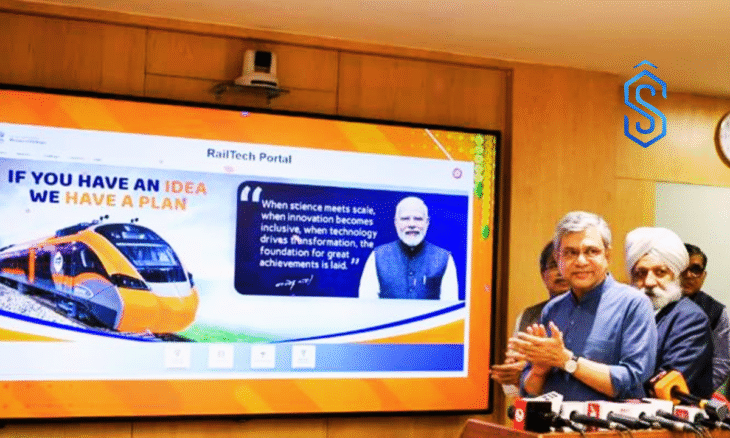
The Rail Tech Portal has been launched as part of the newly announced RailTech Policy to engage innovators, startups, industry and institutions in promoting innovation across Indian Railways.
Announcing the Rail Tech Portal as Reform Number Three and the complete digitisation of the Railway Claims Tribunal (RCT) as Reform Number Four, Union Minister Ashwini Vaishnaw unveiled the initiatives under Indian Railways’ flagship “52 Reforms in 52 Weeks” programme.
The RailTech Policy introduces the dedicated Rail Tech Portal to enable massive and systematic induction of technology into the Railways.
At the same time, the e-RCT system will ensure end-to-end digitisation of the Railway Claims Tribunal, transforming the filing and disposal of claims into a fully digital, AI-enabled process.
Also Read: Digital Passenger Information Systems: MIC Electronics Secures ₹4.45 Crore Eastern Railway Orders
Rail Tech Portal to Simplify Innovation Induction in Indian Railways
Under the RailTech Policy reform, the Rail Tech Portal has been created as a dedicated digital platform to simplify the selection and onboarding of innovators.
The policy allows innovation challenges to be initiated by any innovator or departmental user, with a single-stage detailed submission of proposals through the Rail Tech Portal.
The policy provides a user-friendly interface, increases the scale-up grant more than three times and doubles the maximum grant for prototype development and trials.
The objective is to create a simplified and innovation-driven framework focused on trial and adoption of new technologies instead of rigid vendor-based specifications.
Ashwini Vaishnaw said that anyone with a strong technological idea should be able to approach Indian Railways through the Rail Tech Portal, which will operate as a completely digital, end-to-end process.
He emphasised that startups, researchers and innovators must be able to connect with Indian Railways in a structured, meaningful and simplified manner.
The RailTech Policy has been designed after studying successful innovation models such as the iDEX initiative in defence, startup frameworks of the Ministry of Electronics & IT, and telecom sector innovation policies.
The aim is to remove procedural bottlenecks and build a transparent, simplified and innovation-friendly ecosystem through the Rail Tech Portal.
Also Read: ZF India Launches Advanced Railway Dampers in India for Metro and High-Speed Rail
Key Innovation Areas Identified Under Rail Tech Portal
The RailTech Policy outlines multiple priority areas where innovators can submit proposals via the Rail Tech Portal, including:
- AI-based Elephant Intrusion Detection System (EIDS)
- AI-based fire detection systems in coaches
- Drone-based broken rail detection systems
- Rail stress monitoring systems
- Sensor-based load calculation devices on parcel vans (VPUs)
- Solar panels on coaches
- AI-based coach cleaning monitoring systems
- Obstruction detection in foggy environments
- AI-based pension and dispute resolution systems
Vaishnaw cited the example of AI-based camera systems to detect elephants near railway tracks, stating that the Railways would support up to 50 percent of development funding for viable technological solutions submitted through the Rail Tech Portal. Once a project proves successful, substantial long-term orders would be placed to scale the solution.
He also referred to AI-enabled CCTV systems for passenger security, mentioning how CCTV footage in a recent incident in Kerala helped apprehend culprits quickly.
Predictive monitoring systems, advanced track monitoring solutions using radar, AI, infrared cameras and ultrasonic technologies, and predictive electrical monitoring of overhead wires were identified as promising areas.
Drone-based systems for detecting rail fractures, broken grills and monitoring overhead equipment, including overheating insulators through AI-based analytics, were also highlighted as innovation opportunities under the Rail Tech Portal framework.
E-RCT Digitisation: Reform in Railway Claims Tribunal
Alongside the Rail Tech Portal, Reform Number Four focuses on the complete digitisation of the Railway Claims Tribunal through the e-RCT system.
The Railway Claims Tribunal, constituted under the Railway Claims Tribunal Act, 1987, adjudicates claims against Railway Administration relating to compensation for death or injury in railway accidents and untoward incidents, loss or non-delivery of goods, and refund of fares and freight. It currently functions through 23 Benches located in 21 cities across India, with the Principal Bench in Delhi.
Ashwini Vaishnaw stated that filing claims currently poses challenges, especially for passengers travelling across states. Determining appropriate jurisdiction often becomes a significant issue. The reform aims to make claim filing simple, digital and accessible from anywhere in the country.
Under the new e-RCT system, aggrieved passengers will be able to file claims electronically irrespective of their location, even while travelling or upon reaching their destination.
The entire process – from e-filing to case information systems – will be digitised and AI-enabled. Within the next 12 months, all 23 Benches of the Railway Claims Tribunal will be fully digitised.
From Physical Filing to Paperless Courts
Earlier, claimants and advocates were required to physically visit Tribunal offices for filing cases, submitting documents and tracking case progress, resulting in travel, time and procedural delays. With the introduction of the e-RCT system, cases can now be filed online from anywhere at any time.
The system will digitally connect all 23 Benches on a single platform and enable:
- Paperless court functioning
- Digitised case lifecycle
- Online exchange of pleadings and notices
- Daily order and judgement pronouncement online
- Hybrid hearings (physical + virtual mode) in compliance with Supreme Court directions
- A revamped dynamic microsite for all RCT Benches will further enhance transparency and public access.
Key Modules of e-RCT System
The e-RCT platform comprises three core components:
- E-Filing
- 24×7 online filing of claims and legal documents
- Uploading of petitions, affidavits, annexures and supporting records
- Instant acknowledgement via SMS and email alerts
- Online scrutiny, defect intimation and re-filing
- Case Information System (CIS)
- Centralised database of all cases
- Auto-allocation and case registration
- Real-time tracking from filing to final disposal
- Scheduling, hearing management and progress monitoring
- Document Management System (DMS)
- Digital storage of pleadings, notices, summons, orders and judgements
- Digitally signed records
- Easy retrieval of case files and orders
- Secure record management with disaster recovery
The system also enables online hearings, digital evidence recording, automated alerts and online compliance tracking, reducing manual intervention and improving efficiency.
Citizen-Centric Justice and Broader Reform Vision
The e-RCT system will deliver faster case processing, reduction in adjournments through online participation, real-time status updates, online access to orders and judgements, cost savings, better record management and centralised real-time data on pendency and disposal.
Earlier this month, Ashwini Vaishnaw had announced two major reforms under the “52 Reforms in 52 Weeks” initiative, including continuous end-to-end cleaning of general coaches and expansion of Gati Shakti Cargo Terminals to over 500 hubs to boost logistics capacity.