
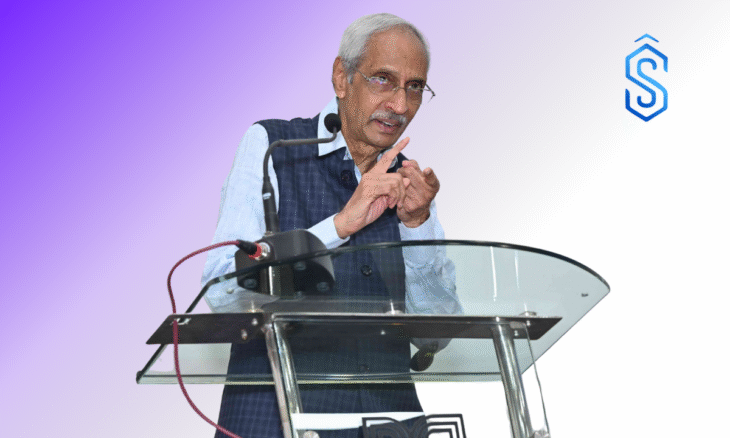
Pune: CSIR–National Chemical Laboratory (CSIR-NCL), Pune, hosted the 2025 edition of the Professor K Venkataraman Memorial Lecture, featuring distinguished scientist Prof T N Guru Row as the keynote speaker.
The annual lecture honours the legacy of Prof K Venkataraman, whose foundational contributions to chemical sciences continue to shape research in India.
Prof T N Guru Row Discusses Noncovalent Bonding and Material Chemistry
Introducing the session, Dr Ashish K. Lele, Director, CSIR–NCL, reflected on the remarkable achievements of Prof. K. Venkataraman, the first Indian Director of the institute and a pioneering chemist fondly remembered as “KV.”
Dr Rajesh Gonnade, Chief Scientist, CSIR-NCL, introduced Prof T N Guru Row, describing him as a leading authority in X-ray crystallography and the pioneer of Charge Density Analysis (Quantum Crystallography) in India.
Also Read: Hydrogen 360: AICTE-ATAL Sponsored FDP Concludes Successfully at AIT Pune
Delivering the lecture titled “Nature of Noncovalent Bonding and its Impact on Chemistry of Materials,” Prof T N Guru Row revisited the scientific legacy of Prof. K. Venkataraman, including the Baker-Venkataraman rearrangement developed at CSIR-NCL.
He emphasized the importance of understanding chemical phenomena at atomic and molecular scales, explaining how bonded and non-bonded interactions govern reaction pathways, molecular organization, and crystallization.
He described the behaviour of atoms within molecules and their transformation into crystalline structures, addressing concepts such as non-bonded contacts, intermolecular space, and the spectrum of interactions from strong hydrogen bonds to weak van der Waals forces.
Advanced Experimental and Computational Approaches Explained
During the lecture, Prof T N Guru Row discussed contemporary analytical approaches including the Independent Atom Model, X-ray Charge Density analysis, electron density modelling, and the Atoms in Molecules (AIM) theory.
He elaborated on computational tools such as Hirshfeld atom refinement and quantum crystallography that enable precise interpretation of material behaviour.
Highlighting the relevance of polymorphism in chemical and pharmaceutical sciences, he presented case studies demonstrating diverse interaction types – from trifurcated C–H…O hydrogen bonds in ferric acid to halogen and chalcogen bonding. His talk also featured 3D deformation density plots illustrating Cl…Cl interactions.
Also Read: GPS Renewables CEO Mainak Chakraborty Speaks on the Age of Green Molecules at CSIR-NCL Pune
Insights on Ebselen and Novel Evidence of Carbon Bonding
Prof T N Guru Row discussed the molecular and biological significance of ebselen, explaining how its polarized Se–N and stable Se–C bonds contribute to its activity and low toxicity.
He also presented the first experimental evidence for carbon bonding in solid-state systems, demonstrating quasi-trifurcated C–H…O/Cl interactions in molecular crystals.
To illustrate the capabilities of Charge Density Analysis, he compared CF3Br and CF4, noting that while CF3Br is a typical example of a significant sigma hole, new findings from his research group reveal that even CF4 can exhibit directional features, challenging conventional chemical understanding.
The event concluded with a vote of thanks extended to the speaker, dignitaries, researchers, and students.