
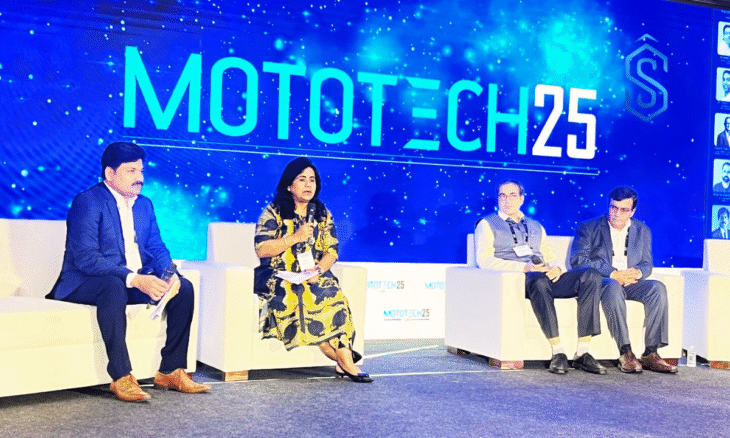
Pune: MOTOTECH 2025, the automotive technology expo and conference, returned to Pune from October 9–10, catalysing innovation, sustainability, and global competitiveness across the country’s automotive manufacturing landscape.
The two-day event served as a vital platform connecting OEMs, component manufacturers, automation leaders, policymakers, and supply-chain experts to chart the future of Indian mobility.
Industry Leaders Set Vision for MOTOTECH 2025
The conference began with an opening address by Sachin Goel, Vice President and Head of Central Quality, Ashok Leyland, on “Quality in the Automotive Manufacturing Landscape.”
Also Read: OPmobility Pune Technical Center to Add 500 New Jobs
Throughout the sessions, experts highlighted sustainable manufacturing, digital product innovation, and automation-driven competitiveness – marking MOTOTECH 2025 as a hub for knowledge exchange and industry collaboration.
Pune’s Leadership in Automotive Transformation
Conference Advisor Shailendra Goswami, CMD of Pushkaraj Group, underscored Pune’s pivotal role in India’s automotive growth story. “Pune remains a true automotive hub, and India is emerging as a global manufacturing centre,” he noted.
“With our intellectual capital and skilled workforce, we can build a credible global platform if we channel this capability into scalable manufacturing.”
Goswami added that India’s transition from traditional practices to Industry 4.0 and now 5.0 – where AI and human intuition converge – represents a defining shift.
“Government intent is clear: raise manufacturing’s share of GDP to 25%. Building a complete ecosystem of Tier-1 to MSME suppliers is central to this goal. Pune’s diverse automotive cluster makes it the right venue for MOTOTECH 2025.”
Also Read: Dassault Systemes Bets Big on Indian Startups, Ecosystem, and AI-Driven Innovation
Supply Chain Resilience and Competitiveness
Delivering insights on competitiveness through logistics, Dr. Rakesh Singh, Chairman, Institute of Supply Chain Management, said, “India is rapidly evolving into a global production base. As exports and rural consumption rise, our supply chains must become more resilient, visible, and tech-driven.”
He emphasized that technologies like AI, IoT, digital twins, and predictive analytics are reshaping how manufacturing systems operate. “If India wants world-class competitiveness, sourcing and selling chains must flow seamlessly, without bottlenecks – like a river.”
Electrification, Entrepreneurship, and Future Mobility
Adding a strong entrepreneurial perspective, Uday Narang, CMD of Omega Seiki Mobility, said, “India’s youth must move from job-seeking to creating enterprises. In EVs, total cost of ownership (TCO) will drive adoption, and if we can beat ICE economics, consumers will switch rapidly.”
He emphasized the need for “country-first” collaboration—learning from Japan, Korea, Europe, and the U.S., while building products in India to strengthen domestic manufacturing capacity.
Cutting-Edge Exhibits at MOTOTECH 2025
The exhibition floor featured leading companies including Universal Robots, ATI Motors, Triam Toolroom, Yash Dynamics, Schneider Electric, WAGO India, Jendamark, Dalmec, Shree Rapid Technologies, TASI India, Light Mechanics, and Marposs – demonstrating advancements in robotics, automation, precision tooling, and digital assembly.
Day Two: Focusing on EV Leadership and Future Skills
The second day of MOTOTECH 2025 will explore EV Leadership, Women in Manufacturing, Shop-Floor Excellence, and Future Skills, with an emphasis on productivity, sustainability, and workforce readiness.