
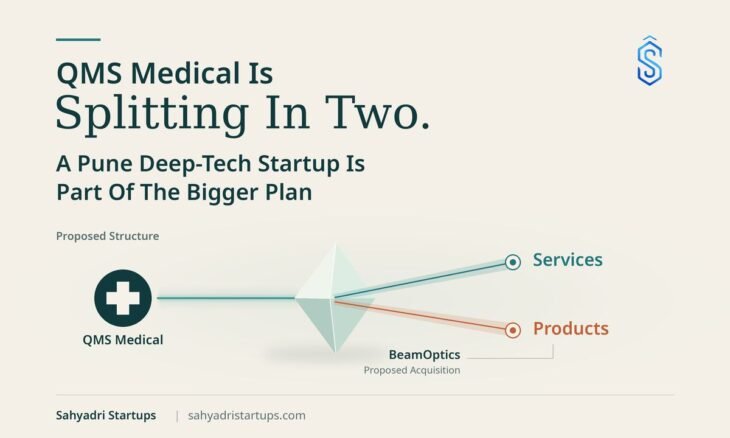
Mumbai: QMS Medical Allied Services is preparing to separate its healthcare services and medical products operations into two independently listed businesses, while pursuing a Pune-based diagnostics technology acquisition to strengthen its manufacturing capabilities.
The proposed restructuring, which involves Health Care at Home India (HCAH), is central to the company’s next phase of growth as it looks to build scale across patient support services and medical devices.
The strategy comes as QMS Medical reported a 33.3% year-on-year decline in profit after tax (PAT) to ₹2.4 crore for Q2 FY27, despite revenue increasing 17.5% to ₹52.5 crore.
The company also withheld full-year EBITDA guidance, citing the need for another quarter to assess its operating performance.
During its November 17 earnings call, QMS outlined plans to operate through two focused verticals: QMS Services, comprising patient support programmes, and QMS Products, covering medical device distribution and manufacturing. The company filed the transcript of the call with the NSE on November 21.
QMS Medical’s Proposed HCAH Deal to Create Separately Listed Services Business
The most significant part of the restructuring is a proposed combination of the healthcare services businesses of QMS Medical and HCAH under Saarathi Healthcare Private Limited, a wholly owned subsidiary of QMS.
The boards of QMS and HCAH approved a composite scheme of arrangement on September 25, 2026.
Under the proposal, their respective healthcare services businesses will be demerged into Saarathi. QMS had acquired the remaining 24% stake in Saarathi in September, taking its ownership to 100%.
The proposed shareholding arrangement will give existing QMS shareholders one Saarathi share for every QMS share held. HCAH’s equity and preference shareholders will receive approximately 1.32 crore shares in the combined entity.
The resulting services business is envisaged to be separately listed on the NSE, subject to regulatory and stakeholder approvals.
The appointed date under the scheme is October 1, 2026, while management expects the approval process involving the NSE, SEBI and the National Company Law Tribunal (NCLT) to take approximately 12 to 13 months.
The arrangement will also bring HCAH’s existing investors, including Quadria Capital, Temasek-backed ABC Impact Fund and the Burman family, into the combined platform.
The business being brought together has more than 160 active patient support programmes, a workforce of over 2,000 healthcare professionals and operations across more than 35 cities. It has impacted over 1.2 million patients.
QMS and HCAH’s combined services platform generated approximately ₹109 crore in FY26 revenue, with a target of around ₹180 crore for FY27. Management is targeting annual growth of 20-25%.
HCAH’s patient support programme division contributed approximately ₹55 crore in FY26 and is projected to generate ₹75-80 crore in FY27.
Management expects operational synergies to begin emerging in FY27-28, although their impact on consolidated reported financials will become visible only from Q4 FY27-28. It also said both divisions in the proposed demerged structure are PAT-positive.
Importantly, the proposed arrangement covers HCAH’s patient support programme business and not its entire home healthcare and out-of-hospital care operations.
Pune’s BeamOptics to Strengthen QMS Medical’s Manufacturing Capabilities
While the HCAH arrangement is intended to consolidate the services business, QMS Medical is looking to build a stronger technology and manufacturing base for its products vertical through the proposed acquisition of BeamOptics Scientific Private Limited.
QMS signed a binding memorandum of understanding on September 25, 2026, to acquire the entire equity of the Pune-headquartered company. The acquisition is expected to bring product development and manufacturing capabilities into a business that currently has a significant distribution presence.
Founded in 2023 by Aashutosh Sharma and Ritesh Kothari, BeamOptics develops in-vitro diagnostic devices and analytical instruments for healthcare, dairy quality testing, food safety and pharmaceutical screening.
The ISO 13485:2016-certified company has developed its own Fourier Transform Infrared (FTIR) spectroscopy platform. Its products include the RedCheck and QCare universal readers. According to QMS, BeamOptics has filed seven patents, of which two have been commercialised.
For QMS, the strategic value of the proposed acquisition lies in gaining access to research and development, product engineering, manufacturing and regulatory capabilities rather than relying solely on third-party medical device products.
The intended model is to combine BeamOptics’ technology and manufacturing capabilities with QMS’s sales, marketing and distribution network. This would allow the company to develop products where demand has been validated and use its existing distribution infrastructure to take them to market.
Management indicated that QMS has already worked with BeamOptics on products.
The acquisition’s valuation and payment structure, however, have not been finalised. QMS said the valuation would be determined after the HCAH corporate action takes effect, expected in approximately 12 to 13 months. Both parties will jointly appoint valuers.
“We are more leaning towards doing this as a share exchange so that there’s no cash outflow in this transaction,” the company’s finance team said during the earnings call.
The transaction is subject to mutually agreed terms and NCLT approval of the composite scheme. QMS has also clarified that the acquisition is not a related-party transaction.
HEINE Agreement Adds Another Growth Channel
Alongside the proposed BeamOptics acquisition, QMS Medical has signed a five-year exclusive distribution agreement with Germany-based HEINE Optotechnik.
The agreement, which takes effect on January 1, 2027, will make QMS the exclusive distributor of HEINE’s primary diagnostic instruments in India.
HEINE’s Indian business generated approximately ₹30 crore in net revenue, equivalent to around 2.6 million euros, in calendar year 2026. QMS expects to roughly double this business over the next five years.
The transition is already affecting the existing distribution channel. Management said business activity is currently slow as the previous channel clears inventory ahead of the changeover.
The HEINE partnership and BeamOptics acquisition represent two different approaches to expanding the products business: adding an established international diagnostic instruments portfolio while building access to domestic product development and manufacturing.
Rising Employee Costs and Working Capital Pressure Weigh on Margins
QMS Medical’s Q2 performance highlights the challenge of translating its expansion into higher profitability.
Although quarterly revenue increased to ₹52.5 crore from ₹44.7 crore, EBITDA declined to ₹6.5 crore from ₹6.9 crore. The EBITDA margin contracted to 12.4% from 15.5%, while PAT fell to ₹2.4 crore from ₹3.6 crore.
Employee expenses rose to ₹12.6 crore from ₹3 crore in the year-ago quarter. Management said additional employees in the services business are backed by pharmaceutical company contracts that cover their costs plus a margin. It attributed the quarter’s margin pressure primarily to the products business.
For H1 FY27, revenue grew 20% to ₹109.4 crore and EBITDA increased 11% to ₹14.8 crore. PAT declined marginally to ₹6.4 crore from ₹6.7 crore.
The company’s balance sheet also reflects higher working capital requirements. Short-term borrowings increased to ₹81.2 crore at the end of September 2026 from ₹68.5 crore at the end of March, while trade receivables rose to ₹71.9 crore from ₹65 crore.
Management attributed part of the higher borrowings to the use of internal accruals for the final payment towards acquiring the remaining stake in Saarathi. It said future internal accruals would be directed towards debt reduction.
The two business verticals also have different cash-flow requirements. Corporate customers in the services business typically take 90 to 100 days to pay, while the products business purchases inventory upfront and extends credit to customers. QMS said it is working to shorten these working capital cycles.
QMS Medical Targets ₹210-220 Crore Revenue in FY27
For the full financial year, QMS Medical expects revenue of ₹210 crore to ₹220 crore, with H2 FY27 expected to be broadly similar to H1.