
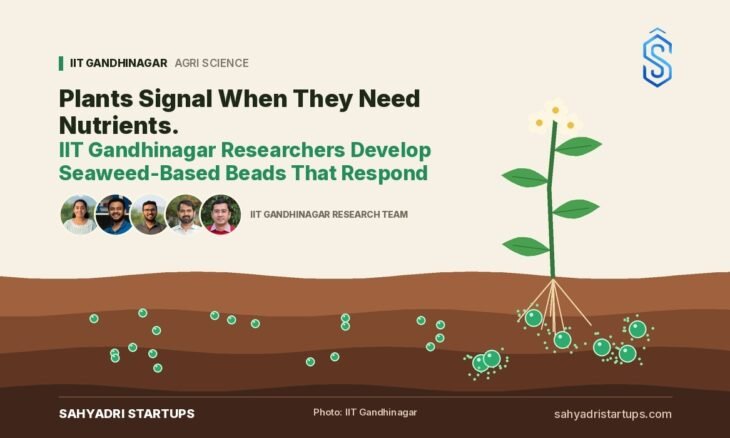
Ahmedabad: Researchers at the Indian Institute of Technology Gandhinagar (IITGN) have developed seaweed-based beads that release essential plant micronutrients in response to soil acidity, offering a potential new approach to addressing iron and zinc deficiencies in agricultural soils.
The microbeads, made from seaweed-derived gel and a cereal-derived natural antioxidant, are designed to release nutrients near plant roots when changes in soil chemistry indicate a shortage.
In laboratory tests, the beads released up to 68% of their iron and 66% of their zinc under acidic conditions.
Published in the journal ACS Omega, the research adapts hydrogel technology used in medical applications for agricultural nutrient delivery.
The technology targets a common problem in farming: essential micronutrients can become locked in soil particles or washed away before plants can absorb them.
The research was conducted by Hitasha Vithalani and Subhojit Ghosh, PhD scholars in IITGN’s Department of Biological Sciences and Engineering, under the guidance of Dr Mukesh Dhanka and Dr Subramanian Sankaranarayanan.
“Hydrogels that hold a drug and release it slowly have immense medical potential. We have adapted this technology so that the gel holds nutrients near the roots until the plants need them,” said Dr Dhanka, corresponding author and Assistant Professor at IITGN.
How the seaweed-based beads work
Plants require micronutrients such as iron, zinc, manganese and copper in small quantities, but their deficiency can disrupt enzyme activity and chlorophyll production, resulting in yellowing leaves, stunted growth and lower yields.
The problem is significant in India. An analysis of Soil Health Card data published in 2021 found that approximately 39% of Indian soils are deficient in zinc and 19% in iron.
Such deficiencies can also reduce the nutritional quality of food, contributing to ‘hidden hunger’.
Conventional methods, including applying micronutrient salts to soil and foliar sprays, have limitations. Nutrients can be fixed in soil or leached away, while foliar spraying is difficult across large fields. Chelated micronutrients are effective but expensive and difficult to degrade from soil.
The IITGN researchers developed seaweed-based beads that respond to changes in the rhizosphere, the region of soil surrounding plant roots.
When plants face an iron or zinc shortage, their roots release organic acids that lower the surrounding soil’s pH, helping dissolve otherwise inaccessible minerals.
“Our nutrient-laden microbeads respond to this cue,” said Vithalani. “We designed them to respond to pH such that when the environment turns acidic, the nutrients inside the beads are released.”
Measuring approximately 3.5 mm, the beads are made from κ-carrageenan, a gelling agent extracted from red seaweed, and trans-ferulic acid, a natural antioxidant found in rice, wheat and oats.
The researchers dissolve these ingredients in water, add micronutrient salts and drip the mixture into a calcium chloride solution.
Calcium ions link the carrageenan chains to form a gel network, while ferulic acid strengthens the structure and makes it sensitive to pH changes. Acidity loosens the network, allowing nutrients to escape.
Tests show higher nutrient release under acidic conditions
In experiments, the beads swelled by approximately 80% over two days at pH 4, compared with 49% at neutral pH and 37% at alkaline pH 9.
“These changes matter because swelling and the breakdown of the material can influence the movement of encapsulated nutrients into the surrounding environment,” said Ghosh.
Over 14 days, the beads released the following quantities of iron and zinc:Soil conditions Iron release Zinc release Acidic (pH 4) 68% 66% Neutral pH 46% 44% Alkaline (pH 9) 28% 27%
The results indicate that the beads release more micronutrients under acidic conditions, although the mechanism is not an absolute on-off switch, as some release also occurs at neutral and alkaline pH levels.
The team subsequently tested the formulation on Arabidopsis thaliana, a model plant widely used in biological research, and Nicotiana benthamiana, a tobacco relative.
The plants were grown in nutrient-poor potting mix acidified to pH 4. One group received beads containing manganese, zinc, copper and iron.
In Arabidopsis, plants receiving the four-nutrient beads recorded approximately 3.3 times more chlorophyll than plants receiving no micronutrients. Their leaves measured around 22 sq. mm, compared with approximately 2 sq. mm in the micronutrient-deficient group.
Plants supplied with the beads also recorded more chlorophyll than those receiving a complete laboratory nutrient solution. Both groups were the only ones to reach flowering.
In Nicotiana benthamiana, plants without micronutrients did not survive, while those receiving the four-nutrient beads recorded the highest chlorophyll levels. Beads containing individual nutrients also supported growth, but were less effective than the combination.
Field trials and environmental safety remain next steps
While the experiments demonstrate the potential of seaweed-based beads to support plant growth under controlled conditions, their effectiveness in agricultural fields remains to be established.
The researchers plan to investigate their impact on crop yields, nutritional quality and micronutrient accumulation in plant tissues.
They also examined the beads after ten days of soil exposure. Changes in their chemical signatures and porous structure provided early indications of breakdown, although complete degradation has not yet been established.
“Biodegradable has to mean safe as well as short-lived. Our further work will also include studying the long-term ecological safety of the beads, including the breakdown of their components and the effect on soil microbes,” said Dr Sankaranarayanan, co-corresponding author.
The formulation uses κ-carrageenan extracted from red seaweeds such as Kappaphycus, cultivated along India’s southern coast, and ferulic acid naturally present in cereals.
Although the ingredients used in the study were sourced from a chemical supplier, the researchers see potential for developing an indigenous agricultural technology.
The team has filed an Indian patent application (No. 202521114626) and is exploring industry partnerships to take the research towards product development.
“Ours is an indigenous technology with the potential to progress towards product development. We are actively looking for industry partners to advance the research to the next stage, with the eventual aim of translating it into an accessible, atmanirbhar solution for farmers,” said the researchers.
The team believes the controlled nutrient-delivery technology could be scaled for applications ranging from home gardening to large-scale agricultural field trials.
Vithalani and Ghosh also won first prize in the SOMS Thesis Showdown organised by the Soluble Fertilizer Industry Association.
The study’s co-authors include Harshil Dave of IITGN and Kashish Agrawal of DY Patil Deemed to be University, Navi Mumbai. The research was supported by IITGN seed and start-up grants and the Department of Biotechnology.