
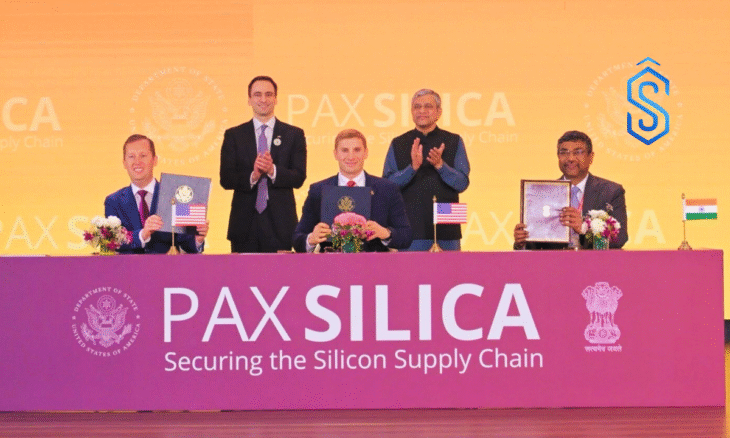
New Delhi: India formally joined Pax Silica at the India AI Impact Summit 2026, marking a significant milestone in strengthening strategic technology and supply chain cooperation between India and the United States.
The signing ceremony brought together senior government leaders from both nations, underscoring a shared commitment under Pax Silica to secure the full technology stack that will power the AI-driven global economy.
Pax Silica is envisioned as a strategic coalition of trusted nations committed to securing the “silicon stack”, from critical minerals and semiconductor fabrication to advanced AI systems and deployment infrastructure.
The initiative aims to reduce overconcentration in global supply chains, prevent economic coercion, and ensure that emerging technologies are developed and governed by open, democratic societies. With India’s formal entry into Pax Silica, the coalition expands its strategic depth in the Indo-Pacific region.
Also Read: India AI Ecosystem: PM Narendra Modi, 16 AI Startup CEOs Discuss Agri, Healthcare, Space Innovations
Addressing the gathering, Union Minister of Electronics and Information Technology Ashwini Vaishnaw framed the moment as one that transcends a ceremonial signing under Pax Silica.
“We are not just holding a summit; we are building the future,” he said, emphasising that new foundations and new opportunities are being created for the younger generation.
Drawing attention to the power of compounding growth since Independence, he added, “If we look at India’s growth since 1947, we can all imagine the impact of compounding.”
He underscored the country’s growing semiconductor capabilities within the broader vision of Pax Silica, stating, “Today, India’s talented engineers are designing the world’s most advanced two-nanometer chips. The semiconductor industry will require around one million new skilled professionals, and this is a very big opportunity for India.”
Speaking at the ceremony, Jacob Helberg, United States Under Secretary of State for Economic Growth, Energy, and the Environment, described the Pax Silica declaration as “not merely an agreement on paper, but a roadmap for a shared future.”
Invoking the shared democratic histories of both nations, he stated, “Today, as we sign the Pax Silica declaration, we say no to weaponized dependency, and we say no to blackmail. Together, we affirm that economic security is national security.”
Highlighting the broader ambition behind Pax Silica, he added, “We are securing the full stack of the future, the minerals deep in the earth, the silicon wafers in our labs and fabs, and the intelligence that will unleash human potential. Pax Silica is our declaration that the future belongs to those who build.”
India Joins Pax Silica: Strategic and Essential
Echoing this sentiment, Sergio Gor, U.S. Ambassador to India, described India’s entry into Pax Silica as both “strategic and essential.”
“Pax Silica is the coalition that will define the 21st century economic and technological order,” he said. “It is designed to secure the entire silicon stack, from the mines where we extract critical minerals, to the fabs where we manufacture chips, to the data centres where we deploy frontier AI.”
Understanding the democratic foundation of the partnership, Ambassador Gor remarked, “Pax Silica is about whether free societies will control the commanding heights of the global economy. We choose freedom. We choose partnership. We choose strength.”
Also Read: India Sovereign AI Ecosystem Deepens Infrastructure as Funding Crosses $5.5B: Tracxn Report
The signing of Pax Silica at the India AI Impact Summit 2026 underscored a clear message: the future of artificial intelligence and advanced technologies will not be left to chance. It will be built deliberately by nations committed to freedom, partnership, and long-term resilience.
Following the Pax Silica signing, a high-level fireside chat featuring Shri S. Krishnan, Secretary, Ministry of Electronics and Information Technology (MeitY); Sergio Gor, U.S. Ambassador to India; Sanjay Mehrotra, CEO of Micron Technology; and Randhir Thakur, CEO and MD of Tata Electronics, underscored the strategic convergence of AI ambition and semiconductor resilience under the broader Pax Silica framework.
Emphasising India’s coordinated push across AI, semiconductors, and critical minerals, S Krishnan said the goal is “resilient collaboration with trusted partners who share our values,” positioning India within the future global tech ecosystem aligned with Pax Silica principles.
Highlighting the immediacy of the shift, Sergio Gor stated, “The AI revolution is not on the horizon — it is already here.” Mehrotra reinforced the supply chain dimension, calling it a “shared commitment to building resilient, secure supply chains” and a “win-win ecosystem to advance AI for good.”
Thakur described Pax Silica as “a timely and strategic step,” noting that the semiconductor journey has always been driven by “materials, innovation, and compute.”
With India’s formal inclusion, the coalition signals a strengthened US-India partnership focused on semiconductor resilience, AI leadership, and securing the silicon stack across the full spectrum of critical minerals, fabrication, and deployment infrastructure.