
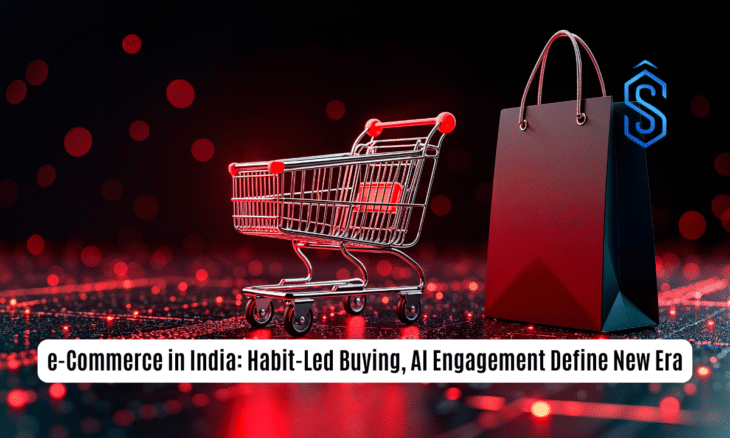
India e-commerce sector is undergoing a quiet but significant transition.
After years defined by festival spikes, discount wars, and metro-heavy demand, new data suggests the market is moving toward structurally driven, habit-led growth, powered by smaller cities, faster fulfilment, and AI-enabled engagement. The shift is visible in both consumer behavior and platform strategy.
AI Moves to the Front End
Recently, Swiggy introduced AI-driven ordering capabilities, enabling users to place food, grocery and dining requests through chatbots such as ChatGPT, Claude and Google Gemini.
The move signals a broader evolution in commerce interfaces, where transactions are no longer confined to apps or websites but are increasingly embedded within conversational AI environments.
In another recent development, LimeChat, an AI-powered conversational commerce platform for direct-to-consumer (D2C) brands, partnered with Microsoft to develop and launch advanced e-commerce chatbots, particularly for WhatsApp.
The collaboration leverages Microsoft Azure OpenAI Service, and other Azure AI technologies to enable more sophisticated, human-like customer interactions.
These integrations reflects a wider industry pivot. AI is not just being used behind the scenes for logistics and pricing, but is beginning to shape how demand is generated and captured.
Also Read: GS1 India Study Reveals ₹5,000 Crore Annual Loss to Poor Product Data in Indian E-Commerce
India e-Commerce: Tier-3 Cities Become Volume Leaders
Data from Unicommerce, based on over 27 million order items processed on its Uniware platform during the 2025 and 2026 Republic Day sales periods, reveals a decisive geographical shift.
Tier-3 cities accounted for nearly 40% of total order items during the sale period, with volumes growing more than 19% year-on-year. Cities such as Kolar, Rohtak, Kamrup, Ernakulam and Khordha emerged as key growth drivers.
The food and beverage category showed even stronger decentralization. Tier-3 markets contributed around 43% of total food and beverage orders, while healthy food volumes more than doubled in Tier-2 cities.
India e-commerce expansion is no longer metro-dependent. Penetration, logistics networks and digital payment adoption appear to have reached a threshold where smaller cities are not just incremental contributors but volume leaders.
Also Read: E-Commerce Export Hubs to Empower Indian SMEs with Cost-Effective Cross-Border Logistics
India e-commerce: Growth Is Being Driven by Habit, Not Hype
India e-commerce industry recorded a 26.2% year-on-year increase in order volumes in FY2023, while gross merchandise value (GMV) grew by 23.5% over the same period, according to the India E-commerce Index 2023 report.
This divergence, orders growing slightly faster than overall GMV, suggests that growth was more driven by higher purchase frequency than by increases in average ticket size alone.
FMCG and beauty & personal care categories are among the fastest-growing segments in Indian e-commerce. A WebVerbal report on India’s e-commerce market notes that FMCG e-commerce is growing at about 52% annually, making it one of the fastest-expanding online categories as part of the broader retail shift toward everyday purchases.
The segment includes personal care, food & beverages, and health & wellness products, all linked to repeat consumption demand.
This signals a maturing consumption pattern for India e-commerce sector. Rather than one-time discretionary splurges during sale events, consumers appear to be embedding e-commerce into everyday purchasing behavior. Structural growth is replacing event-driven volatility.
Also Read: CHINI KUM Raises ₹1 Crore Pre-Seed Funding to Build Zero-Sugar Beverage Platform in India
India e-commerce: Speed Is Becoming a Competitive Differentiator
- Channel performance highlights rising consumer expectations around fulfilment speed.
- Quick commerce growth far outstrips other segments and is a leading driver of order volumes.
- The segment now accounts for 70–75% of total e-grocery orders, up from about 35% in 2022, a rapid shift that reflects faster adoption and increased order volumes in the segment.
- Execution quality is emerging as a primary lever.
Brands increasingly rely on automation for inventory synchronization, real-time routing and customer engagement during the sales period. In a market where pricing competition remains intense, operational precision is becoming equally decisive.
Just having the right tools isn’t enough, says Mahesh Raja, Chief Growth Officer at Ness Digital Engineering.
“To truly make use of data products, companies need people with a different mindset and skill set; someone who understands data, knows how to build useful tools from it, and can think like a product manager. For example, a data engineer who not only builds pipelines but also thinks about how marketing teams will use that data to run campaigns or a product manager who understands data well enough to help design a customer insights dashboard that sales teams actually want to use,” he says.
Also Read: etaily Secures Fresh Capital from SMBC, Total Funding Reaches USD 24 Million
India e-commerce: AI Is Closing the Conversion Gap
AI’s influence is also visible deeper in the funnel. JioMart integrated WhatsApp commerce, allowing users to browse products, place orders and complete purchases entirely through chat.
This conversational commerce approach helped recover abandoned carts and boost engagement by offering real-time order updates and interactive shopping experiences directly within WhatsApp. These automated engagements contributed to improved conversion rates during high-intent traffic windows.
LimeChat case studies reveal that usage of AI-powered WhatsApp chatbots to automate customer support and guide purchase decisions helped brands like WOW Skin Science and The Man Company.
Because of these bots, response times improved, complex inquiries were handled automatically, and conversion rates increased, demonstrating real ecommerce impact from AI communications.
This suggests AI is not only enhancing backend efficiency but directly influencing revenue capture, particularly during peak demand periods where drop-offs typically erode sale performance.
Also Read: CBIC Launches Deferred Customs Duty Payment Scheme for Eligible Manufacturer Importers
The Shape of 2026: Structural, Distributed, AI-Enabled
Taken together, the signals that define current India e-commerce inflection point include smaller cities driving a growing share of volumes, repeat consumption replacing discount-led spikes as the primary growth engine, speed and automation becoming critical to conversion and retention, and AI engagement tools increasingly shaping sale outcomes.
India e-commerce and tech companies don’t need massive AI spending to win, says Rajat Mishra, CEO and Founder of Prezent, but they do need to apply AI intelligently and strategically.
“Smaller, more cost-effective models that show breakthroughs don’t always require massive budgets, and teams need to be conscious of that when planning the next few years. Which also translates to how AI’s economic impact depends not just on raw capability but on how organizations apply these tools thoughtfully,” he says.
The implications are significant. As India’s digital commerce base widens geographically and deepens behaviorally, growth is becoming less about promotional bursts and more about operational capability.
The sector appears to be entering a phase where infrastructure, execution quality, and AI-driven engagement matter as much as assortment and discounting.
If these trends continue, 2026 may be remembered less for explosive growth headlines and more for something more durable, i.e., the consolidation of India e-commerce as a habitual, distributed and technology-optimized layer of everyday Indian consumption.