

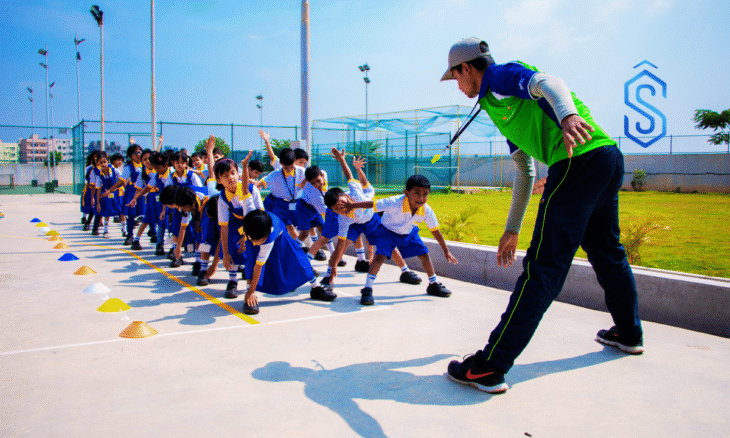
Bengaluru: Sportz Village has released findings from its 14th Annual Health Survey (AHS) 2026, revealing that only one in three school children in India can run without running out of breath.
The Sportz Village survey, regarded as the most comprehensive school fitness study in the country, assessed 1,41,840 children across 333 schools in 112 cities.
The 14th edition of the Annual Health Survey by Sportz Village delivers evidence-based insights into post-COVID fitness recovery, the impact of structured Physical Education (P.E.), and ongoing health gaps that require systemic attention.
Launched in 2010, the Sportz Village Annual Health Survey has evolved into a key benchmark for tracking children’s physical health in India.
The 2026 edition assessed seven parameters – Body Mass Index (BMI), Aerobic Capacity, Anaerobic Capacity, Upper Body Strength, Lower Body Strength, Core/Abdominal Strength, and Flexibility – offering a longitudinal perspective on the physical development of Indian school children.
Also Read: Walnut Child Development Clinics Promote ‘Early Checks’ for Timely Child Development Support
Aerobic Fitness Emerges as the Biggest Concern
According to Sportz Village’s findings, two out of every three school-going children in India are unable to sustain basic cardiorespiratory activity.
Aerobic fitness, widely regarded as the strongest predictor of lifelong cardiovascular health, remains the most alarming and persistent deficit recorded by Sportz Village over the past 14 years.
The survey highlights that the absence of aerobic fitness in childhood creates a direct pathway to adult lifestyle diseases such as diabetes, hypertension and heart disease.
Despite broader recovery trends, aerobic capacity showed only incremental improvement – rising from 27.5% in 2023 to 34.4% in 2025 – making it the weakest parameter tracked in the Sportz Village study.
Alongside this, 40% of children fall outside a healthy BMI range. The data shows minimal change in post-COVID recovery, with 59.1% classified as healthy in 2023 and 59.6% in 2025. The Sportz Village report indicates that body composition responds more to sustained lifestyle changes than to school PE interventions alone.
Further, 49% of children do not meet the upper body strength benchmark, while 44% fall short on lower body strength — pointing to increasing sedentary lifestyles and screen dependency.
Sportz Village CEO Speaks on Urgency of Action
Saumil Majmudar, Co-founder, CEO & MD, Sportz Village, said: “This year’s findings rearm something we have always believed – healthy childhoods are intentionally built! At a time when children are facing rising lifestyle-related health risks and growing emotional pressures, building healthy habits early has never been more important.
Schools play a critical role by designing structured opportunities for movement, but lasting impact comes when families and communities support the same environment. As a country, we must continue to track and understand children’s well-being at scale, so that we can respond meaningfully and collectively. The opportunity before us is clear – to act with intent today and create healthier, happier childhoods for the years ahead.”
Also Read: Roots to Wings: Inamdar Hospital Introduces Integrated Child Development Services
COVID Crash and Structured PE Comeback
The Sportz Village survey documents the sharpest fitness decline in its history during the pandemic years. In 2020, 70.5% of students met overall fitness benchmarks. By 2022, following extended school closures and lockdowns, that number dropped to 56.2%.
However, as schools reopened and structured activity resumed, recovery was significant. Overall fitness levels climbed to 84.4% in 2024 and 84.8% in 2025, surpassing pre-COVID benchmarks.
One of the most decisive findings from Sportz Village is that students enrolled in a structured PE programme for two consecutive years improved overall fitness from 66% to 82% – a 16 percentage-point gain. Schools conducting more than 80 PE sessions annually recorded 86% overall fitness levels.
The data underscores that structured, consistent Physical Education programmes produce measurable results.
Gender Insights: Girls Outperform Boys, But Lag in Aerobic Capacity
The Sportz Village survey reveals that girls outperform boys in five of seven fitness parameters:
- BMI (62% vs 57%)
- Flexibility (73% vs 68%)
- Core Strength (88% vs 86%)
- Upper Body Strength (53% vs 45%)
- Anaerobic Capacity (65% vs 63%)
However, only 27% of girls demonstrate healthy aerobic capacity compared to 41% of boys — marking a 14 percentage-point gap, the widest gender divide in the survey.
While girls show stronger performance in flexibility and strength metrics, aerobic endurance remains a key area requiring gender-responsive interventions, according to Sportz Village findings.
Public School Students Outperform Private School Peers
The Sportz Village report also shows that children in government and public schools outperform private school peers in five of seven parameters. These include:
- Aerobic Capacity (40% vs 33%)
- Anaerobic Capacity (81% vs 62%)
- Flexibility (78% vs 69%)
The anaerobic capacity gap alone stands at 19 percentage points. Private schools lead only in upper body strength.
The findings suggest that higher daily movement, greater outdoor exposure and reduced sedentary time may be contributing factors.
A Shared Responsibility
The Sportz Village survey reiterates that children’s health is a shared responsibility between families and schools. While parents influence nutrition, outdoor time and screen habits, schools provide the structural environment for sustained physical development.
The report emphasizes that merely allocating time for sport is insufficient. Structured, assessment-driven Physical Education programmes that track measurable parameters are necessary to drive long-term improvements.