
New Delhi: India has taken a major step towards the digital transformation of maritime governance with the launch of E-Samudra, a comprehensive digital platform integrating services for seafarers, shipping companies, ports and other maritime stakeholders.
The initiative was accompanied by a series of reforms focused on strengthening seafarer security, safety, welfare and service delivery.
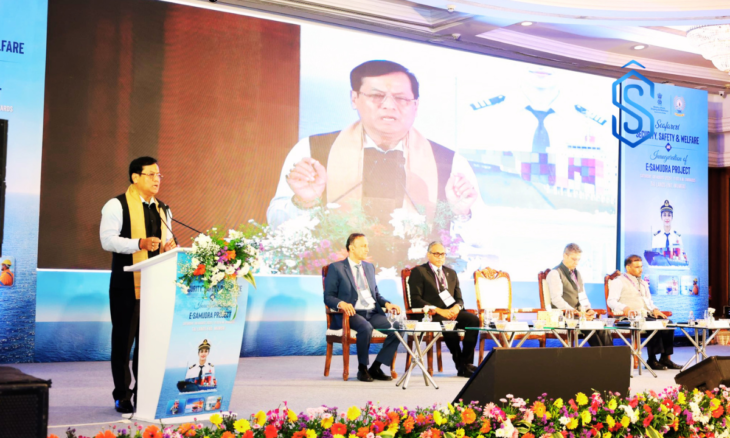
Union Minister for Ports, Shipping and Waterways (MoPSW) Sarbananda Sonowal inaugurated E-Samudra during a national stakeholder interaction on “Seafarer Security, Safety and Welfare and Inauguration of E-Samudra” held in Mumbai.
The event was organised by the Directorate General of Maritime Administration (DGMA) under the Ministry.
The launch marks a major development in India’s efforts to modernise maritime governance through technology-enabled, transparent and stakeholder-centric services.
E-Samudra to Provide Single-Window Maritime Services
E-Samudra brings multiple maritime services onto a single digital platform, covering seafarers, shipping companies, ports and other stakeholders.
The platform is designed to provide single-window digital services, end-to-end workflows, online payments, real-time tracking and digitally issued certificates.
Secretary, MoPSW, Vijay Kumar said India’s maritime policy is now anchored in three pillars: the Merchant Shipping Act, 2025, which recognises seafarers as Key Workers; the Maritime Amrit Kaal Vision 2047; and the principle of Minimum Government, Maximum Governance.
“E-Samudra will bring maritime services into a single digital window with end-to-end workflows, online payments, real-time tracking and digitally issued certificates.
Our objective is not merely to put processes online, but to make them predictable, transparent and time-bound,” Kumar said.
The platform is expected to strengthen digital maritime governance by bringing various services and processes together while improving transparency and reducing compliance-related burdens for maritime stakeholders.
Also Read: India Tops Global Ship Recycling Rankings in 2025, Achieves Maritime India Vision 2030 Goal Early
Sarbananda Sonowal Highlights Seafarer Security, Safety and Welfare
Addressing the gathering, Sarbananda Sonowal said the transformation of India’s maritime sector under the leadership of Prime Minister Narendra Modi places seafarers at the centre of the country’s long-term growth strategy.
“Under the visionary leadership of Prime Minister Narendra Modi, India is pursuing an ambitious transformation of the maritime sector through Maritime India Vision 2030 and Maritime Amrit Kaal Vision 2047.
Seafarers remain at the heart of this journey. Our commitment is clear: every Indian seafarer must be safe, respected and supported. As India strengthens its position as a global maritime power, we must ensure that those who power this growth work fearlessly, safely and with dignity,” Sarbananda Sonowal said.
The minister highlighted India’s growing maritime capabilities, noting that the country has emerged as the second-largest supplier of seafarers globally. He expressed confidence that India would soon become the world’s largest supplier of seafarers.
Sonowal also noted that India has become the world’s leading ship recycling destination and is working towards positioning itself among the world’s top five shipbuilding nations.
On the launch of E-Samudra, Sonowal said, ”E-Samudra is not merely a technology platform; it is a significant step towards making maritime governance simpler, more transparent and more stakeholder-centric.
Technology is meaningful only when it improves the lives of people. Through E-Samudra, we are ensuring Ease of Living for our seafarers and Ease of Doing Business for the maritime sector.”
DGMA Showcases Digital Maritime Initiatives
Alongside E-Samudra, DGMA showcased several initiatives aimed at modernising maritime administration and improving seafarer welfare.
These initiatives include the recently launched e-NAVIK 24×7 grievance redressal system, the upcoming Seafarer Tracking Dashboard, the Digital Seafarers Employment Agreement (d-SEA) and enhanced welfare measures under the Seafarers Welfare Fund Society (SWFS).
The initiatives are intended to strengthen digital maritime governance while improving access to services and support for India’s seafarer community.
Director General of Maritime Administration Shyam Jagannathan described E-Samudra as a transformational platform that moves maritime administration away from a physical office-based model towards Digital First and Faceless Governance.
“E-Samudra transforms maritime administration from a physical office-based model into an integrated digital ecosystem. It represents a transition towards Digital First and Faceless Governance, ensuring that a seafarer onboard a vessel can access government services as easily as someone sitting ashore,” he said.
India’s Seafarer Workforce Crosses 3.23 Lakh
India’s active seafarer workforce has increased significantly, rising from about 1.03 lakh in 2013 to more than 3.23 lakh in 2025.
The expansion of India’s maritime workforce underscores the need for stronger digital service delivery, regulation and welfare measures.
The E-Samudra platform is intended to support this growing workforce through integrated digital services and improved maritime governance.
The event brought together representatives from the maritime industry, seafarer organisations, recruitment and placement agencies, maritime training institutes, shipowners, government agencies and maritime professionals from across the country.
DGMA Highlights Response to Global Shipping Disruptions
The event also highlighted DGMA’s response to recent geopolitical disruptions affecting global shipping.
According to the Ministry, DGMA monitored more than 16,000 calls, handled over 40,000 communications and coordinated the safe repatriation of more than 4,000 stranded Indian seafarers.
The efforts involved joint coordination with the Ministry of External Affairs, Indian missions, the Indian Navy, shipowners and other maritime stakeholders.
The response highlighted the role of coordinated administration and digital systems in strengthening India’s maritime security, safety and welfare framework.
Focus on Seafarer Wellbeing and Women in Maritime Workforce
Officials also highlighted initiatives such as Sagar Mein Yog, which promotes the physical and mental wellbeing of seafarers, and Sagar Mein Samman, which aims to strengthen opportunities and support for women seafarers.
The Ministry said the number of women seafarers has increased significantly in recent years, reflecting greater inclusivity in the maritime workforce.
These initiatives form part of the broader effort to strengthen seafarer welfare alongside India’s evolving maritime governance framework.
Sonowal Interacts with Maritime Stakeholders and Young Professionals
During the programme, Sarbananda Sonowal interacted with representatives of recruitment and placement services, maritime stakeholders, cadets and young maritime professionals.
The discussions covered recruitment, employment, welfare, regulatory compliance and career development.
Sonowal urged the next generation of Indian seafarers to uphold the values of safety, professionalism, dignity and continuous learning, while assuring them of the government’s continued support.
E-Samudra and India’s Digital Maritime Governance Push
The launch of E-Samudra marks a significant milestone in India’s transition towards technology-enabled, transparent and citizen-centric maritime governance.
By integrating multiple services on a common digital platform, the government expects to improve service delivery, reduce compliance burdens, strengthen transparency and reinforce India’s position as a leading global maritime nation.
The platform, along with initiatives such as e-NAVIK 24×7 grievance redressal, the Seafarer Tracking Dashboard and Digital Seafarers Employment Agreement, represents the government’s broader push to make maritime administration more accessible, predictable and digitally enabled.