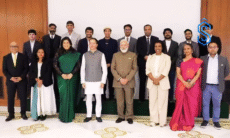

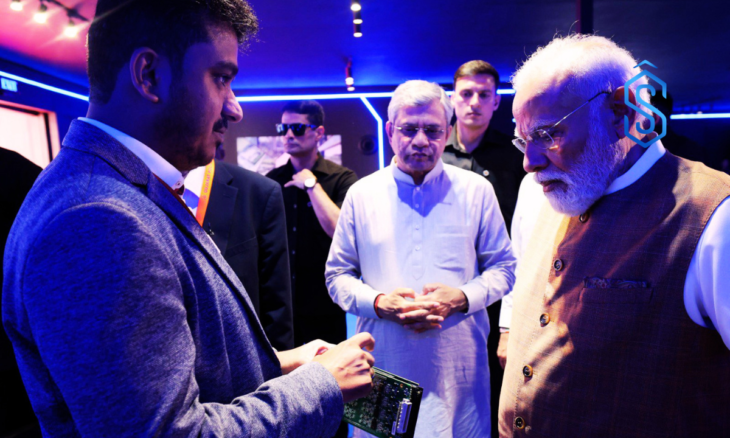
Sanand: Kaynes Semicon marked a major milestone in India’s semiconductor journey as Prime Minister Narendra Modi inaugurated the semiconductor manufacturing facility of Kaynes Technology in Sanand, Gujarat, officially commencing production at the plant.
Speaking at the inauguration, PM Modi underscored the rapid growth of India’s semiconductor ecosystem, noting that Kaynes Semicon represents the accelerating pace of development in the sector.
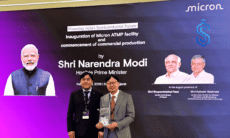
Referring to his recent visit to Sanand for the Micron facility, he said, “This is not merely a coincidence, it is proof of the speed at which India’s semiconductor ecosystem is developing.”
The launch of Kaynes Semicon is being seen as a significant step in strengthening India’s ambition to become self-reliant in semiconductor manufacturing and a reliable player in global supply chains.
Kaynes Semicon Strengthens India’s Global Semiconductor Role
Congratulating Kaynes Technology, the Gujarat government, and the workforce, the Prime Minister expressed pride in an Indian company entering semiconductor chip manufacturing. He noted that Kaynes Semicon has now become part of the global semiconductor supply chain.
“This is a wonderful beginning. In the coming days, many Indian companies, through global collaboration, will give the world a resilient semiconductor supply chain,” PM Modi stated.
Highlighting the ‘Make in India, Make for the World’ vision, the Prime Minister said that Kaynes Semicon is already contributing to exports, with Intelligent Power Modules being supplied to a California-based company. A significant portion of production is reportedly booked for export, effectively building a bridge between Sanand and Silicon Valley.
“The modules made in Sanand will reach American companies and from there will power the entire world,” he added.
Strategic Importance of Kaynes Semicon Products
The Intelligent Power Modules manufactured at Kaynes Semicon are expected to play a critical role in strengthening the electric vehicle ecosystem and heavy industries in India and globally.
PM Modi emphasized that this initiative is not limited to a single product but reflects India’s broader ambition to emerge as a dependable semiconductor supplier worldwide.
“This is not just about one product, it is about India becoming a reliable semiconductor supplier in the global market,” he asserted.
Also Read: HANMI Semiconductor Supports Micron’s $2.75 Billion India Semiconductor Investment
India Semiconductor Mission Driving Growth
The Prime Minister recalled that India’s semiconductor ambitions were formalized during the COVID-19 pandemic with the launch of the India Semiconductor Mission in 2021. He described it as more than an industrial policy.
“This mission is not just an industrial policy, it is a declaration of India’s self-confidence,” he said.
Under this mission, projects worth over ₹1,60,000 crore are underway across six states. Kaynes Semicon and Micron’s facility are key components of this initiative.
PM Modi also highlighted the development of the indigenous ‘Dhruv 64’ microprocessor, aimed at supporting 5G infrastructure, automotive electronics, and industrial automation.
Next Phase: India Semiconductor Mission 2.0
Looking ahead, the Prime Minister announced the next phase—India Semiconductor Mission 2.0—introduced in the Union Budget. This phase will focus on domestic production of semiconductor equipment and materials, aiming to create a full-stack ecosystem.
He noted that Kaynes Semicon represents the kind of industrial capability India seeks to scale through global and domestic partnerships.
“Our effort now is to create an ecosystem so that we can forge big partnerships in both domestic and global supply chains,” PM Modi said.
Workforce Development and Innovation Push
The government is also focusing on building a future-ready workforce. PM Modi stated that India is close to achieving its target of training over 85,000 design professionals.
Through the Chips to Startup programme, around 400 universities and startups have gained access to advanced design tools, leading to the development of more than 55 chips—further strengthening initiatives like Kaynes Semicon.
“Technology development and a skilled workforce must go hand in hand, India is ensuring both,” he added.
India’s Semiconductor Market Growth Outlook
According to industry estimates cited by the Prime Minister, India’s semiconductor market is currently valued at approximately $50 billion and is projected to exceed $100 billion by the end of this decade.
He highlighted growing global investor interest and reiterated India’s goal of manufacturing a majority of its semiconductor requirements domestically, with facilities like Kaynes Semicon playing a pivotal role.
Building a Resilient Supply Chain
PM Modi also outlined India’s efforts to secure raw material supply chains, including participation in Pax Silica and the launch of the National Critical Minerals Mission.
He mentioned initiatives such as:
- ₹1,500 crore scheme for mineral recycling
- Rare Earth Corridor across Odisha, Andhra Pradesh, Tamil Nadu, and Kerala
These efforts aim to ensure a stable and secure supply chain to support projects like Kaynes Semicon.
India’s ‘Techade’ Vision
Describing the current decade as India’s ‘Techade,’ the Prime Minister emphasized that it is not just about economic competition but about shaping the future technology landscape.
He pointed to India’s leadership in AI adoption, Digital India initiatives, fintech growth, and the AI Impact Summit as indicators of technological progress. The rise of facilities like Kaynes Semicon is expected to further strengthen this ecosystem.
“21st century India is not merely a witness to change, but is moving forward with the resolve to lead that change,” PM Modi said.