

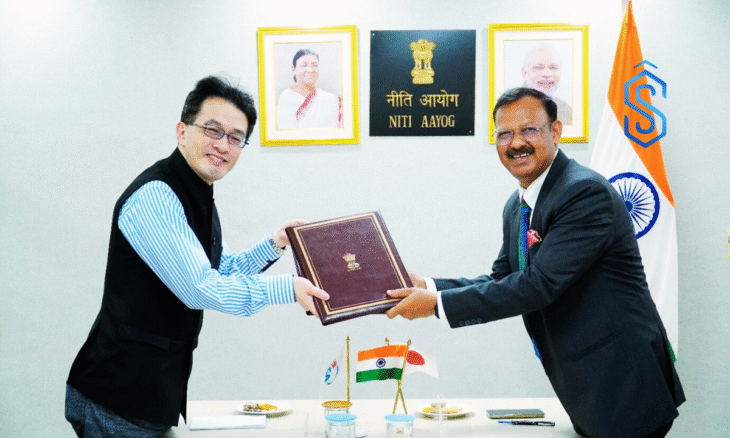
New Delhi: In a significant step towards strengthening India–Japan development cooperation, JICA and NITI Aayog today signed the Record of Discussions (RoD) for the “Project for Promotion of the Program for Japan – India Cooperative Actions Towards Sustainable Development Goals – Phase II.”
The agreement marks the next phase of collaboration focused on accelerating Sustainable Development Goals (SDGs) outcomes in Aspirational Districts and Aspirational Blocks.
The RoD was signed in the presence of Rohit Kumar, Additional Secretary and Mission Director, Aspirational Districts and Blocks Programme, NITI Aayog, and Takeuchi Takuro, Chief Representative, Japan International Cooperation Agency India.
The Japan International Cooperation Agency-backed initiative aims to further deepen institutional cooperation and enhance implementation systems at the district and block levels.
This collaboration between JICA and NITI Aayog reaffirms the strong India–Japan development partnership and advances joint efforts toward achieving the Sustainable Development Goals (SDGs), particularly in Aspirational Districts (ADs) and Aspirational Blocks (ABs).
Rohit Kumar noted that the partnership brings together institutional strengths, shared knowledge and on-ground experience to accelerate inclusive development in underserved regions.
Also Read: India’s FTAs Open Global Opportunities for MedTech Startups: Piyush Goyal
Through JICA’s continued engagement, the project seeks to strengthen the impact of flagship development programmes at the grassroots level.
The project under the Aspirational Districts Programme (ADP) and Aspirational Blocks Programme (ABP), supported by JICA, aims to strengthen policy frameworks and implementation systems across six key themes – Global Partnership, Health & Nutrition, Education, Agriculture & Water Resources, Financial Inclusion & Skill Development and Basic Infrastructure.
JICA-Supported Phase II: Focus on Institutional Capacity Building
The JICA-supported Phase II will focus on institutional capacity building, improved monitoring and evaluation mechanisms, and effective localisation of the Sustainable Development Goals.
As part of the expanded engagement, JICA and NITI Aayog will undertake a range of strategic interventions. Key activities under the project include people-to-people and capacity-building exchanges, Japan–India knowledge forums, identification and dissemination of Best Practices, and targeted support to Aspirational Districts and Aspirational Blocks.
The partnership is expected to facilitate structured knowledge-sharing platforms and policy-level dialogue to strengthen district-level governance systems.
Takeuchi Takuro, Chief Representative, JICA India, commended the successful implementation of ADP and ABP, noting that India’s district and block-level monitoring systems stand out globally.
He emphasized that the project represents a mutually beneficial, cooperative initiative further strengthening the Japan–India partnership.
Through Phase II, JICA will continue to support evidence-based governance models and institutional frameworks aligned with SDG targets.