
Mumbai: As geopolitical tensions and financial volatility reshape global markets, IGF Mumbai 2026 brought together leading investors, policymakers and capital markets leaders to evaluate India’s role in an increasingly fragmented global economy.
Discussions at IGF Mumbai 2026 focused on how global capital flows are being influenced by military conflict in West Asia, supply-chain disruptions and tightening liquidity conditions.
The third edition of the India Global Forum’s flagship Mumbai event – IGF Mumbai 2026: Catalysing Capital – assembled influential voices from private equity, venture capital, public markets and policy circles.
At IGF Mumbai 2026, participants explored how evolving geopolitics and economic uncertainty are reshaping investment patterns and where India stands in this changing global landscape.
Despite rising global risks, investors at IGF Mumbai 2026 expressed strong confidence in India’s long-term structural growth story and the country’s expanding role in the global economic order.
IGF Mumbai 2026: Investors Highlight India’s Emerging Global Role
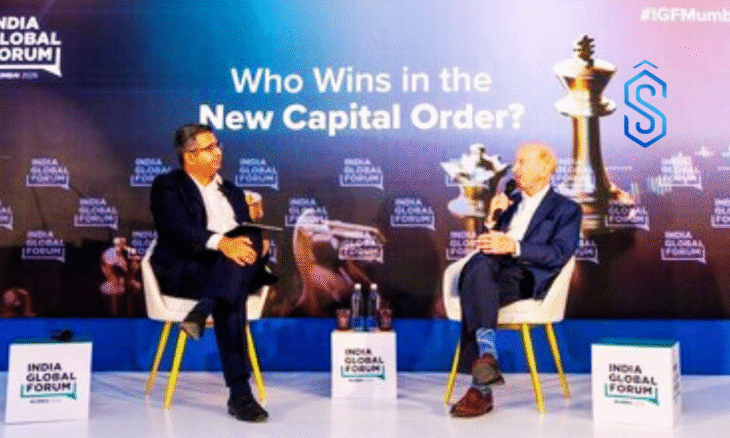
Speaking during a session at IGF Mumbai 2026, Howard Morgan, Chairman of B Capital, said the current moment for India represents more than just an increase in foreign investment inflows.
“What makes this moment different is not just the amount of foreign capital – it is the spirit and confidence within India itself.”
Morgan noted that global investors are increasingly viewing India as a potential technology powerhouse rather than merely a services hub.
“There’s a strong belief that India can become a global technology player, not just a services provider or a support hub for the rest of the world. India can produce goods and services for global markets, and for its own domestic market, which is now larger than China’s.”
Strategic Position in a Changing Global Economy
Reflecting on India’s positioning amid global economic realignment, Manoj Ladwa, Chairman of India Global Forum said discussions at IGF Mumbai 2026 highlighted the country’s unique strategic balance.
“In this evolving global landscape, India occupies a uniquely powerful position. Large enough to matter, open enough to integrate, and independent enough to make sovereign choices.
India can expand trade while strengthening resilience, attract global capital while building domestic capability, and partner widely without becoming narrowly dependent. That balance will define the next phase of India.”
Geopolitical Risks Shape Investor Conversations
Geopolitical developments in West Asia formed a key backdrop to conversations at IGF Mumbai 2026, particularly concerns around energy supply disruptions through the Strait of Hormuz.
Providing regional context, Sunjay Sudhir offered a perspective on the rapidly evolving geopolitical environment.
“The geopolitics of the Middle East are changing rapidly, and history is being written in real time. What we are witnessing now is unprecedented in this part of the world. The region has always been volatile, but few imagined that tensions could escalate to this extent.”
Domestic Capital Emerges as Key Strength
Several speakers at IGF Mumbai 2026 highlighted the rising importance of domestic capital in strengthening India’s financial resilience.
Amit Chandra, Chairperson of Bain Capital Private Equity, pointed to the growing role of Indian investors in driving capital formation.
“Domestic capital is becoming one of India’s biggest strengths. Indian investors are increasingly deploying capital through equities and SIPs, while the country also holds vast untapped wealth in assets like gold.”
The rise of domestic participation in financial markets was widely discussed during IGF Mumbai 2026, with speakers noting its stabilising effect during periods of global market volatility.
Mutual Fund Participation Reflects Investor Maturity
Commenting on investor behaviour trends, Radhika Gupta, Managing Director & CEO of Edelweiss Mutual Fund, said participation in mutual funds continues to grow steadily.
“February 2026 numbers for the mutual fund industry were actually 10% higher than January 2026 numbers. I think that reflects rising consumer maturity.”
Her remarks at IGF Mumbai 2026 highlighted how increasing participation in systematic investment plans (SIPs) is gradually strengthening India’s domestic investment ecosystem.
Domestic Investors Competing with Global Capital
Another trend discussed at IGF Mumbai 2026 was the growing ability of domestic investors to compete with international funds in major transactions.
Manisha Girotra, CEO of Moelis, noted that Indian strategic investors are increasingly competing with global players in asset acquisitions.
“One of the most encouraging trends is the rise of domestic capital. Indian strategic players are now competing with global investors to acquire assets. That rarely happened earlier.”
IPO Market Remains a Key Differentiator
India’s strong primary market ecosystem was also highlighted at IGF Mumbai 2026. Karthik Reddy, Co-founder and Managing Partner of Blume Ventures, observed that India’s ability to sustain public listings remains a key differentiator.
He noted that even during phases of foreign outflows from Indian equities, global investors continue allocating capital to Indian primary markets, particularly initial public offerings (IPOs).
Long-Term Perspective on Global Cycles
Looking at broader global trends, Vani Kola, Managing Director of Kalaari Capital, emphasised the importance of maintaining a long-term perspective.
“In the last 40 years that I have been professionally engaged in the world of startups, conflict cycles come and go. They don’t matter if you take a long-term perspective.”
India Positioned for the Next Phase of Global Capital
Against the backdrop of geopolitical uncertainty and shifting investment flows, discussions at IGF Mumbai 2026 underscored a growing consensus among global investors: India’s economic scale, strengthening domestic capital base and institutional resilience are positioning the country as a central force in the evolving global capital order.
For investors navigating an uncertain global environment, conversations at IGF Mumbai 2026 suggested that India is increasingly being viewed not as a speculative opportunity but as a stable and strategic investment destination.