

Mumbai: India’s Housing Conversion Time improved in 2025 despite a decline in overall housing sales, according to the latest data released by ANAROCK Group’s proprietary AI analytics platform ASTRA.
The average time taken by brokerages to convert initial leads into confirmed bookings reduced from 32 days in 2024 to 26 days in 2025, indicating faster buyer decision-making across key housing segments.
Between 2020 and 2025, Housing Conversion Time trends show that the conversion cycle was lowest in 2022 at 22 days and highest in 2020 at 35 days, reflecting shifts in demand cycles and buyer sentiment across India’s top cities.
“The drop in lead-to-buy conversion days is essentially due to higher sales of big-ticket size homes across the top cities,” says Dr Prashant Thakur, Executive Director & Head – Research & Advisory, ANAROCK Group.
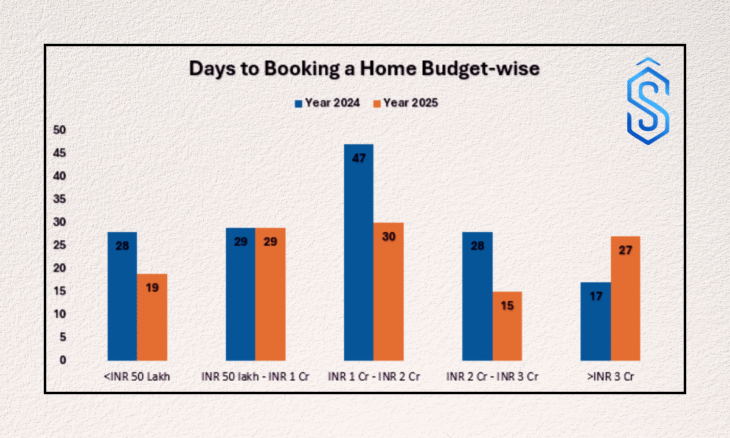
“Among all the sold housing budget segments, the lead-to-buy conversion time was the lowest – at 15 days – for homes priced between ₹2-3 Cr in 2025. It was 28 days in 2024, and this explains why the overall conversion time decreased in 2025 over 2024, despite sales reducing by 14% over the year across the top 7 cities.”
The Housing Conversion Time metric is widely considered an indicator of demand intensity and buyer readiness in the residential real estate market. Budget-wise analysis reveals notable shifts in buyer decision cycles across housing categories.
Also Read: Academic Real Estate Supercycle: India’s Higher-Education Sector Eyes 2.7 Billion Sqft Expansion
Budget-wise Trends Highlight Buyer Behaviour Shifts
A deeper analysis shows that homes priced between ₹1–2 Cr recorded the longest Housing Conversion Time, averaging approximately 30 days in 2025. This marks a sharp improvement from 47 days in 2024, indicating significantly faster buying decisions in this category.
“Buyers of homes priced between INR 50 lakh to INR 1 Cr took the second-longest time (~29 days) to push the ‘buy’ button from the day they generated the first to paying the booking amount,” says Santhosh Kumar, Vice Chairman – ANAROCK Group.
“It was the same back in 2024, as well. Notably, homes priced under INR 3 Cr pushed the conversion time to 27 days in 2025, against 17 days in 2024 when it was the lowest.”
“This increase in conversion time from the lowest point reflects a shift from a seller-driven market to a more cautious, selective luxury housing-driven one,” he adds. “Demand in the luxury category is normalising now, with ample new luxe supply entering the market giving the target clientele a wider spread of options.”
The Housing Conversion Time for luxury housing priced above ₹3 Cr increased significantly from 17 days in 2024 to 27 days in 2025, reflecting more deliberate purchase decisions amid rising supply and alternative investment opportunities.
Also Read: Pune Real Estate Market H2 2025 Driven by GCCs as Housing Enters Consolidation Phase
Housing Conversion Time: ₹2–3 Cr Segment Emerges as Fastest-Moving Category
Homes priced between ₹2–3 Cr recorded the lowest Housing Conversion Time across all budget segments in 2025 at just 15 days, compared to 28 days in 2024 — a year-on-year reduction of 13 days. This segment continues to demonstrate strong buyer confidence and faster transaction closures.
Buyers in this price bracket are typically financially prepared and well-informed about market movements, enabling quicker decision-making and booking conversions. The segment also benefits from perceived value and relatively limited supply.
For developers, the reduced Housing Conversion Time in the ₹2–3 Cr category indicates stronger pricing power and faster inventory turnover, making it one of the most commercially attractive segments in the current housing market.
Affordable Housing Shows Faster Decisions Amid Limited Supply
Affordable housing priced below ₹50 lakh also recorded improved Housing Conversion Time, declining from 28 days in 2024 to approximately 19 days in 2025.
This improvement is attributed to limited new supply in the affordable housing category over recent years, rising rental costs across major cities, and faster loan processing enabled by digital lending systems and improved access to credit.
“Such a shortened lead-to-buy cycle among lower-budget buyers clearly signals necessity-driven demand in the affordable housing segment,” says Santhosh Kumar.
Overall, the Housing Conversion Time data highlights evolving buyer preferences, strong momentum in mid-premium housing, and a gradual normalization of luxury housing demand across India’s top residential markets.